Increasing the vertical load on a tire generally increases its grip. Yet when load is transferred from one tire to another on the same axle, the combined grip of the two tires can decrease, even though their total vertical load remains unchanged.
This seemingly counterintuitive behavior is one of the fundamental principles of suspension tuning.
Understanding it reveals why adjusting an anti-roll bar can change a car’s handling balance and cornering performance.
Tire Load Sensitivity: The Nonlinear Relationship Between Load and Grip
The peak lateral force a tire can generate is the product of its vertical load and the corresponding peak lateral friction coefficient.
If the friction coefficient were constant, doubling the vertical load would double the peak lateral force.
In practice, the friction coefficient generally decreases as tire load increases. Each additional increment of load therefore tends to produce a progressively smaller gain in peak lateral force.
This is a nonlinear relationship. The dependence of a tire’s frictional characteristics on vertical load is known as tire load sensitivity.
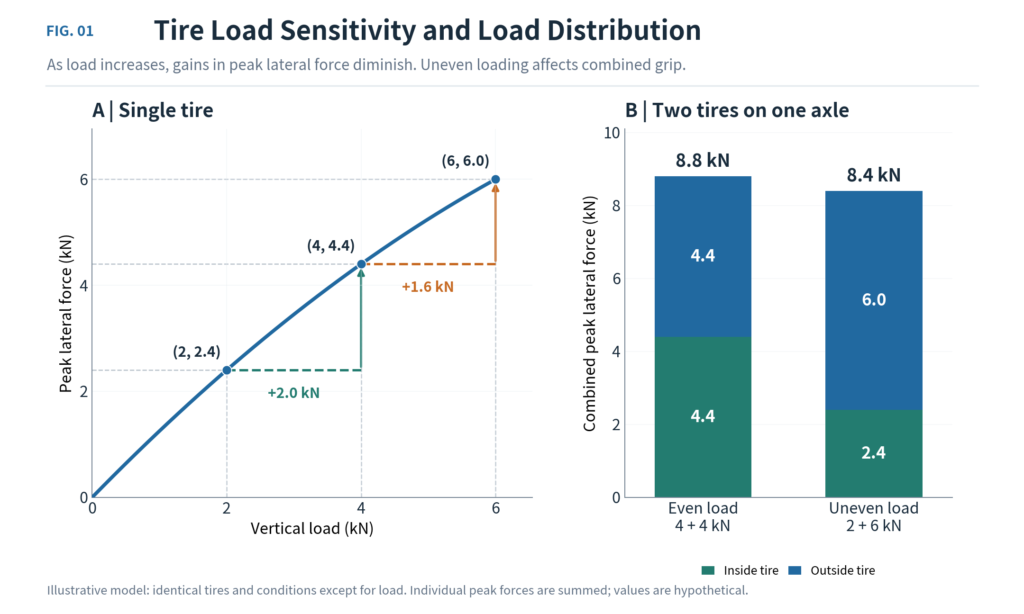
Figure 1A illustrates this relationship using hypothetical values.
As vertical load increases from 2 kN to 4 kN and then to 6 kN, peak lateral force increases from 2.4 kN to 4.4 kN and then to 6.0 kN. However, the ratio of peak lateral force to vertical load decreases from 1.20 to 1.10 and then to 1.00.
The tire generates more grip under greater load, but the additional load becomes progressively less effective at generating grip.
Why the Same Total Load Can Produce Different Levels of Grip
Figure 1B illustrates the implications of tire load sensitivity for two identical tires on the same axle.
With a combined vertical load of 8 kN distributed equally between the two tires, their combined peak lateral force is 8.8 kN.
Now consider transferring 2 kN of vertical load from the inside tire to the outside tire.
The outside tire gains 1.6 kN of peak lateral force, while the inside tire loses 2.0 kN. Their combined peak lateral force therefore decreases to 8.4 kN.
The total vertical load remains 8 kN, but the combined cornering capacity decreases by 0.4 kN.
This example sums the individual peak lateral forces of two identical tires under otherwise identical conditions. In an actual car, the forces generated by each tire also depend on factors such as slip angle and camber angle.
Tire load sensitivity makes load distribution an important factor in determining how much grip a car can generate.
Lateral Load Transfer and Roll Moment During Cornering
When a car corners, its tires generate the lateral forces required to change its direction of travel.
In a conventional car, the center of gravity of the sprung mass—the part of the vehicle supported by the suspension—is generally located above the roll axis.
During cornering, lateral acceleration acting through this height difference creates a moment that tends to tilt the body toward the outside of the corner.
This rotational effect is called the roll moment, and the resulting angular movement of the body is called body roll.
Cornering also causes the vertical load on the outside tires to increase and the load on the inside tires to decrease. This redistribution of vertical load is known as lateral load transfer.
During steady-state cornering on a flat road, with constant aerodynamic downforce, the total vertical load carried by the four tires remains constant.
In a simplified model with equal front and rear track widths and a fixed center-of-gravity position, the total lateral load transfer is determined by vehicle mass, center-of-gravity height, track width, and lateral acceleration.
Suspension tuning allows us to influence how this lateral load transfer is distributed between the front and rear axles.
How an Anti-Roll Bar Works
An anti-roll bar, also commonly called a sway bar or stabilizer bar, mechanically connects the left and right sides of the suspension.
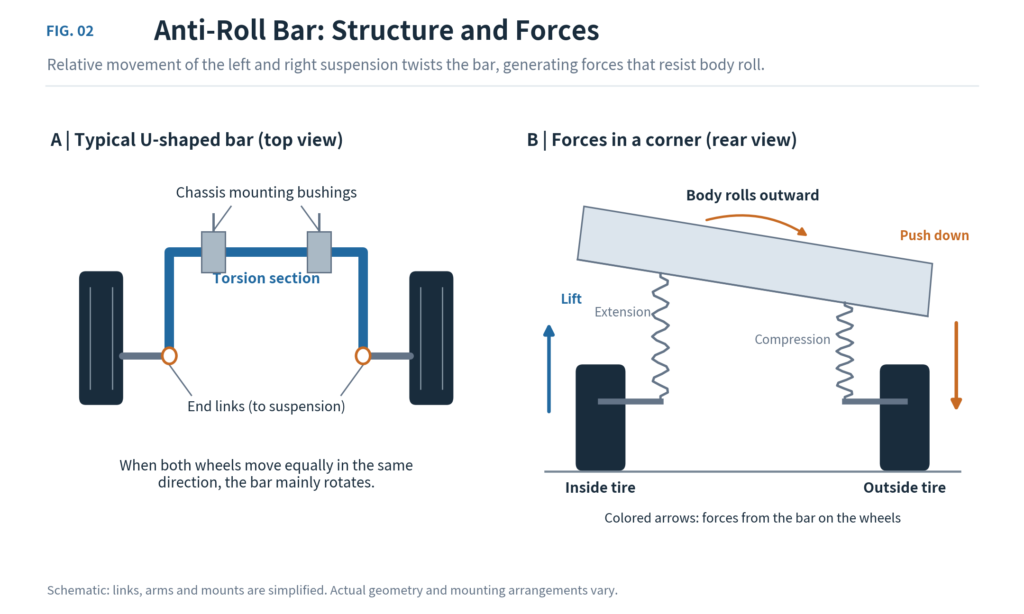
Figure 2A shows the basic construction of a conventional U-shaped anti-roll bar.
Its central section is supported by mounting bushings attached to the chassis, while its ends are connected to the suspension through end links.
When both wheels move equally in the same direction, the bar mainly rotates within its mounting bushings.
During cornering, the outside suspension compresses while the inside suspension extends. This relative movement twists the bar.
As the bar resists twisting, it generates the forces illustrated in Figure 2B: a downward force on the outside wheel and an upward force on the inside wheel.
The corresponding reaction forces acting on the chassis resist body roll.
The resistance of the suspension to body roll is known as roll stiffness. It is provided primarily by the suspension springs and anti-roll bars.
Stiffening an anti-roll bar increases the roll stiffness of the axle on which it is installed.
For a more detailed explanation of suspension fundamentals, see What Do Dampers and Springs Do? Understanding Suspension Compression and Compression Speed (in Japanese).
How Roll Moment Creates a Difference in Wheel Loads
When the suspension resists body roll, the resulting moment is supported through differences in the vertical reaction forces at the tires.
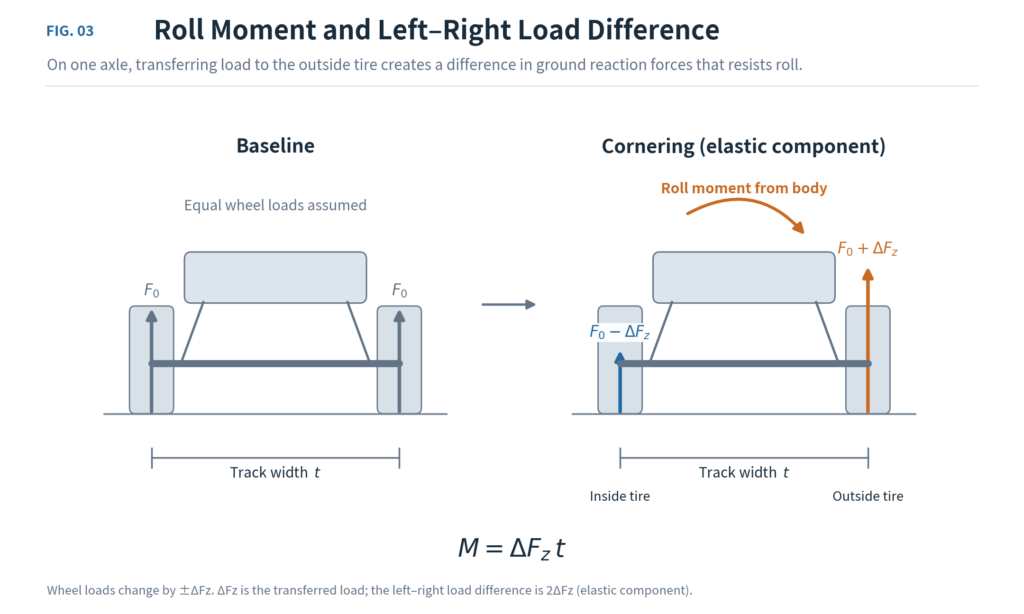
Figure 3 compares two conditions on a single axle: a baseline condition with equal wheel loads and a cornering condition in which load is transferred from the inside tire to the outside tire.
The increase in outside wheel load and the corresponding decrease in inside wheel load create a moment that resists body roll.
This relationship can be expressed as:
M = ΔFz × t
Where:
- M is the roll moment resisted by the axle.
- ΔFz is the vertical load transferred from the inside tire to the outside tire.
- t is the track width.
For example, transferring 1 kN of load from the inside tire to the outside tire increases the difference between their vertical loads by 2 kN.
For a given track width, the greater the roll moment resisted by an axle, the greater the corresponding difference in wheel loads.
This mechanical relationship connects suspension roll stiffness to tire load distribution.
How Anti-Roll Bars Change Front-to-Rear Load Transfer Distribution
The front and rear suspensions share the component of the roll moment resisted by the elastic forces of the suspension.
Assuming a torsionally rigid chassis, the front and rear of the body experience the same roll angle.
The moment resisted by each axle is the product of its roll stiffness and that common roll angle.
Consequently, the axle with greater roll stiffness carries a greater share of the elastic roll moment.
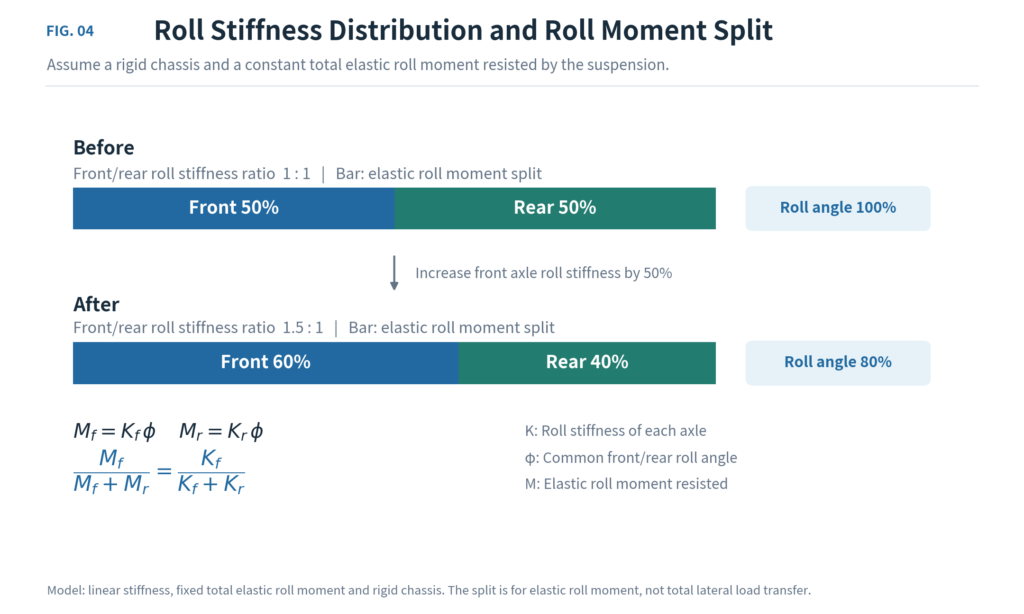
Figure 4 illustrates what happens when the front axle’s roll stiffness is increased by 50%, starting from a baseline in which the front and rear roll stiffness values are equal.
Initially, the front and rear suspensions each resist 50% of the total elastic roll moment.
Increasing front roll stiffness changes the front-to-rear roll stiffness ratio from 1:1 to 1.5:1. The resulting roll moment distribution becomes 60% front and 40% rear.
Total roll stiffness also increases, reducing the body roll angle to 80% of its original value under the same elastic roll moment.
Applying the relationship illustrated in Figure 3, the increased roll moment at the front axle produces a greater difference between the front wheel loads. At the rear axle, the reduction in roll moment produces a smaller difference between the rear wheel loads.
This is the fundamental mechanism through which anti-roll bar adjustments change the front-to-rear distribution of lateral load transfer.
In an actual car, lateral load transfer also includes geometric contributions through the suspension and contributions from unsprung mass. Roll center heights and front and rear track widths also influence the overall distribution.
Figure 4 uses a simplified model to isolate the elastic component that can be adjusted through roll stiffness.
Two Dimensions of Anti-Roll Bar Tuning
Anti-roll bar tuning involves two distinct but related variables: total roll stiffness and its front-to-rear distribution.
Total Roll Stiffness
The combined roll stiffness of the front and rear axles primarily determines how much the body rolls under a given roll moment.
Increasing front and rear roll stiffness by the same proportion reduces body roll while maintaining the existing roll stiffness distribution.
Front-to-Rear Roll Stiffness Distribution
The relative roll stiffness of the front and rear axles determines how they share the elastic roll moment.
Changing this ratio while maintaining the same total roll stiffness allows the distribution of elastic lateral load transfer to be adjusted while keeping the body roll angle approximately unchanged.
These two dimensions provide a framework for identifying which vehicle characteristics a suspension adjustment is intended to improve.
How Anti-Roll Bars Affect Understeer and Oversteer
We can now connect the tire load sensitivity illustrated in Figure 1 with the distribution of roll moment illustrated in Figure 4.
When an axle carries a greater share of lateral load transfer, the difference between its inside and outside tire loads increases. Through tire load sensitivity, this tends to reduce the combined peak lateral force available from those two tires.
At the other axle, the reduced load difference tends to increase combined peak lateral force.
This makes it possible to adjust the relative cornering capacities of the front and rear axles through anti-roll bar tuning.
| Anti-Roll Bar Adjustment | Effect of Tire Load Sensitivity | Handling Tendency |
|---|---|---|
| Stiffen the front | Less front grip, more rear grip | Toward understeer |
| Soften the front | More front grip, less rear grip | Toward oversteer |
| Stiffen the rear | More front grip, less rear grip | Toward oversteer |
| Soften the rear | Less front grip, more rear grip | Toward understeer |
These are the general tendencies attributable to tire load sensitivity when one anti-roll bar is adjusted while the other remains unchanged and cornering conditions are held constant.
When front-end cornering capacity is limiting a car’s performance, an adjustment that shifts relative grip toward the front axle can help reduce understeer.
When rear-end cornering capacity is the limiting factor, the opposite adjustment can help restore handling balance.
Why Both Stiffer and Softer Anti-Roll Bars Can Improve Cornering
Anti-roll bar stiffness also affects body roll, tire orientation, steering response, and the ability of the suspension to follow uneven road surfaces.
The appropriate stiffness therefore depends on the interaction of several effects.
Body Roll, Camber, and Steering Response
As the body rolls, suspension movement changes the angle of the tires relative to the road surface. This inclination is known as camber.
Depending on the suspension geometry, reducing body roll can help maintain a more favorable camber angle at the outside tires during cornering, improving their contact with the road and their ability to generate lateral force.
Reduced body movement can also improve steering response.
When these benefits, together with any improvement in handling balance, outweigh the grip losses associated with uneven tire loading, increasing anti-roll bar stiffness can improve cornering performance.
Uneven Tire Loading and Road Compliance
Increasing anti-roll bar stiffness at one axle tends to increase the difference in vertical load between its inside and outside tires.
As this difference grows, so does the loss of combined grip attributable to tire load sensitivity. In extreme cases, the inside wheel may lift off the road, eliminating its contribution to grip.
A stiffer anti-roll bar also increases the mechanical coupling between the left and right suspension systems. When one wheel encounters a bump, its movement has a greater influence on the opposite wheel.
On uneven surfaces, this can reduce the ability of the tires to maintain effective contact with the road.
Once the losses associated with uneven tire loading and reduced road compliance outweigh the benefits of controlling body roll, further increases in anti-roll bar stiffness can cause cornering performance to plateau or decline.
When Softer Anti-Roll Bars Improve Performance
Softening or removing an anti-roll bar reduces the roll stiffness of its axle.
The inside tire retains more vertical load, while the concentration of load on the outside tire is reduced. The left and right suspension systems can also move more independently, potentially improving road compliance.
These changes can improve cornering performance when that axle is limiting the car’s cornering capacity or when uneven road surfaces are compromising tire contact.
The accompanying increase in body roll, changes in camber and steering response, and redistribution of lateral load transfer toward the opposite axle must also be considered.
The appropriate anti-roll bar stiffness depends on tire characteristics, suspension geometry, road conditions, and the relative cornering capacities required from the front and rear axles.
Two Ways to Reduce Understeer: Which Should You Choose?
There are two common anti-roll bar adjustments that can reduce understeer through the effects of tire load sensitivity:
- Softening the front anti-roll bar.
- Stiffening the rear anti-roll bar.
The difference between these approaches becomes clear when we consider total roll stiffness and front-to-rear roll stiffness distribution separately.
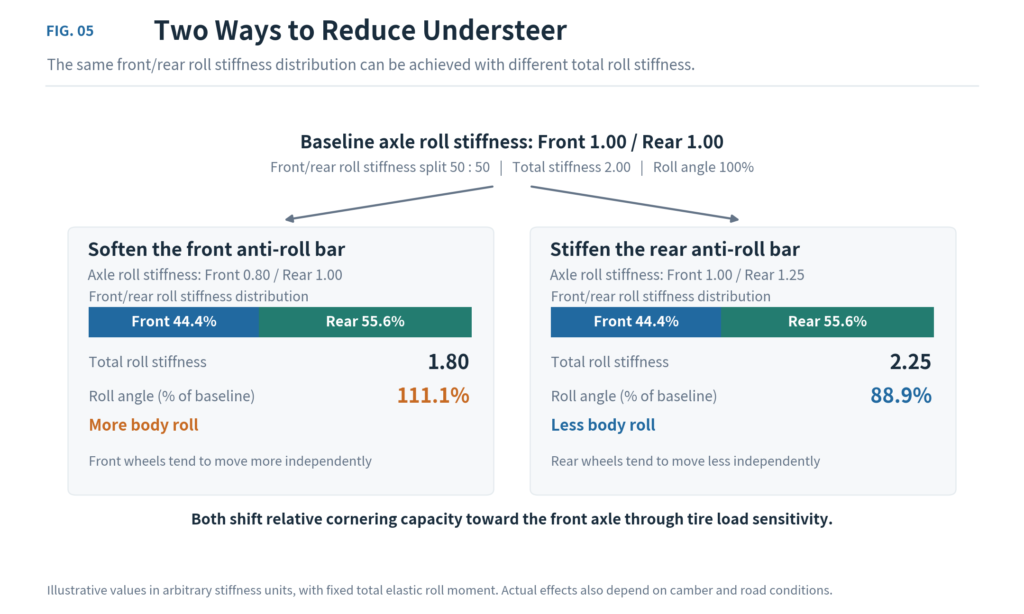
Figure 5 compares the two approaches using a baseline in which front and rear axle roll stiffness are both assigned a value of 1.00.
In the first case, softening the front anti-roll bar reduces total front axle roll stiffness to 0.80.
In the second case, stiffening the rear anti-roll bar increases total rear axle roll stiffness to 1.25.
| Parameter | Baseline | Softer Front | Stiffer Rear |
|---|---|---|---|
| Front axle roll stiffness | 1.00 | 0.80 | 1.00 |
| Rear axle roll stiffness | 1.00 | 1.00 | 1.25 |
| Total roll stiffness | 2.00 | 1.80 | 2.25 |
| Front roll stiffness share | 50.0% | 44.4% | 44.4% |
| Rear roll stiffness share | 50.0% | 55.6% | 55.6% |
| Roll angle relative to baseline | 100% | 111.1% | 88.9% |
Both adjustments achieve the same front-to-rear roll stiffness distribution. Under a constant total elastic roll moment, they therefore produce the same distribution of elastic roll moment between the two axles.
Their effects on body roll, however, are opposite.
Softening the front increases body roll and allows the front wheels to move more independently.
Stiffening the rear reduces body roll and increases the mechanical coupling between the rear wheels.
This distinction provides a practical basis for choosing between the two approaches.
If improving front tire contact and front suspension compliance on uneven surfaces is a priority, softening the front anti-roll bar may be the more appropriate option.
If reducing body roll and improving steering response are also priorities, stiffening the rear anti-roll bar may be preferable, provided the rear axle has sufficient grip in reserve.
Two adjustments can achieve the same change in roll stiffness distribution while producing opposite effects on other vehicle characteristics.
The choice depends on the combination of characteristics the driver or engineer wants to improve.
The Essence of Suspension Tuning: Grip Capacity and Its Distribution
A car’s cornering performance depends on both the combined grip available from its four tires and the distribution of cornering capacity between the front and rear axles.
Even when the combined peak lateral force of the four tires is high, the cornering capacity of one axle may limit overall performance if it falls short of the lateral force required from that axle.
Increasing the car’s cornering limit therefore requires both axles to generate the forces demanded of them while making effective use of the available tire grip.
Tire load sensitivity gives load distribution its significance in suspension tuning. Anti-roll bars provide a mechanical means of adjusting that distribution while also influencing body roll and suspension behavior.
Understanding these relationships brings lateral load transfer, body roll, tire grip, understeer, oversteer, and suspension setup together within a single framework.
The essence of suspension tuning is to establish the conditions under which all four tires can contribute their capabilities effectively to the dynamic performance of the car as a whole.
Explore Other Articles
English Articles : A Topic-by-Topic Guide to This Site
GR Yaris 6MT or GR-DAT? ★ Find the One That Fits the Way You Enjoy Driving
Cars, Driving & Automotive Engineering | English Article Guide
Want to know more about the author and the thinking behind this site?
→ About Rikutsu-Kone-Taro
