Why do racing drivers make small, repeated steering inputs while cornering?
These movements, commonly described as sawing at the wheel, can help drivers assess the available tire grip. Similar steering movements can also be seen when drivers correct understeer or oversteer.
What makes this particularly interesting is that the same action—reducing the steering angle—can help a car turn more effectively in one situation and suppress excessive rotation in another.
Drawing on my own circuit-driving experience in the Toyota GR Yaris, this article explores the physics behind sawing at the wheel and its relationship with corrective steering, throttle-induced tuck-in, and trail braking, using nine illustrations.
1. What Is Sawing at the Wheel?
The term sawing comes from the back-and-forth motion of a saw.
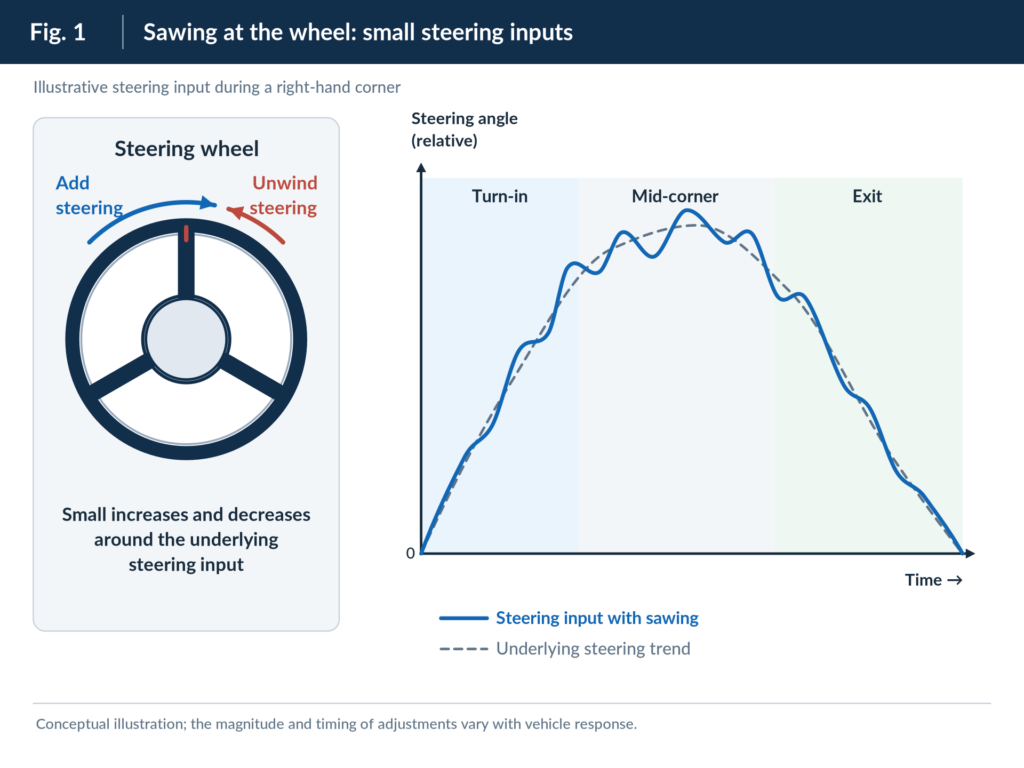
As illustrated in Fig. 1, it describes repeated, small increases and decreases in steering angle around the steering input required to negotiate a corner.
In motorsport, the term can refer to small adjustments used to assess tire grip or correct vehicle behavior. It can also carry a negative connotation when those movements are excessive.
In Japan, the technique of probing tire grip through small steering inputs is sometimes called saguri handoru, meaning exploratory steering.
When driving near the limits of tire grip, drivers assess the car’s dynamic state through several sources of information:
- Steering feedback
- The car’s response to steering inputs
- Tire squeal
- Changes in lateral acceleration
- Vehicle rotation and sideslip
- Differences between the intended and actual driving lines
Japanese racing driver Tetsuya Yamano describes the process of responding to early signs of understeer and oversteer while seeking to maintain neutral steering behavior as balance control.
Source: Tetsuya Yamano’s Driving Technique Guide — ABARTH SCORPION MAGAZINE (in Japanese)
Understanding the purpose of these small steering inputs begins with understanding how tires generate lateral force.
2. The Physics Behind Sawing at the Wheel
2-1. How Slip Angle Generates Lateral Force
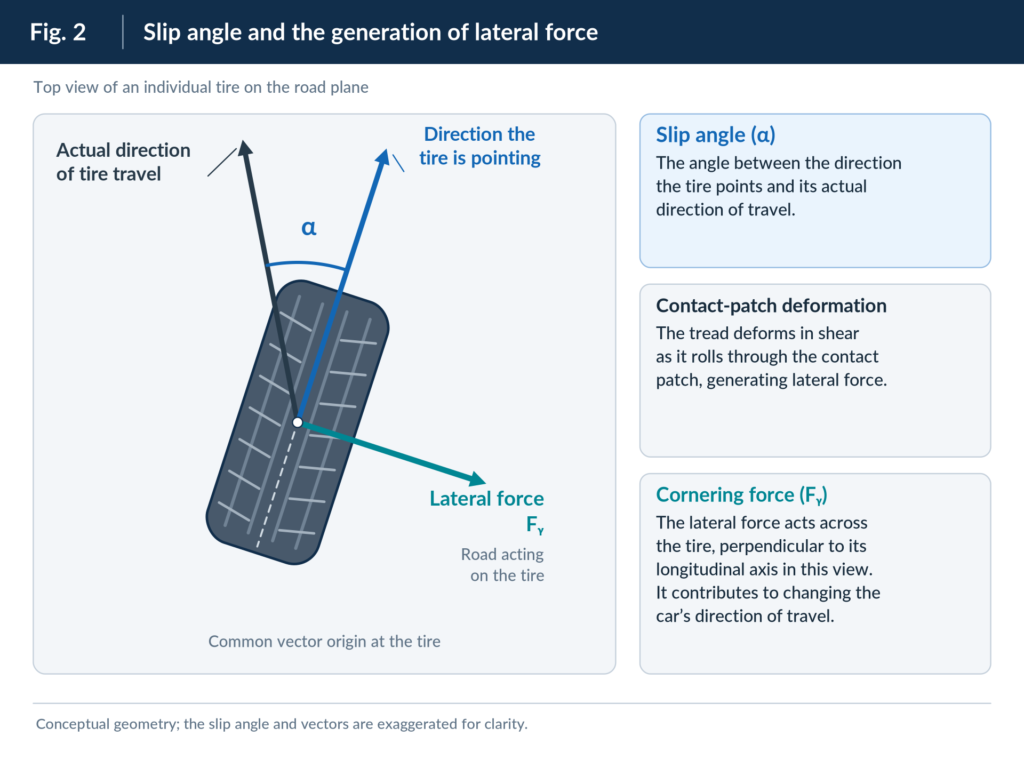
During cornering, an angle develops between the direction in which a tire is pointing and the direction in which that tire is actually traveling.
This is known as the slip angle.
As illustrated in Fig. 2, slip angle causes deformation within the tire’s contact patch. The road consequently exerts a lateral force on the tire, known as cornering force.
This force contributes to changing the car’s direction of travel.
Changes in vehicle rotation and sideslip can alter the tire’s direction of travel and therefore its slip angle, even when the steering angle remains constant.
Under otherwise constant conditions, including vertical load, longitudinal force, and road surface characteristics, lateral force generally varies with slip angle as illustrated in Fig. 3:
- At small slip angles, lateral force increases as slip angle increases.
- At a certain slip angle, lateral force approaches its maximum.
- Beyond this region, increasing contact-patch sliding can cause lateral force to plateau and eventually decline.
There is therefore a slip angle at which a tire generates its maximum lateral force under a given set of conditions.
This angle varies with tire characteristics, vertical load, braking and driving forces, temperature, and road surface conditions.
2-2. Why Reducing Steering Angle Can Help a Car Turn
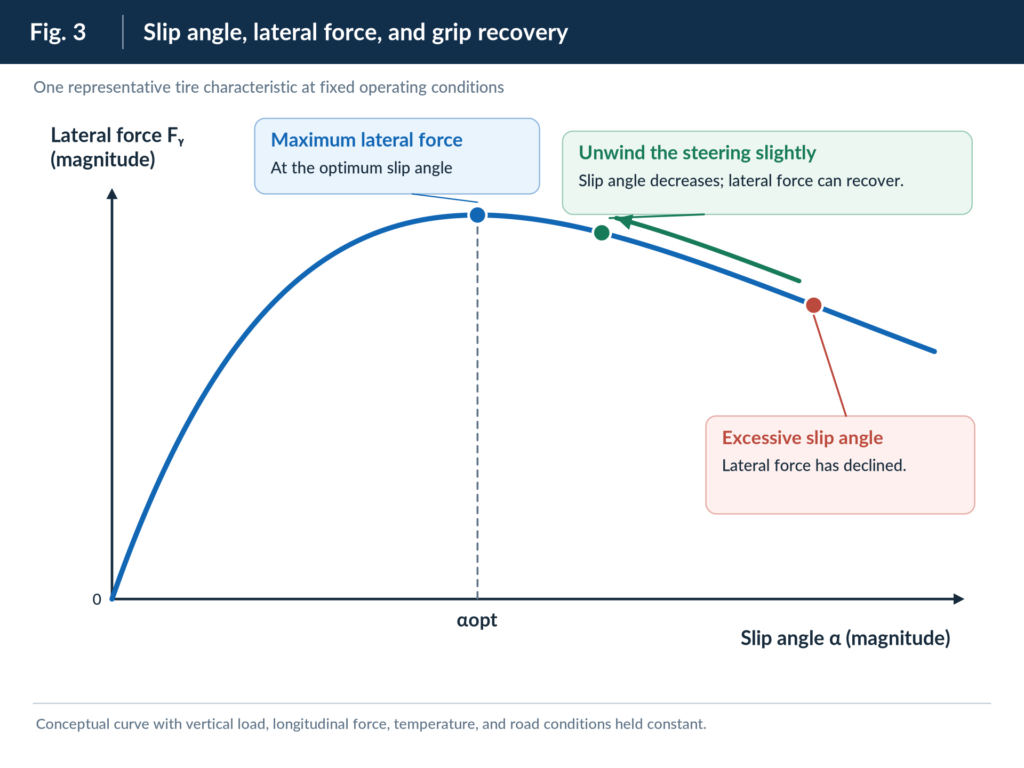
When the front tires exceed the slip angle associated with maximum lateral force, adding more steering input may reduce the lateral force they generate.
The red point in Fig. 3 represents an example of this condition.
Reducing the steering angle slightly can bring the slip angle back toward the region of maximum lateral force. As indicated by the green arrow, this can allow the front tires to recover some of their cornering force.
From the driver’s perspective, it can feel as though the sliding front tires suddenly bite into the road again.
Reducing the steering angle can sometimes make the car turn more effectively.
This is one possible explanation for the sensation I experience during circuit driving when small steering inputs seem to make the front tires bite into the road.
3. A Functional Classification of Sawing at the Wheel
Exploratory and Corrective Steering Inputs
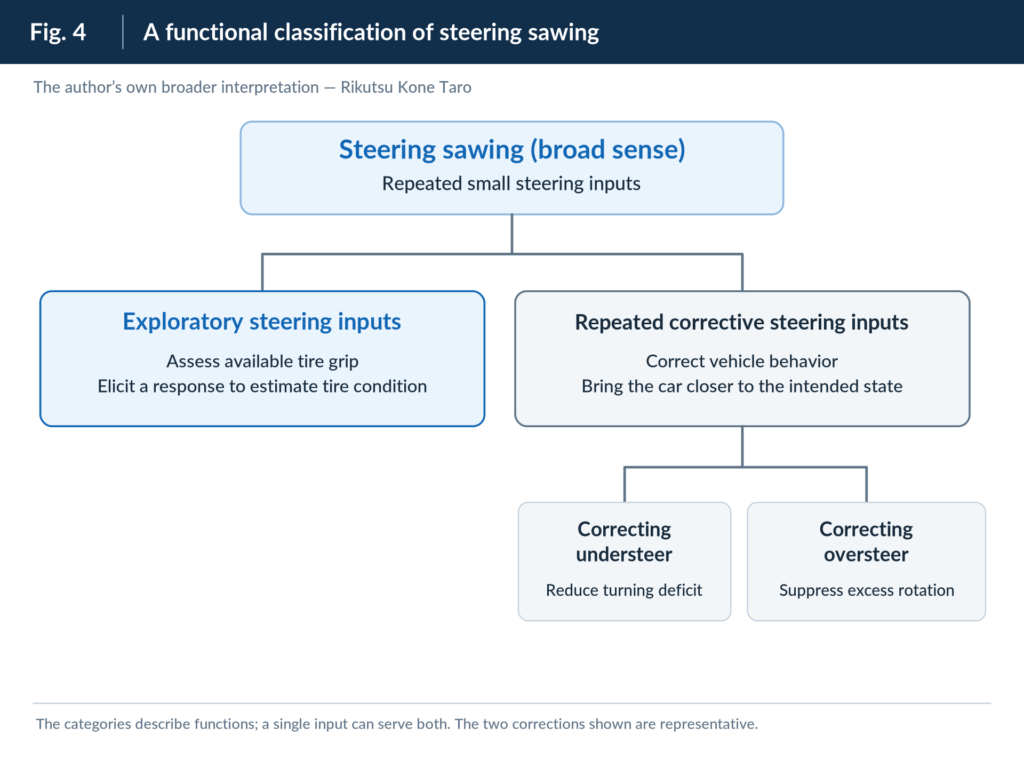
In the functional classification I propose here, I use sawing at the wheel in a broader sense, based on the visible similarity between repeated small steering movements.
This broader definition includes both exploratory steering inputs and repeated corrective steering inputs.
Within the corrective category, I focus on two representative functions during near-limit cornering: correcting understeer and correcting oversteer.
Fig. 4 illustrates this original functional classification, proposed by Rikutsu Kone Taro.
3-1. Exploratory Steering Inputs: Understanding the Available Grip
Exploratory steering inputs are small steering movements intended to reveal the current condition of the tires.
By adding a small amount of steering, the driver can observe whether the car’s cornering response increases, begins to plateau, or is accompanied by changes in steering feedback.
These responses provide information about the available front-tire grip.
On wet surfaces and through corners with changing gradients, banking, or surface conditions, the lateral force available from the tires can vary continuously.
Exploratory steering can therefore be understood as an active way of eliciting vehicle responses to assess changing grip conditions.
3-2. Corrective Steering Inputs: Changing Vehicle Behavior
Corrective steering inputs are steering adjustments intended to bring the car’s behavior closer to the driver’s desired state.
Two representative applications arise during near-limit cornering.
Correcting Understeer
When the front tires have insufficient grip relative to the rear tires, the car may turn less than intended for the steering input applied, causing its driving line to run wide.
This is a characteristic form of understeer.
If excessive front-tire slip angle is responsible, reducing the steering angle can help recover lateral force through the mechanism illustrated in Fig. 3.
When excessive entry speed, braking force, or driving force contributes to the problem, appropriate pedal adjustments are also important.
Correcting Oversteer
When the rear tires have insufficient grip relative to the front tires, the rear of the car may slide outward and the vehicle may rotate more than the driver intends.
This is a characteristic form of oversteer near the limits of grip.
The driver can respond by reducing the steering angle into the corner and, when necessary, steering in the opposite direction.
This latter action is known as countersteering.
As the car stabilizes, the driver progressively removes the corrective steering input.
A steering correction can be completed with a single adjustment. Repeated small corrections involving increases and decreases in steering angle fall within the broader definition of sawing illustrated in Fig. 4.
3-3. How the Same Steering Input Can Produce Opposite Effects
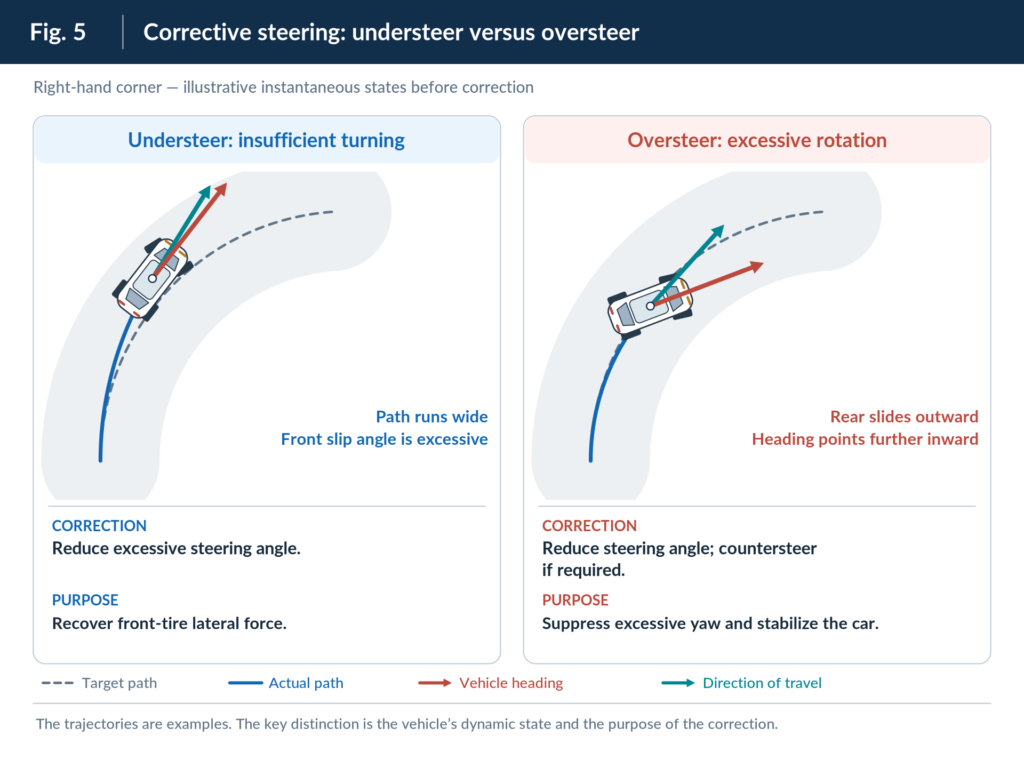
Fig. 5 compares corrective steering inputs used to address understeer and oversteer.
When excessive front-tire slip angle causes understeer, reducing the steering angle can help restore cornering force. When rear-tire sideslip causes oversteer, reducing the steering angle or applying countersteer serves to suppress excessive vehicle rotation.
Understanding this distinction requires attention to both the car’s orientation and its actual direction of travel.
The component of the combined tire forces acting perpendicular to the car’s direction of travel changes that direction, while the net yaw moment about its center of gravity changes its rate of rotation.
Recovering front-tire lateral force can therefore contribute to both tightening the car’s trajectory and promoting rotation. The resulting vehicle behavior depends on the forces generated by the rear tires and the car’s current dynamic state.
The same reduction in steering angle can thus serve two opposing purposes: restoring insufficient cornering response or suppressing excessive rotation.
The meaning of a steering input depends on the relationship between that input and the car’s current dynamic state.
4. Sawing at the Wheel, Tuck-In, and Trail Braking
A car’s cornering behavior can be controlled through the throttle and brakes as well as the steering wheel.
The key to understanding how these three controls work together lies in the tire friction circle and longitudinal load transfer.
4-1. The Tire Friction Circle
The forces a tire can generate against the road are limited.
The friction circle and friction ellipse are conceptual models illustrating the relationship between longitudinal forces—braking and driving forces—and lateral force.
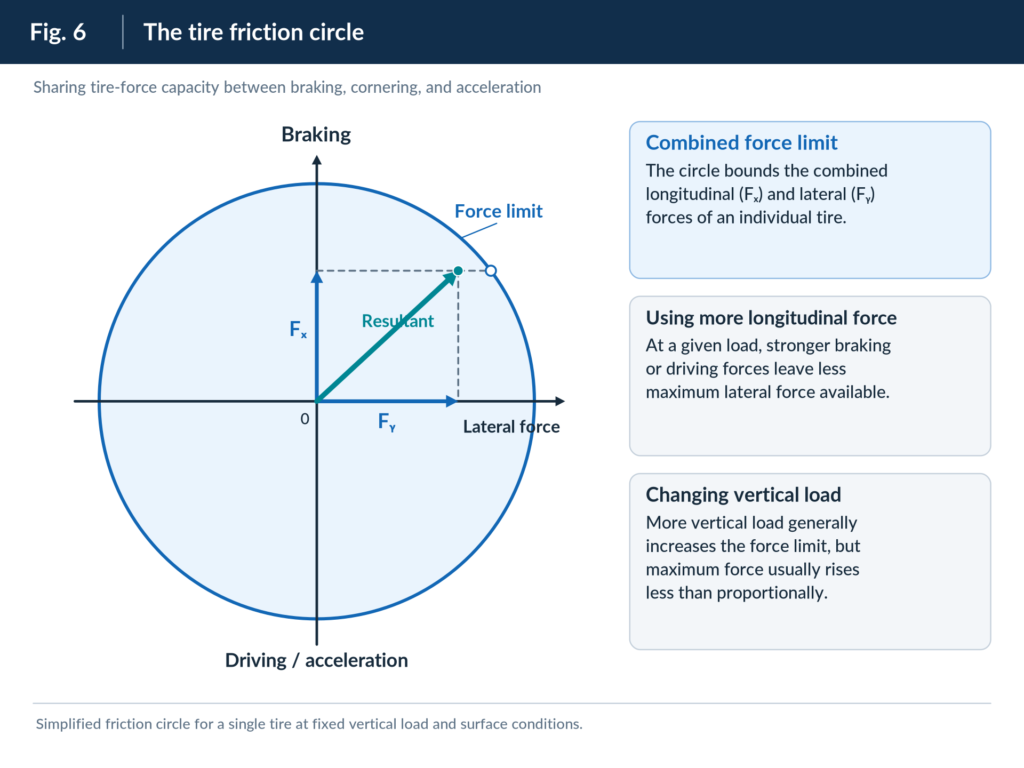
Fig. 6 illustrates the friction circle of an individual tire under a constant vertical load.
The radius of the circle represents the limit of the combined force available from the tire. The diagonal arrow represents the resultant of its longitudinal and lateral forces.
At a given vertical load, using more tire capacity for braking or acceleration reduces the maximum force available for cornering.
Increasing the vertical load generally increases the maximum force a tire can generate, effectively enlarging its friction circle.
However, the relationship is nonlinear. The maximum force a tire can generate generally increases by a smaller proportion than its vertical load. This characteristic is known as tire load sensitivity.
Understanding tire grip during cornering therefore requires consideration of two factors:
- The total force-generating capacity of the tire
- How that capacity is shared between braking, cornering, and acceleration
4-2. Throttle-Induced Tuck-In
When a driver eases off the throttle during cornering, the car may turn more sharply toward the inside of the corner, tightening its line.
This response is known as tuck-in, particularly in discussions of lift-off behavior.
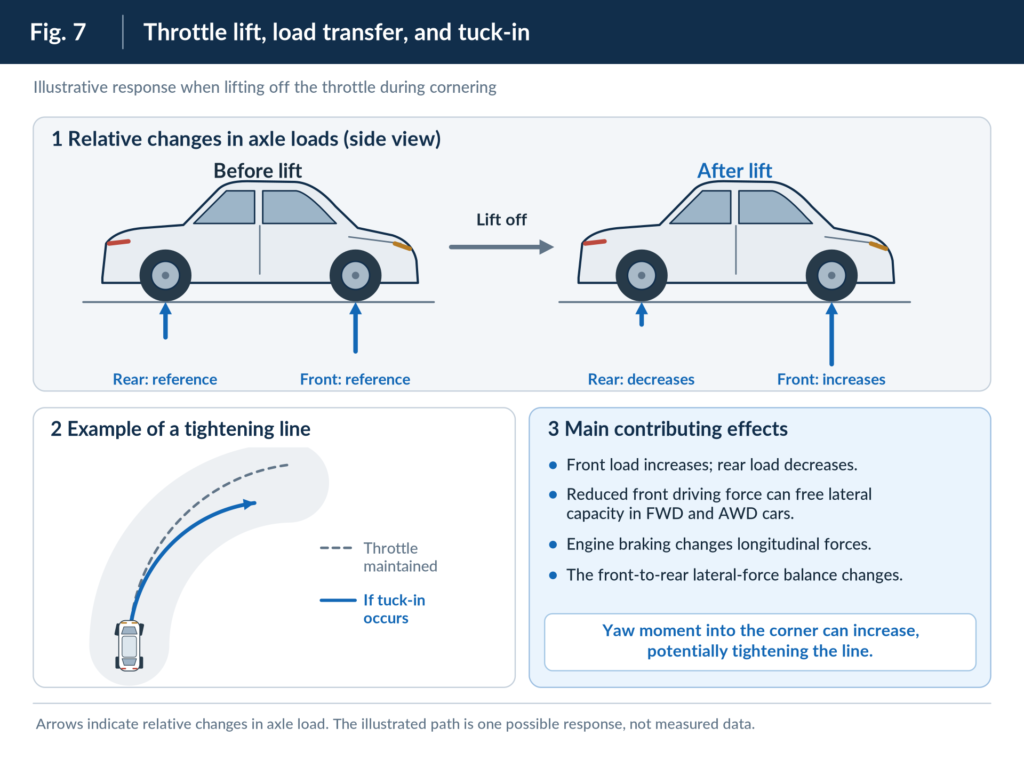
The upper section of Fig. 7 illustrates changes in vertical tire loads before and after the driver reduces throttle input.
As longitudinal acceleration shifts toward deceleration, front-axle load tends to increase and rear-axle load tends to decrease relative to their previous values.
In front-wheel-drive cars and all-wheel-drive cars such as the GR Yaris, reducing the driving force at the front tires may also free up some of their capacity for generating lateral force.
Longitudinal forces arising from engine braking can also affect the lateral forces generated by the front and rear tires.
Together, these effects can alter the front-to-rear balance of lateral forces and increase the yaw moment acting in the direction of the turn.
The lower section of Fig. 7 illustrates one possible resulting change in the car’s trajectory when tuck-in occurs.
Tuck-in is particularly associated with front-wheel-drive cars, but it can also occur in front-engine rear-wheel-drive, mid-engine, rear-engine, and all-wheel-drive cars.
The response depends on factors including weight distribution, drivetrain layout, engine braking, limited-slip differentials, and electronic control systems.
The broader technique of using throttle input to influence cornering behavior is known as throttle steering.
4-3. Controlling Cornering Behavior Through Braking
When approaching a slow corner at the end of a long straight, drivers typically begin with heavy braking while keeping the steering angle close to zero.
They then progressively release the brakes while increasing the steering angle.
This technique is known as trail braking.
During this phase, deceleration transfers load toward the front tires, which simultaneously generate braking and lateral forces.
As the driver releases brake pressure, a greater proportion of the tires’ force-generating capacity can become available for cornering, as illustrated by the friction circle in Fig. 6.
At the same time, reduced deceleration tends to decrease front-axle load, reducing the size of the front tires’ friction circles.
By adjusting brake pressure, the driver manages the balance between these two effects to obtain the required front-tire lateral force.
Braking can also alter the front-to-rear balance of lateral forces and thereby influence vehicle rotation.
4-4. Coordinating the Three Driver Controls
The different ways in which steering, braking, and throttle inputs influence cornering can be summarized as follows:
| Driver control | Related technique | Primary effect |
|---|---|---|
| Steering | Sawing and corrective steering | Adjustment of front-tire slip angles and lateral forces |
| Brakes | Trail braking | Adjustment of braking forces and longitudinal load transfer |
| Throttle | Use of tuck-in | Adjustment of driving forces and longitudinal load transfer |
For example, when the front tires have excessive slip angles while simultaneously transmitting substantial driving force, reducing both steering angle and throttle input may have complementary effects on the recovery of lateral force.
Should steering and throttle inputs therefore be synchronized when combining sawing with tuck-in?
Tire-force development, drivetrain response, load transfer, and suspension movement each have different response characteristics. The time between a driver’s input and its physical effects therefore varies.
The important consideration is the coordination of these physical effects through appropriately timed and measured inputs, guided by the car’s response, rather than synchronization according to a fixed rhythm.
5. Cornering Strategies and Sawing at the Wheel: Three Hypotheses
Cornering often involves a continuous transition from deceleration to acceleration, sometimes with an intermediate phase of approximately constant speed.
Throughout this process, the proportions of braking, lateral, and driving forces demanded from the tires change.
The apex is a geometrical point along the chosen driving line. The transition from deceleration to acceleration depends on corner geometry, driving line, and vehicle characteristics.
In my experience driving the GR Yaris on a circuit, sawing at the wheel feels particularly effective during deceleration from turn-in through trail braking. Throttle-induced tuck-in, by comparison, feels effective during the acceleration phase after the apex.
Taking this experience as a starting point, I have considered three possible cornering patterns based on the primary control technique used during each phase.
Pattern A is based on my driving experience and its proposed physical explanation. Patterns B and C are further hypotheses derived from vehicle dynamics and different cornering strategies.
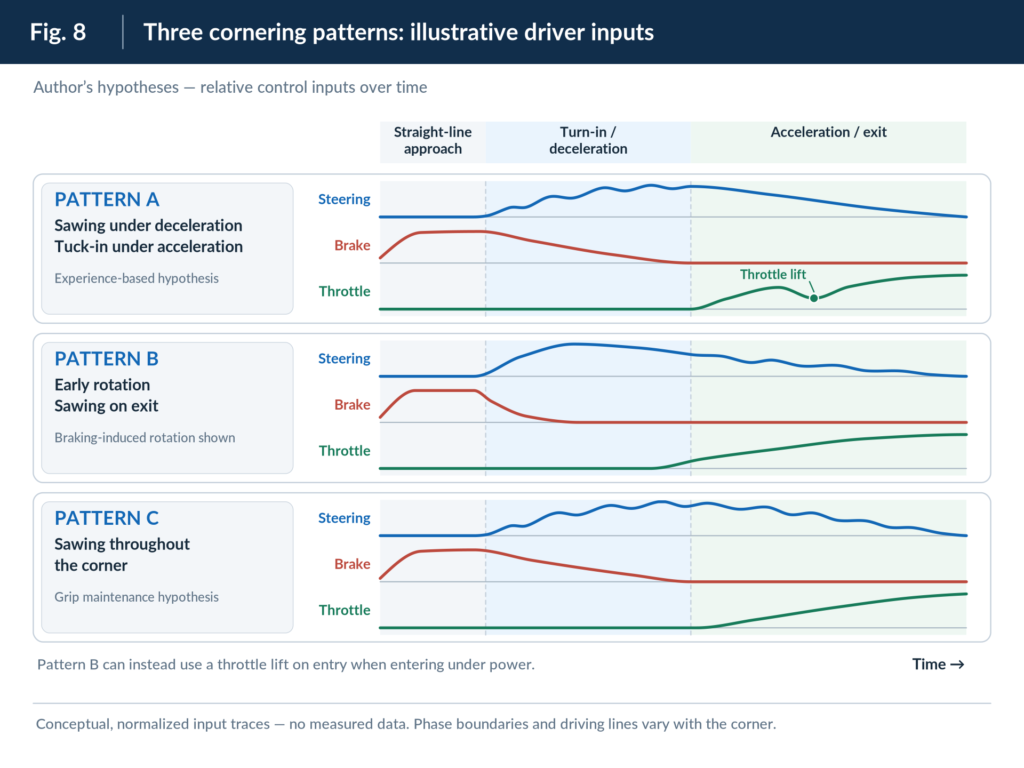
Fig. 8 compares the three patterns through illustrative changes in steering angle, brake pressure, and throttle opening over time.
5-1. Pattern A: Sawing Under Braking, Tuck-In Under Acceleration
This is the pattern I most commonly experience in the GR Yaris.
While cornering under braking, small steering inputs are used alongside brake-pressure adjustments to extract the required front-tire lateral force.
As the driver transitions from braking to acceleration, load transfers rearward. In the GR Yaris, the front tires also begin transmitting driving force.
These changes can limit the lateral force available from the front tires, potentially producing power understeer.
Momentarily reducing throttle input can promote tuck-in and help the car resume the required cornering trajectory. Acceleration can then continue as the car achieves the desired orientation.
The defining feature of this pattern is the use of steering as the primary means of correcting understeer during deceleration and throttle as the primary means during acceleration.
Reducing throttle input during corner exit comes at the cost of temporarily reducing acceleration. The timing of initial throttle application and the rate at which throttle input increases are therefore important factors influencing corner-exit speed.
5-2. Pattern B: Tuck-In on Entry, Sawing on Exit
This pattern emphasizes vehicle rotation during the first part of the corner and acceleration during the second.
In corners entered with some throttle applied, lifting off can promote rotation through tuck-in.
Achieving the required vehicle orientation during the first part of the corner can create greater scope for progressively unwinding the steering and accelerating during the second.
Small corrective steering inputs can then be applied as necessary while maintaining acceleration.
I believe this approach may complement a late-apex driving line, which places the apex farther into the corner and emphasizes acceleration on exit.
Corners Following a Long Straight
At the end of a long straight, the throttle is typically already fully closed during the initial straight-line braking phase.
In this situation, braking-induced rotation offers another way of actively changing the car’s orientation during corner entry.
The driver introduces steering input toward the end of the braking phase, using the changing balance of tire loads and lateral forces to promote rotation.
Even a brief overlap between braking and steering during progressive brake release constitutes a form of trail braking.
Rapid rotation while rear-axle load is relatively low can produce increased rear-tire sideslip.
The car also has yaw inertia, meaning that changes in its rate of rotation require a yaw moment acting over time.
If rotation exceeds the driver’s intention, corrective steering, potentially including countersteering, may be required.
Repeated small steering corrections in this situation fall within the broader definition of sawing illustrated in Fig. 4.
An entry strategy focused on early rotation can therefore also involve sawing to stabilize the car.
In my view, this approach demands considerable skill in corners requiring substantial deceleration from high speed, because braking, rotation, and vehicle stabilization must be coordinated within a short period.
5-3. Pattern C: Sawing from Turn-In to Corner Exit
This pattern involves assessing tire grip and maintaining the required lateral force throughout the corner.
Exploratory and corrective steering inputs allow the driver to respond to changing grip conditions during the transition from deceleration to acceleration.
As illustrated in Fig. 8, small steering adjustments are superimposed on the underlying steering input whenever required, from turn-in through corner exit.
I envisage near-limit cornering accompanied by a light, continuous tire squeal throughout the corner.
The relationship between tire squeal and lateral force varies with tire construction, temperature, wear, and road surface conditions. The intensity and changes in tire noise provide one source of information for assessing grip.
I believe this approach may be particularly relevant to long, sweeping, medium- and high-speed corners, where maintaining lateral force over an extended period is important.
5-4. What These Three Patterns Reveal About Cornering Strategy
| Pattern | Entry and deceleration | Exit and acceleration | Main emphasis |
|---|---|---|---|
| A | Sawing | Tuck-in | Changing the primary control technique between phases |
| B | Tuck-in or braking-induced rotation | Sawing | Early rotation and exit acceleration |
| C | Sawing | Sawing | Sustained use of lateral force |
The comparison between Patterns B and C suggests two different approaches to cornering: prioritizing exit speed by establishing the car’s orientation early, or maintaining cornering speed through sustained lateral force.
I believe the latter approach may complement a driving line with a larger cornering radius.
Driving-line selection and vehicle control are closely related. Drivers combine the available control techniques to guide the car along their chosen line.
The effectiveness of each pattern is likely to depend on corner geometry, the lengths of the preceding and following straights, road surface conditions, and vehicle characteristics.
The input traces in Fig. 8 are conceptual representations of these hypotheses.
Comparative testing using actual driving data would be required to determine their relative effects on lap times.
6. The Benefits and Limitations of Sawing at the Wheel
As the lateral-force curve in Fig. 3 suggests, additional steering inputs can disturb lateral force and reduce cornering performance when the tires are already operating at suitable slip angles.
Tires also require time to develop lateral force in response to changes in slip angle.
Excessively frequent steering adjustments can therefore create a sequence in which the driver repeatedly corrects disturbances generated by previous inputs.
This helps explain why some driving instructors view excessive sawing negatively.
The effectiveness of sawing depends on the balance between the information and corrective benefits it provides and the variations in lateral force and vehicle behavior that it introduces.
When the appropriate steering angle remains constant, maintaining that angle is a sensible approach. When the appropriate steering angle changes, corresponding steering adjustments become necessary.
I therefore regard smooth driving as the achievement of smooth vehicle behavior through inputs whose magnitude and timing are appropriate to the car’s dynamic state.
7. Understanding the Car and Controlling the Car
The distinction between exploratory and corrective steering inputs illustrated in Fig. 4 can also be understood from the perspective of control theory.
Exploratory steering provides information for state estimation, while corrective steering uses feedback to bring the car’s behavior closer to the desired state.
During actual cornering, these two functions form a continuous cycle.
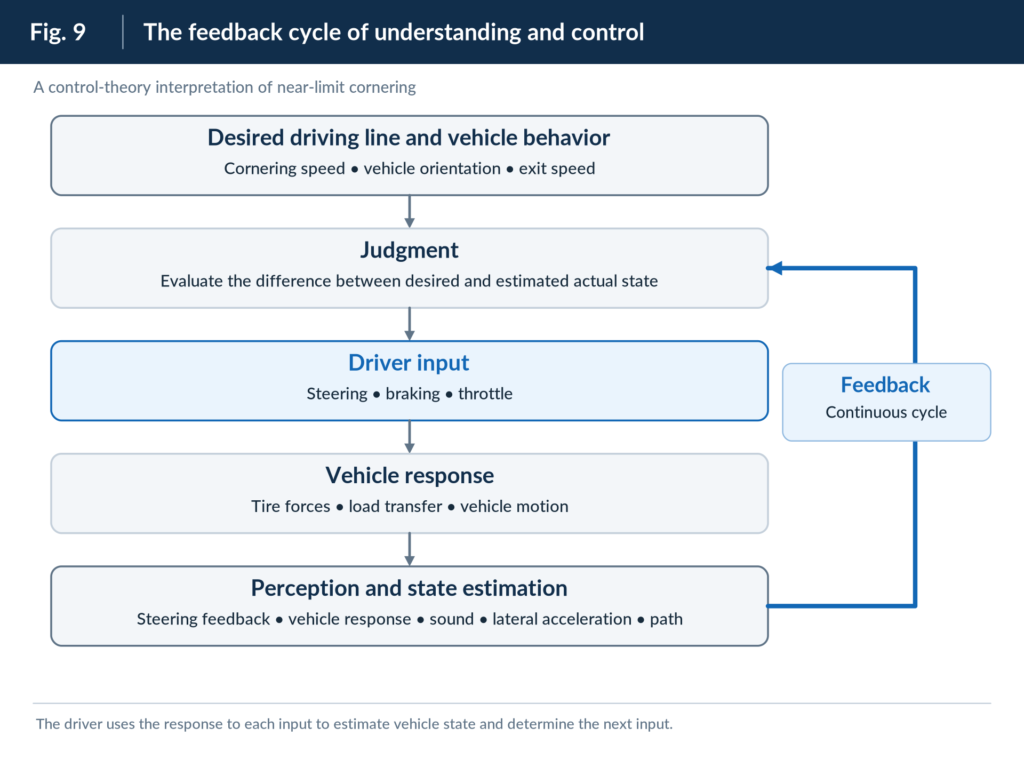
As illustrated in Fig. 9, the driver establishes a desired driving line and vehicle behavior, then evaluates the difference between the desired and perceived actual conditions.
The driver operates the steering wheel, brakes, and throttle, observes the resulting vehicle response, and uses this information to determine the next input.
A single steering input can serve both exploratory and corrective functions because changing the car’s behavior also produces new information about its dynamic state.
In control-theory terms, the driver is performing continuous feedback control while estimating the vehicle’s state.
The steering wheel can therefore be understood both as a control device that changes the car’s behavior and as an extension of the driver’s senses that provides information about the car.
We learn about the car by controlling it, and what we learn about the car determines how we control it next.
These small steering movements seem to embody something fundamental about driving: the continuous interaction between understanding a vehicle and controlling it.
The next time you watch onboard footage of a racing driver, pay attention to the car’s rotation and the driver’s braking and throttle inputs alongside the movements of the steering wheel.
Each small steering input may reveal something about what the driver is trying to understand and what they are trying to change.
Explore Other Articles
English Articles : A Topic-by-Topic Guide to This Site
GR Yaris 6MT or GR-DAT? ★ Find the One That Fits the Way You Enjoy Driving
Cars, Driving & Automotive Engineering | English Article Guide
Driving Techniques ★ Braking, Cornering, Weight Transfer & Track Practice — Article Guide
Want to know more about the author and the thinking behind this site?
→ About Rikutsu-Kone-Taro
