Our sense of time becomes less reliable when we are deeply engaged in an activity or completely absorbed in what we are doing.
When we are enjoying ourselves, time seems to pass quickly. When we become absorbed in troubleshooting equipment or carrying out a difficult task, we may lose track of how much time has passed. Something we expected to take only a few minutes can consume far more time than anticipated.
Clock time, meanwhile, serves as a shared reference across society.
Train and bus departures, taxi arrangements, business hours, and appointments all depend on a common time reference. Weather forecasts also describe expected changes in relation to specific times.
Time continues to pass while we are absorbed in our activities.
As it passes, the range of actions still available to us changes.
Can we continue and still finish on time?
Would shortening the activity make it possible?
Do we need to stop immediately and head back?
Making these decisions requires an objective reference: the current time.
Knowing the accurate time helps us understand which options remain available to us.
This is the principle behind the requirements I have developed for a wristwatch used at sea, and the watch I currently wear.
1. At Sea, the Passage of Time Changes Your Options
When taking a motorboat or sailboat out to sea, we need to consider weather forecasts, our vessel’s position, and the current time together.
Forecast conditions change throughout the day, while the vessel’s position changes as we travel.
Knowing the current time allows us to compare predicted changes in wind, rain, waves, and temperature with our present location and the time required to return to port.
For example, we might believe that stronger winds are still some time away when the forecast period has already begun. Or we might think there is plenty of time before rain arrives, only to encounter it during the return voyage.
An incorrect understanding of the current time can lead to these kinds of errors in judgment.
The same applies when equipment or onboard fittings develop a problem.
While concentrating on a repair, we may spend far more time than expected. Checking the time when we pause allows us to decide whether to continue working on the problem or make a temporary repair and return to port.
What matters here is the time remaining for action.
We can estimate it by taking the time until the next constraint or deadline, then subtracting the time needed for travel or other necessary tasks, along with an appropriate safety margin.
The result helps determine whether to continue, shorten the activity, or withdraw.
Weather forecasts contain uncertainty, so actual changes in wind and sea conditions must also be observed when deciding how much safety margin to preserve.
The reason for checking the time at sea is to understand how the passage of time changes which actions remain feasible.
2. Time Management at Sea Continues After Returning to Port
The time available for activities at sea depends on more than the planned arrival time at the marina or harbor.
After returning, there are still tasks to complete: securing the boat, unloading equipment, washing down the vessel, rinsing gear with fresh water, and changing clothes.
If public transportation is involved, train and bus departure times must also be considered. If a taxi is needed, the timing of the booking becomes another consideration.
The longer we stay out enjoying ourselves, the less time remains for these tasks.
Ending an activity a little earlier can make it possible to clean up without rushing and catch the transportation we originally planned to use.
I regard boating, recreational activities, post-voyage maintenance, and the journey home as consecutive parts of the same day.
By checking the current time and working backward from the time required for the remaining activities, I can determine how much longer I can stay at sea.
Managing time in this way also preserves the options available after returning to port.
3. Knowing the Time Even When Away from the Boat
When anchored, I enjoy swimming and snorkeling. Depending on the destination, I may also use a kayak or an underwater scooter.
During these activities, I am away from the boat’s instruments, and I leave my smartphone on board.
Seawater strongly attenuates the radio signals used by ordinary smartphones for mobile communication and satellite positioning systems such as GPS. Underwater communication and positioning therefore have limited practical use, making a waterproof wristwatch a suitable way to check the time.
With a wristwatch, I can determine how much time has passed since leaving the boat, how much time remains before my planned return, when I need to begin the voyage back to port, and how long remains before forecast weather changes.
Even when completely absorbed in an activity, I can adjust my plans according to the current time.
A wristwatch is also useful while operating the boat or working on deck.
The information is always close at hand, and checking it requires only a glance at my wrist.
Being able to read the accurate time immediately, without operating anything, is one of the main reasons I wear a wristwatch.
4. Five Requirements for a Wristwatch Used at Sea
Based on these activities and operating conditions, I have organized my requirements for a marine-use wristwatch into five categories.
1. Immediate Access to Information
The most important requirement is being able to read the time at a glance.
As I have presbyopia, the display must be easy to read with the naked eye.
Either an analog or digital display is acceptable. The information must be sufficiently large and legible in strong sunlight, in the evening, and inside a dimly lit cabin.
I also want the date and day of the week to remain visible. They are useful when checking facility schedules and public transportation services after returning to port.
Ideally, the watch should require no operation at all after departure. The necessary information should already be displayed whenever I raise my wrist.
2. Reliable Information with Minimal Maintenance
Maintaining sufficient timekeeping accuracy while minimizing maintenance is another important requirement.
I choose a radio-controlled watch because it can automatically synchronize with a standard time signal when reception is available, allowing me to leave port with an accurately set watch.
When the time signal is unavailable, the watch continues operating as a conventional quartz watch.
Solar charging serves a similar purpose.
A solar-powered watch charges from everyday light exposure, reducing the need to manage its power supply.
Combining a reliable means of maintaining timekeeping accuracy with an easily readable display makes the wristwatch a dependable reference for decision-making.
3. Comfortable All-Day Wear
The display needs to be large enough to read easily, but I prefer the watch itself to be thin and light.
A thick watch can catch on the cuffs of rainwear, cold-weather clothing, jackets, and shirts when putting them on or taking them off.
A heavy watch can become uncomfortable during long periods of wear and may interfere with arm movements while swimming or snorkeling.
I prefer metal cases and bracelets, so titanium is particularly attractive.
The goal is to combine low weight with durability in a watch that remains comfortable throughout the day.
4. Resistance to the Marine Environment
On board, a wristwatch may strike the hull, railings, cleats, metal fittings, boarding ladders, or other equipment.
A dependable manufacturer’s product with a durable case and bracelet and a scratch-resistant crystal is therefore desirable.
Surface-hardened titanium and sapphire crystal are useful in these conditions.
The watch also needs sufficient water resistance for swimming and shallow skin diving.
A secure bracelet and clasp are important as well, because they reduce the risk of losing the watch underwater.
5. Acceptable Consequences of Damage or Loss
At sea, there is always a possibility of damaging a watch or losing it underwater.
I include that possibility among the conditions under which I choose equipment.
The more expensive a watch is, the stronger the desire to recover it may become if it is lost. However, attempting to retrieve an object underwater can involve considerable risk.
The desire to protect a valuable possession can influence our judgment about personal safety.
For this reason, I prefer a watch that I could abandon if necessary for safety and replace with an equivalent model if it were lost.
The psychological and financial consequences of damage or loss should remain within limits that I am prepared to accept.
5. Defining the Role of the Wristwatch
These five requirements make the purpose of my wristwatch clear.
Its job is to provide the current time, date, and day of the week whenever I need them.
I obtain weather forecasts from devices intended for weather information and monitor the vessel’s position using marine navigation equipment. For notifications, phone calls, payments, step counting, heart-rate monitoring, and music playback, I use other devices when necessary.
Assigning each task to equipment suited to that purpose allows me to keep the requirements for my wristwatch focused.
Solar-powered watches also have finite service lives.
Rechargeable cells, mechanical components, lubricants, and water-resistant seals deteriorate with age. Eventually, maintenance, repair, or replacement becomes necessary.
I regard a wristwatch for use at sea as a practical tool selected for its suitability to my activities, rather than as a possession that must last a lifetime.
If technology advances and a more suitable product becomes available, I can choose again.
6. My Primary Watch: CITIZEN PROMASTER AT6085-50E
My current primary watch is the CITIZEN PROMASTER AT6085-50E from the LAND series.
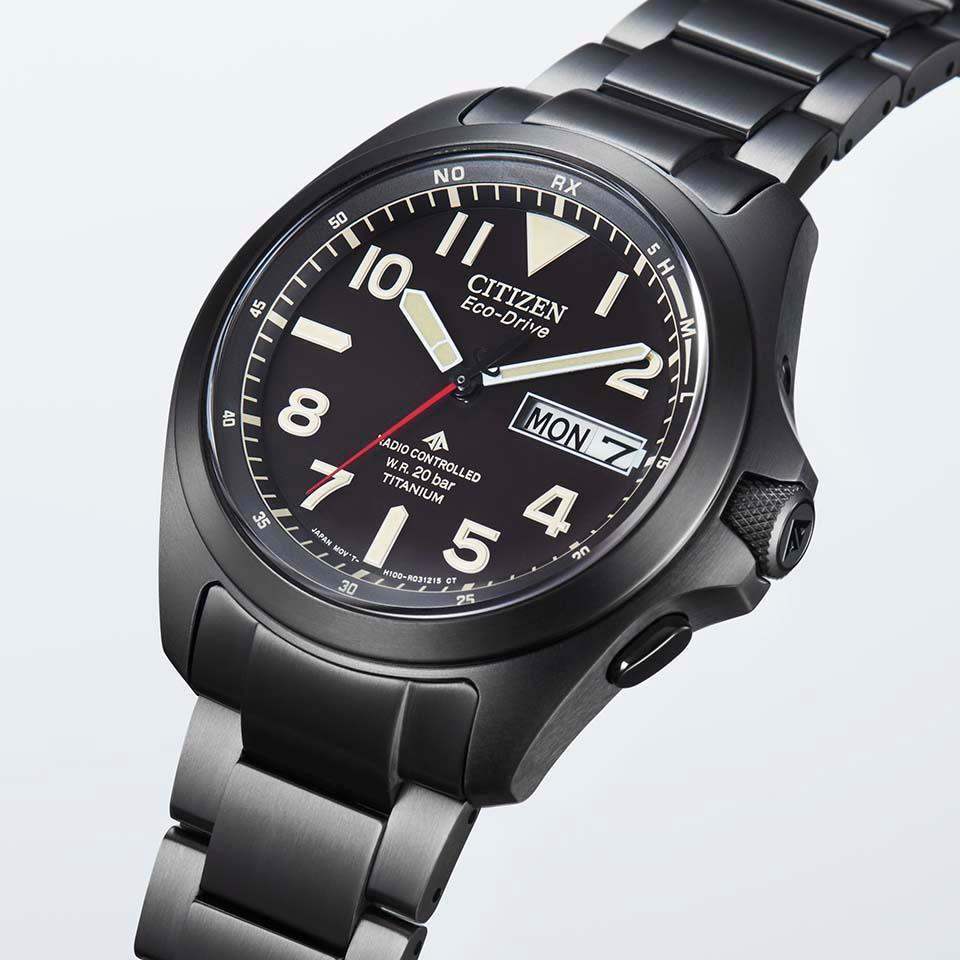
It is a radio-controlled watch powered by Citizen’s Eco-Drive technology, with continuously displayed date and day-of-the-week indicators.
The case and bracelet are made from Super Titanium with a Duratect DLC surface treatment. The crystal is spherical sapphire glass with an anti-reflective coating.
According to Citizen’s published specifications, the watch measures 39.0 mm in diameter, 11.4 mm in thickness, and weighs 96 g.
It also offers 20-bar water resistance, luminous hands and hour markers, and magnetic resistance.
Citizen’s Perfex technology incorporates functions designed to prevent or correct hand misalignment caused by shocks and magnetic interference.
The radio-controlled time synchronization function is designed for reception of Japanese standard time signals within Japan.
When those signals cannot be received, the watch operates as a quartz watch with a specified accuracy of ±15 seconds per month.
These specifications are available on the official Citizen product page.
The AT6085-50E belongs to Citizen’s PROMASTER LAND series.
When choosing equipment, I place greater importance on how well it matches my actual operating conditions than on the product category assigned by its manufacturer.
After identifying the functions I needed at sea and looking for a watch that met those requirements, I arrived at this LAND-series model.
7. Using 20-Bar Water Resistance for Swimming and Skin Diving
The AT6085-50E is an everyday-use watch with enhanced water resistance rated to 20 bar.
Under Citizen’s usage classifications, watches rated from 10 to 30 bar are suitable for ordinary swimming, marine sports, and skin diving.
The activities I undertake, including swimming, snorkeling, and diving a few meters to inspect the underside of my boat, fall within this category.
Scuba diving requires a watch specifically designed and rated for diving. An ordinary watch rated to 20 bar and a diver’s watch rated for 200 meters of diving belong to different usage categories.
Water resistance can deteriorate with age and use.
Citizen recommends periodic inspections and replacement of water-resistant gaskets every two to three years to maintain water resistance.
Before using the watch in the water, I check that the screw-down crown is securely locked. I avoid operating the crown or buttons underwater or while the watch is wet.
After exposure to seawater, I rinse away salt with fresh water and wipe the watch dry.
With my particular watch, I have experienced no water ingress so far, including during skin dives to depths of approximately five meters.
I intend to continue using it within the manufacturer’s specified conditions and arranging the necessary inspections.
Citizen explains water-resistance classifications and maintenance in its official guidance.
8. Why I Prioritized Thinness and Low Weight Over a Dedicated Diver’s Watch
Many dedicated diver’s watches have substantial pressure-resistant structures, rotating bezels, and relatively large, thick cases.
Some of them feel bulky and heavy on my slender wrist.
Most of the time I spend wearing a wristwatch at sea is spent operating the boat or working on deck.
I therefore consider both the conditions in which I use the watch underwater and the much longer periods when I wear it on board.
For my activities, it makes sense to combine sufficient water resistance for the swimming and skin diving I undertake with a thin, lightweight case that remains comfortable throughout the day.
The AT6085-50E meets those requirements.
Among the models I have examined so far, it offers the best combination of legibility, timekeeping accuracy, comfort, and water resistance for my needs.
If I had to replace it because of damage or loss, I would probably choose the same AT6085-50E again, provided its specifications remained unchanged.
9. My Backup Watch Is Attached to My Bag Handle
For a backup watch, I use a full-metal Casio G-SHOCK.
Its purpose is to provide an independent time reference if I ever have reason to question the reading on my primary watch.
The full-metal G-SHOCK I own is exceptionally robust.
However, I find it large, thick, and heavy on my wrist, making it uncomfortable for extended wear.
I am also dissatisfied with its readability under certain conditions. The crystal is flat, while the LCD is recessed within the dial, so the display can be difficult to read depending on the lighting and viewing angle.
I therefore make use of its shock resistance by attaching it to the handle of my bag.
In that position, its weight and interference with clothing are no longer concerns. I do not worry much if it gets bumped around on board, and I can use it to compare the time shown by my primary watch or the boat’s instruments whenever necessary.
On my wrist, I wear a watch that is comfortable all day and provides immediate access to the time.
On my bag, I keep a robust backup watch.
The two watches serve different purposes, each in a location suited to its role.
10. Conclusion: Knowing the Time Means Knowing Which Options Remain
Activities at sea are governed by various time-related constraints, including weather conditions, the vessel’s position, the time required to return to port, and plans after arrival.
Making decisions within these constraints requires us to correct our subjective sense of elapsed time against an objective clock.
The requirements I place on a wristwatch—legibility, accuracy, comfort, resistance to the marine environment, and acceptable consequences of loss—are all intended to support sound decisions.
For my current needs, the CITIZEN PROMASTER AT6085-50E provides the best combination of these qualities.
Knowing the time also means knowing which options remain available to us.
From those options, we decide what to do next.
That is the job I expect my wristwatch to perform at sea.
Want to know more about the author and the thinking behind this site?
→ About Rikutsu-Kone-Taro
