This page introduces my very first boat: a Jeanneau Merry Fisher 895 Sport, built by the French manufacturer Jeanneau.
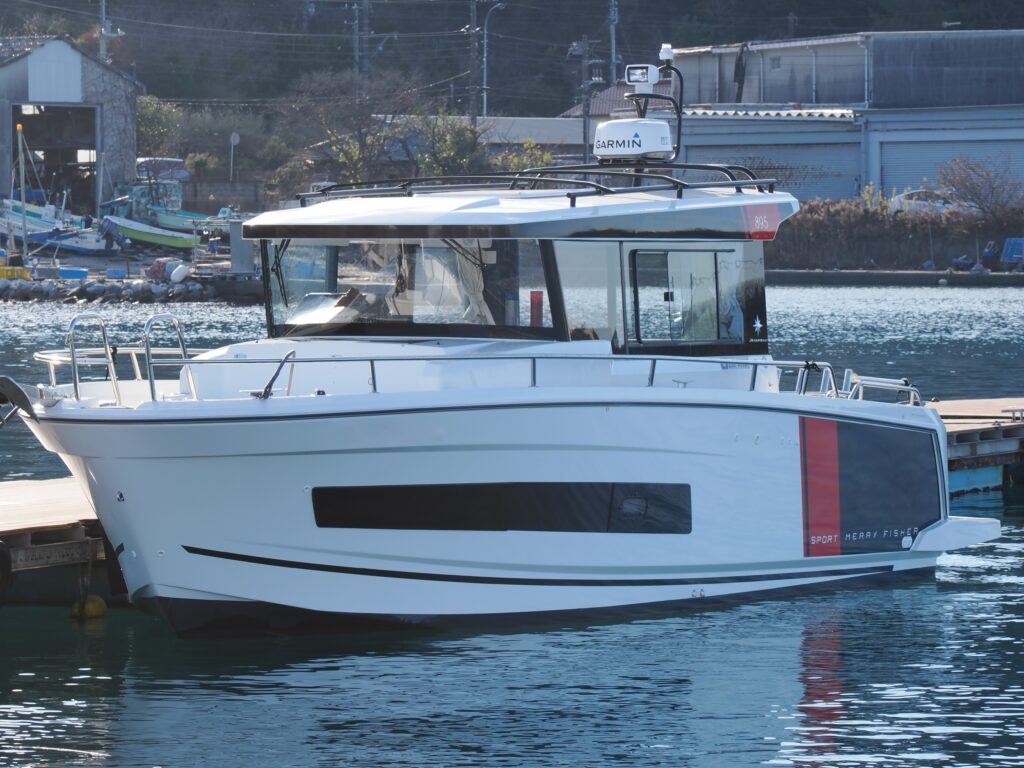
My boat, a Merry Fisher 895 Sport at the cock
About the Merry Fisher 895 Sport featured in this article
The boat featured here is the original-generation Merry Fisher 895 Sport, essentially the Série 1, which preceded the current Merry Fisher 895 Sport Série 2. Anyone buying a new Merry Fisher 895 Sport today will generally be looking at the Série 2. The hull layout, interior arrangement, equipment, and other details described in this article refer to my earlier-generation boat.
Jeanneau is a major French manufacturer of sailboats and powerboats, and in Japan it is well known in boating circles alongside Beneteau.
The Jeanneau brand is part of Groupe Beneteau, and boats from Jeanneau and Beneteau sometimes seem to share a certain family resemblance in their overall character and layout. In some cases, you need to look at them with considerable interest before the differences really become obvious.
What follows is simply my own view of my boat, based on my own preferences, experience, and inevitably subjective judgment.
I also own a Yamaha Festa 31 sailing yacht, which I introduce separately.
How my requirements became clear while looking for a boat
After deciding to buy a boat, I spent quite a bit of time looking at different boats and marinas.
As I did so, the things I personally wanted from both the boat and the marina gradually became clearer.
Rather than choosing a specific manufacturer or model first, I worked out how I wanted to use a boat. The Merry Fisher 895 Sport was where that process eventually led me.
Requirement 1 | Suitable for in-water mooring and ready to go whenever I feel like it
My first requirement was simple: I wanted to be able to go boating whenever the mood struck me.
That made suitability for permanent in-water mooring important.
For the way I planned to use the boat, an outboard-powered boat seemed better suited to long-term in-water mooring and easier for me to maintain than a sterndrive boat.
I also preferred outboards to a shaft-drive installation when I considered maintenance of the propulsion system, access for servicing, and the possibility of eventually replacing the engines.
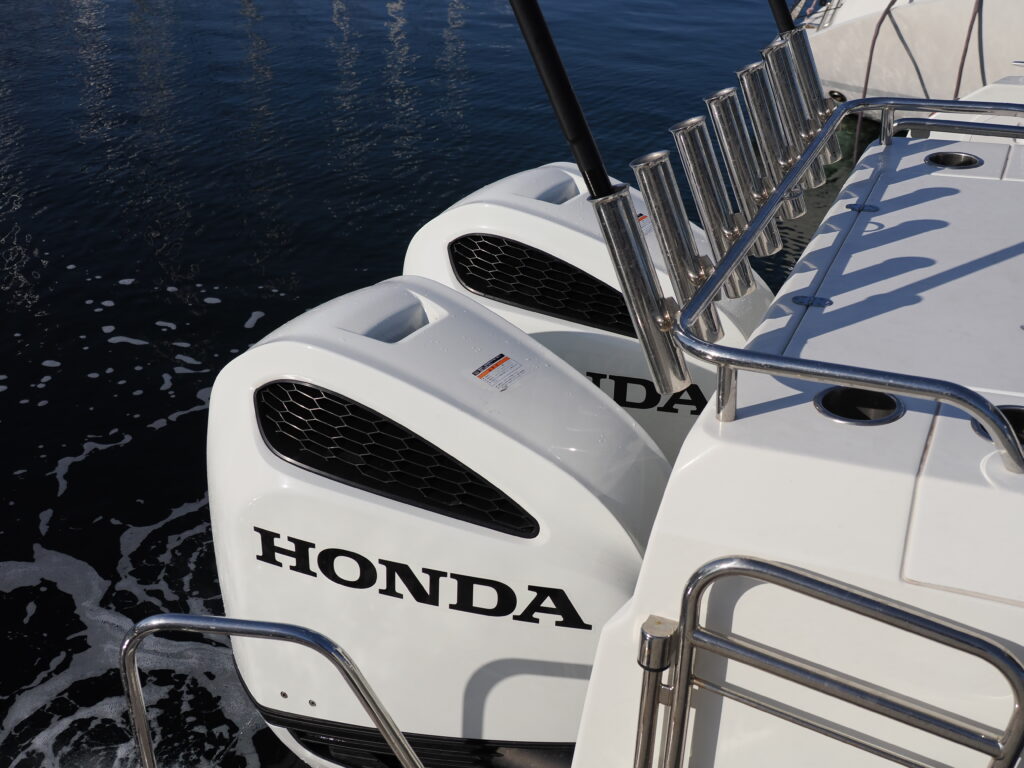
Photo 1. The two outboard engines mounted at the stern of my Merry Fisher 895 Sport
Outboard engines are installed at the stern and propel the boat forward by pushing it through the water with their propellers.
In automotive terms, it is a bit like a rear-engine, rear-wheel-drive (RR) car.
An outboard integrates the engine, gearcase, propeller, water pump, and most of the major mechanical components required for propulsion into a single unit mounted outside the hull.
That makes engine access relatively straightforward, and replacing the propulsion unit itself is generally easier than with many inboard or shaft-drive arrangements.
My boat has twin outboards, so two engines sit side by side at the stern.
With twin-outboard installations like this, counter-rotating propellers are used so that the two propellers rotate in opposite directions.
On my boat, viewed from the stern looking toward the bow, the starboard propeller rotates clockwise and the port propeller rotates counterclockwise.
When the boat is moored, the lower units and propellers can also be tilted clear of the water.
Being able to keep the submerged parts of the propulsion system out of seawater is helpful in reducing corrosion and marine growth.
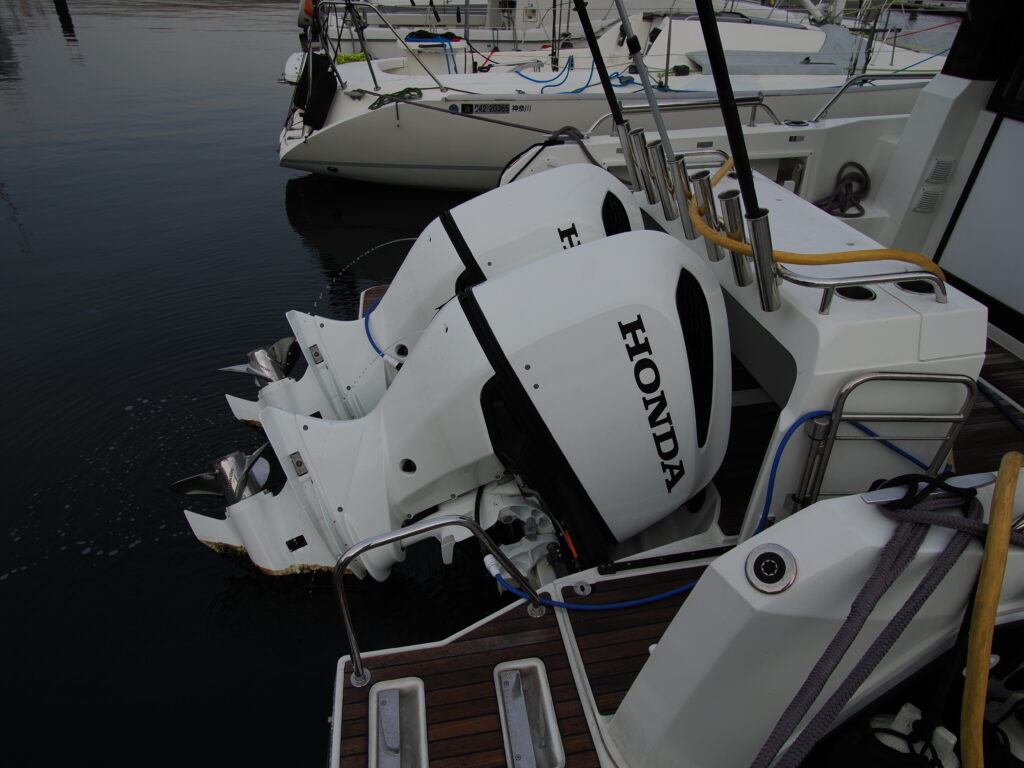
Photo 2. The outboards tilted up while the boat is moored
Requirement 2 | A walk-in cabin and plenty of usable interior space
My second requirement was a proper cabin that could keep out the wind and rain, with enough headroom to stand and walk inside.
I also wanted a reasonable amount of interior space.
Two separate enclosed spaces make it easier to have guests aboard.
In Japanese real-estate terms, I was imagining something like an extremely compact 2LK apartment. For an English-speaking reader, that is roughly a very compact two-room apartment with a combined living and kitchen area.
I wanted to use the boat almost like an SUV.
Swimming gear, a kayak, food, clothes, and all kinds of toys could simply be loaded aboard without having to think too hard about where every single item would go.
Requirement 3 | Plenty of power and propulsion redundancy
My third requirement was strong engines with enough power that carrying a lot of gear would not make the boat feel underpowered.
I also wanted to reduce the risk of losing propulsion as much as reasonably possible.
That led me toward twin Japanese outboards.
Twin engines provide propulsion redundancy, and I personally have a great deal of confidence in the reliability of Japanese engines.
There was also another reason.
Twin outboards simply look extremely cool.
I still remember the first time I saw a boat with two large outboards mounted side by side.
My immediate reaction was:
“Wow. That looks fantastic.”
Sometimes that kind of reaction matters when choosing something you intend to have fun with.
Requirement 4 | Long cruising range
My fourth requirement was range.
In summer, I wanted to be able to leave around sunrise, spend the whole day roaming around, and return toward sunset without constantly watching the fuel gauge.
So I wanted a boat with enough fuel capacity to support that kind of day.
Requirement 5 | Easy to handle single-handed
My fifth requirement was easy single-handed operation.
More specifically, I wanted a sliding door immediately beside the helm so that I could step outside quickly while maneuvering the boat.
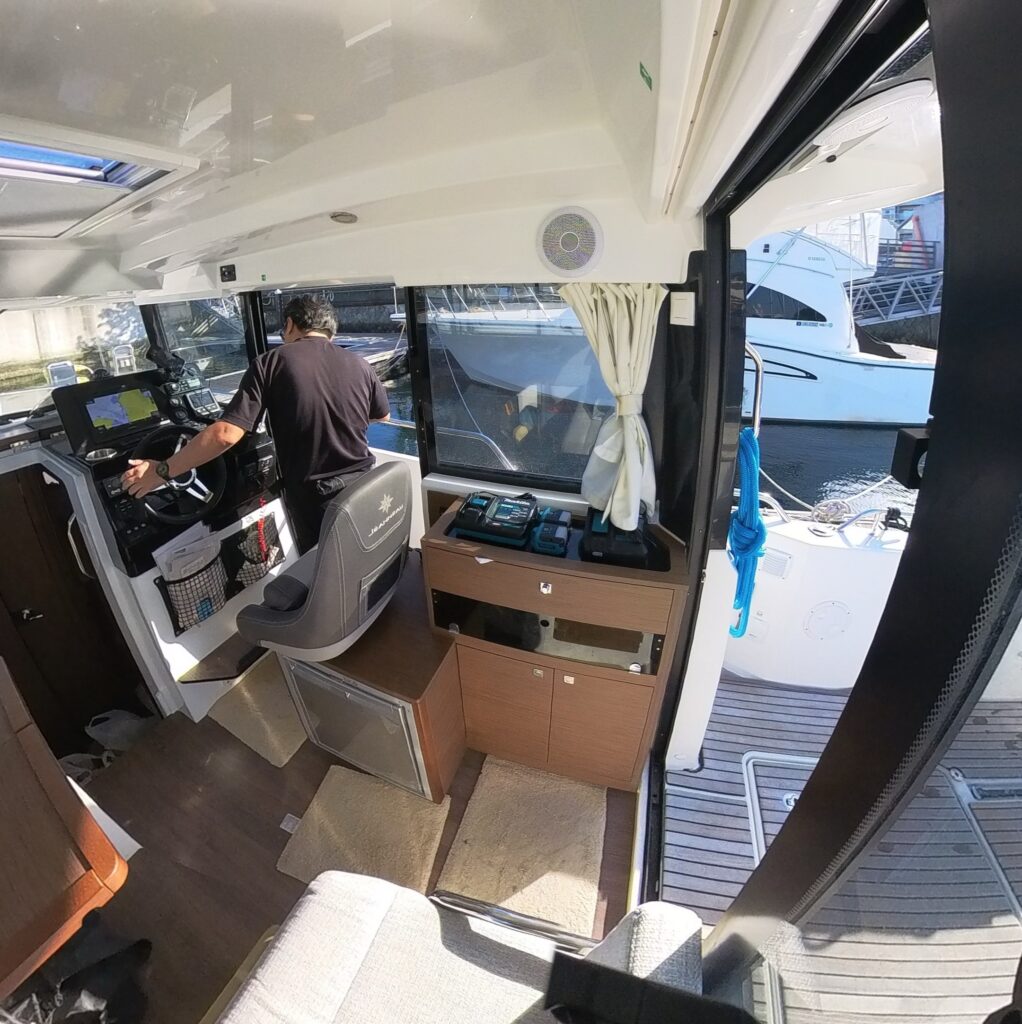
Photo 3. Looking outside through the sliding door beside the helm
During docking and undocking, being able to move from the helm to the deck in only a few steps is extremely useful.
The Merry Fisher 895 Sport also has a proper passage running along the starboard side from bow to stern.
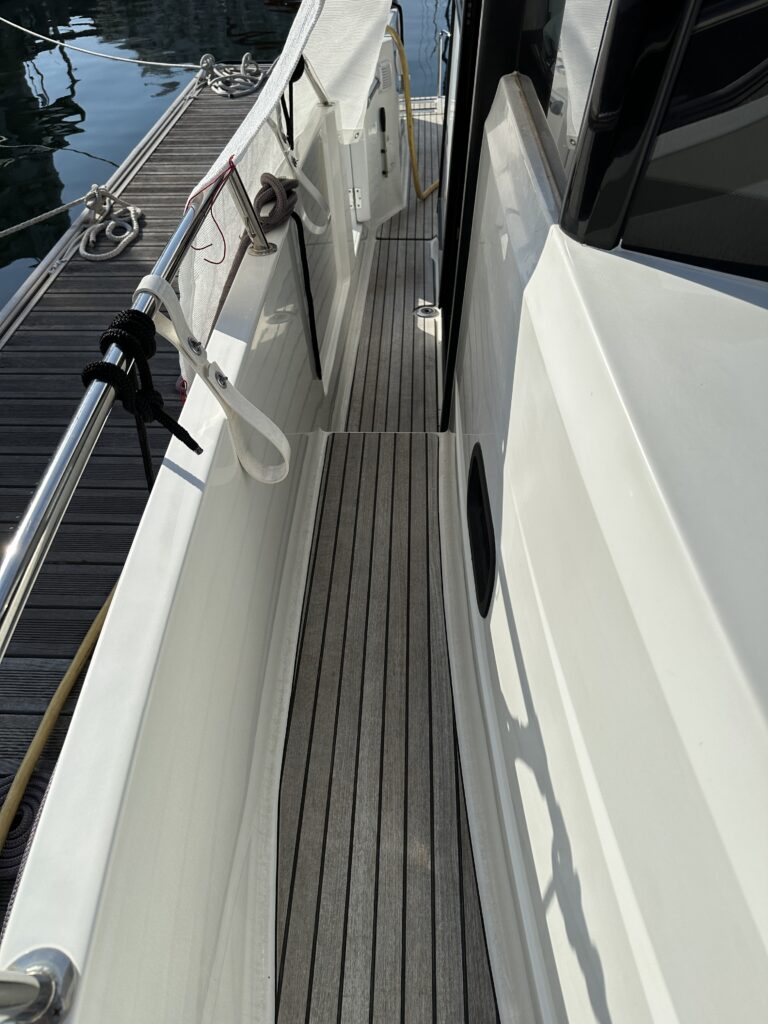
Photo 4. The starboard-side passage running from bow to stern. It makes single-handed operation much easier.
This full-width passage is on the starboard side, while the port side is more like a narrow catwalk.
The asymmetrical layout allows the cabin to remain relatively spacious while still providing a proper working passage on the side where the operator needs to move fore and aft.
It is one of my favorite design features of the Merry Fisher 895 Sport.
When operating the boat alone, it is genuinely convenient.
Requirement 6 | A boat that is enjoyable to look at and enjoyable to be inside
My sixth requirement was aesthetic.
I wanted the exterior and interior to have a certain sense of foreign style and beauty.
In simple terms, I wanted a boat that looked stylish.
I wanted to enjoy looking at it from the dock.
I also wanted to enjoy the atmosphere once inside.
Beyond being good transportation, I wanted the boat itself to be something I could enjoy simply by having it around.
The French-designed Merry Fisher 895 Sport had that quality for me.
Requirement 7 | A private toilet compartment and hot shower
My seventh requirement was a private enclosed compartment with a toilet.
A hot-water shower would make it even better.
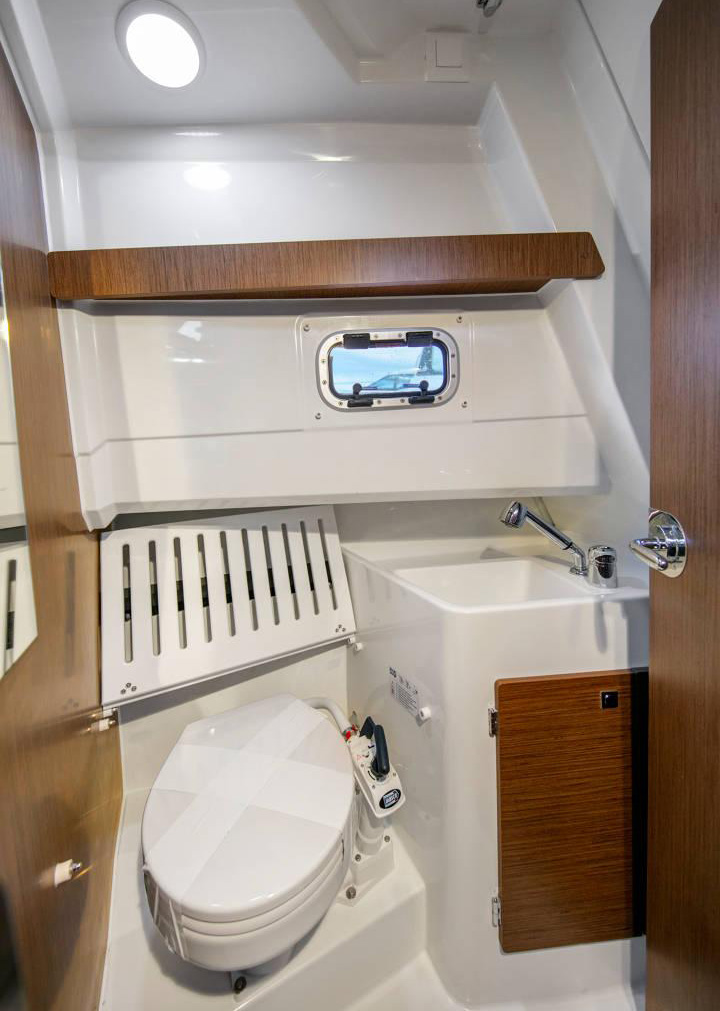
Photo 5. The toilet and shower compartment aboard the Merry Fisher 895 Sport. It also has a hot-water shower.
For a boat of this size, having a private head and hot shower makes a significant difference in how comfortably the boat can be used over a long day or on longer trips.
Discovering the Merry Fisher 895 Sport
While searching with these requirements in mind, I discovered the Merry Fisher 895 Sport.
At the time, Beneteau also had the Barracuda 9, which looked very appealing.
I liked that boat too, but it had already been discontinued and was becoming difficult to obtain as a new boat.
The Merry Fisher 895 Sport therefore remained one of my strongest candidates.
How it differs from the Merry Fisher 895
The Merry Fisher 895 Sport has a closely related sibling model with an almost identical name:
the Merry Fisher 895.
Only the word “Sport” is missing from the name, but the actual difference in character between the two boats is greater than the naming might suggest.
The Merry Fisher 895 has a different front-window arrangement and a different interior configuration around the bow. Its galley is also positioned in a more conventional location.
It probably offers more interior living space than the Sport, and its forward berth feels luxurious enough to describe as a proper bedroom rather than simply a place to sleep.
I thought it was a very good boat.
So why did I choose the Sport instead?
I honestly cannot remember clearly anymore.
I probably thought the Merry Fisher 895 Sport looked a little more fun and a little more suited to the kind of playing-around-on-the-water use I had in mind.
It may have been no more sophisticated a reason than that.
Availability in Japan at the time may also have influenced the decision.
At the time, I had no intention of fishing from this boat
When I first wrote the Japanese version of this article, I was not fishing.
That may sound slightly odd given that the boat is called a “Merry Fisher,” but at the time I intended to enjoy it entirely without fishing.
I did not yet feel that I had enough knowledge, skill, or what I would call the necessary commitment to take fishing seriously.
That raises the question of why fishing should require commitment, but that is a separate subject.
So what do you do with a boat if you are not fishing?
There are endless ways to enjoy the sea.
For example:
Swimming at beaches that are difficult to reach by road.
Carrying a kayak aboard and landing from the sea.
Calling at waterfront stations and small ports for food and photographs.
Visiting other marinas and staying there.
Looking at Yokohama from the water.
Cruising out to Izu Oshima.
Or simply wandering around Tokyo Bay with no particular destination.
The Sumida River also has landing facilities, so heading upriver and looking at Tokyo from the water can be great fun.
Another option is to explore Tokyo Bay slowly while using marinas and waterfront stops along the way.
In shallow areas around Urayasu, for example, it can be enjoyable to anchor in a suitable safe location and then use a kayak to wander around on the water.
The Merry Fisher 895 Sport became the boat that let me take my idea of fun out on the water
When I thought about all of those activities, the requirements came together quite neatly.
I wanted to be able to stand and work on the bow.
I wanted to carry lots of gear.
I wanted plenty of engine power.
I wanted long range.
I wanted easy single-handed operation.
I wanted a cabin where I could get out of the weather.
And I wanted a boat that I would enjoy simply looking at.
The Merry Fisher 895 Sport suited those requirements remarkably well.
Twin outboards combined with a bow thruster also make maneuvering in tight spaces considerably easier.
That gives me a lot of reassurance when docking at a marina or harbor I have never visited before.
My basic idea was simple:
load the boat with food and all my favorite toys, then head wherever I felt like going.
For me, that is exactly what the Merry Fisher 895 Sport was made for.
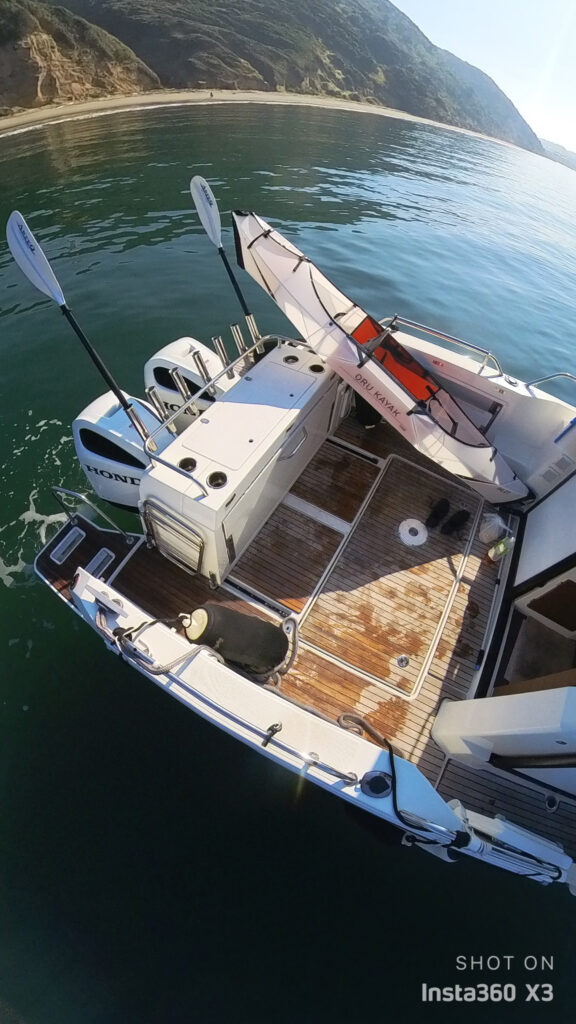
Photo 6. Carrying a kayak aboard my Merry Fisher 895 Sport
From Merry Fisher 895 Marlin to Sport, and then to Série 2
The original Merry Fisher 895 Sport that I own follows the lineage of a model that was previously sold as the Merry Fisher 895 Marlin.
Jeanneau renamed the Marlin range as Merry Fisher Sport in 2021.
The change reflected the way these boats had increasingly come to be used for a broader range of activities, including water sports and other outdoor pursuits, rather than being associated primarily with fishing.
That description fits my own use of the boat remarkably well.
I carry a kayak.
I go swimming.
I visit islands.
I cruise between marinas.
I wander around Tokyo Bay.
For the way I use it, the name Merry Fisher Sport suits the boat very well.
The Merry Fisher 895 Sport has since evolved into the Série 2, the current generation of the model.
I intend to keep having fun on the water for the rest of my life
The summer of 2023 was, up to that point, the most active summer of my life.
Owning a boat changed the sea for me.
It went from being something I looked at to something I could move through and actively use as a place to play.
Go somewhere simply because I want to go there.
Stop somewhere because it looks interesting.
Carry a kayak.
Jump into the sea.
Have a meal in a harbor.
Enjoy the scenery.
Then move on somewhere else.
I think that freedom may be the greatest thing I gained from buying this boat.
I intend to keep having fun on the water for the rest of my life.
Safety first, of course.
Update | Seakeeper Ride installed in July 2024
In July 2024, I installed Seakeeper Ride on my Merry Fisher 895 Sport.
It uses rapidly controlled surfaces mounted at the stern to actively manage the boat’s attitude while underway.
I have also written separately about the system and my impressions after actually using it.
Update | Outriggers installed around April 2026
Around April 2026, I installed outriggers on my Merry Fisher 895 Sport.
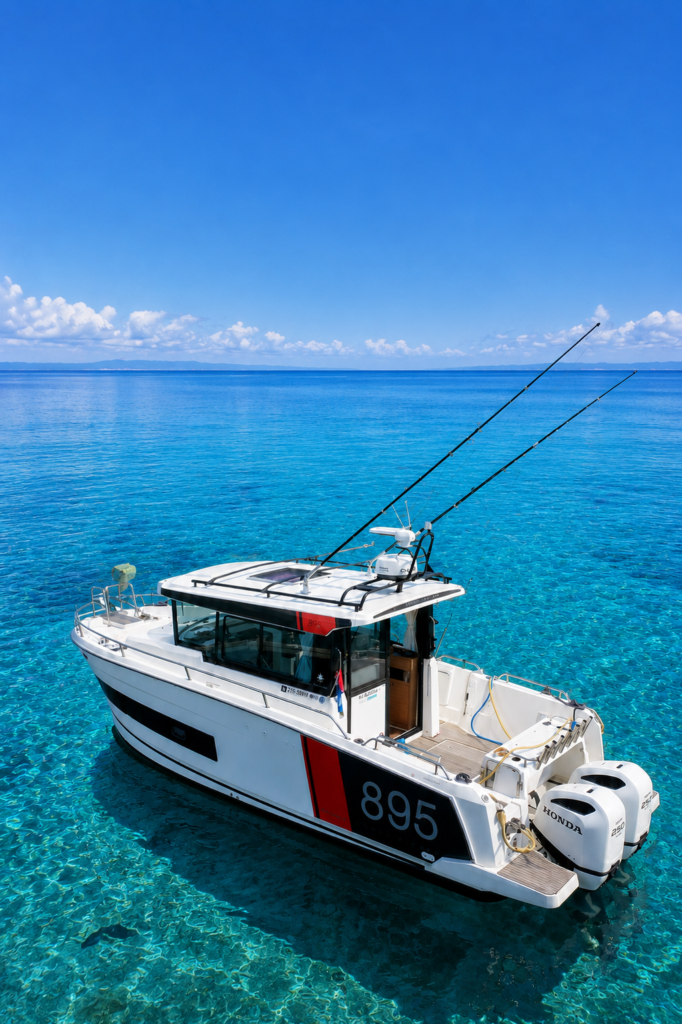
AI made photo
Outriggers are used in trolling to spread lures or baits farther out to either side of the boat.
Once they were installed, however, they produced another effect that had nothing to do with their function.
They made the boat look even more spectacular than before.
With the long outrigger poles rising diagonally outward from above the cabin, the overall silhouette of the boat changed considerably.
I had already liked the slightly rugged, purposeful appearance of the Merry Fisher 895 Sport, and I had always enjoyed the sight of the two large outboards sitting side by side at the stern.
Adding the outriggers made the boat look even more like a machine built to go out to sea and have fun.
I installed them as functional equipment, but they also increased the simple pleasure I get from looking at the boat.
A boat should be fun to use.
And I think it also matters that, every now and then, you can stand on the dock, look at it, and grin.
Explore Other Subjects
These automotive articles are one part of a broader collection covering boating, fishing, photography, technology, human behavior, history, and life decisions.
English Articles : A Topic-by-Topic Guide to This Site
Want to know more about the author and the thinking behind this site?
→ About Rikutsu-Kone-Taro
