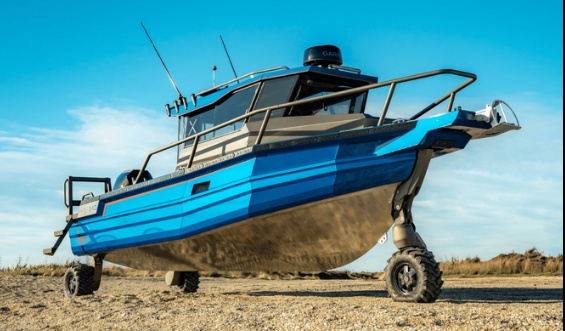
Introduction | A Boat With Wheels
There is a New Zealand boat manufacturer called StabiX.
When you first see one of its boats, the hull is probably not the first thing that catches your eye.
It is the wheels.
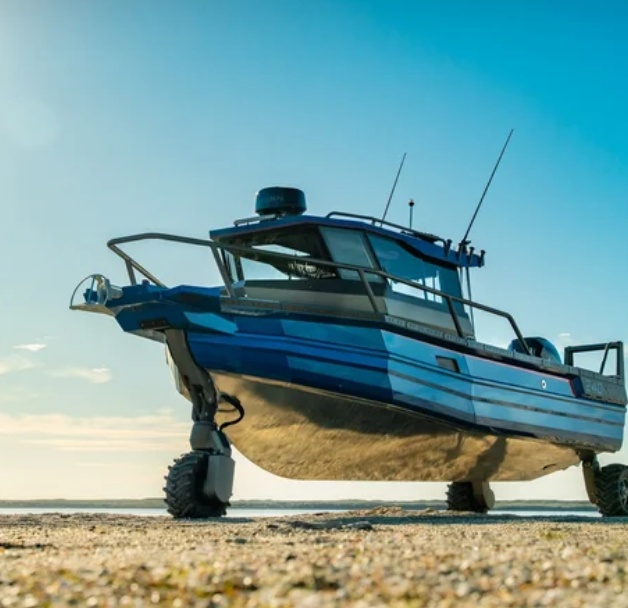
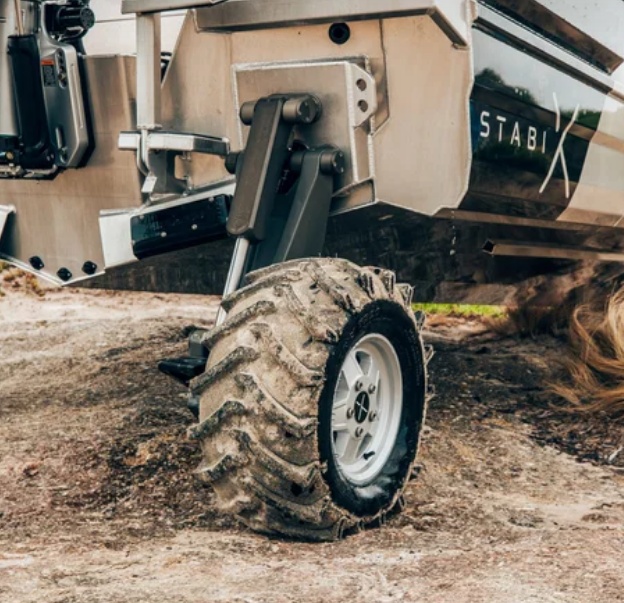
Large wheels extend from the hull, allowing the boat to drive across the beach and enter the water under its own power. Once it reaches sufficient depth, it runs on its outboard engines and retracts the wheels.
This is what is known as an amphibious boat.
The idea, however, is somewhat different from an amphibious vehicle intended to travel on public roads.
The main purpose of the wheels is to let the boat move under its own power between a storage area, an access track, the beach and the water, making launching and retrieval easier.
In other words, it is better understood as:
a technology that gives the boat itself some of the land-side functions previously required to launch and retrieve it, rather than a technology that turns a boat into a car.
As I looked further into StabiX, I began to realise that these “boats with wheels” are not simply an unusual invention made by one company in New Zealand.
Behind them is a small but distinct industrial ecosystem built around amphibious boats.
StabiX Does Not Make the Wheel Systems Itself
StabiX is an independent company led by Paul Adams, one of the co-founders of Stabicraft.
Adams stepped down as CEO of Stabicraft in 2020 and founded StabiX so that he could move away from a management-focused role and become more deeply involved in design and product development again. StabiX itself describes the company as independent from Stabicraft.
What makes the story more interesting is that StabiX does not develop the amphibious wheel systems entirely in-house.
StabiX also offers non-amphibious boats, but in its amphibious configurations customers can choose between Anura and Tectrax wheel systems.
Anura offers systems in which an internal-combustion engine powers hydraulics, as well as EOH — Electric Over Hydraulic — versions in which a 48-volt electric motor drives the hydraulic system. The amphibious Haines Hunter OP725 Overlander, for example, uses the Anura S25 EOH system.
Tectrax’s current Generation 2 system is fully electric and dispenses with the hydraulic circuit altogether.
In other words, there is a division of labour between:
companies that build the boat itself
and
companies that build the systems that make the boat amphibious.
By 2025, around 75 amphibious boat models were being offered by 17 boatbuilders in New Zealand, using several competing system families including Sealegs, Anura and Tectrax.
This is not a huge industry.
But it has become a small industrial ecosystem of its own, combining boatbuilders, system suppliers, sales and servicing.
So why did this ecosystem emerge in New Zealand?
It Started With Sealegs
To understand the story, we need to look at Sealegs before StabiX.
Sealegs began in 2001 with an idea sketched on a napkin, and entered production in 2004.
The problem it set out to solve was very simple:
putting a boat into the water — and getting it back out again — is a hassle.
Sealegs itself describes the original problem as the time and effort involved in launching and retrieving a boat from a beachfront property or boat ramp.
With a conventional trailer boat, you tow the boat to a ramp, reverse the trailer into the water, launch the boat, and then repeat the process in reverse when you return.
Sealegs moved part of that process onto the boat itself.
On land, the boat drives on its wheels and enters the water under its own power.
When it returns, the wheels come down again and the boat drives back onto land.
So the invention was not really about turning a boat into a road vehicle.
It was about:
integrating into the boat itself the functions of “getting into the water” and “getting back out” — functions that had traditionally existed outside the boat.
And the important point is that the invention did not remain an isolated novelty.
It entered production, and more people began using it.
As that happened, knowledge accumulated within society itself:
this thing called an amphibious boat exists, and this is how you use one.
Stabicraft Had Already Built a Sealegs Boat
There is an important fact here that connects the story directly to StabiX.
Stabicraft’s official history records that in 2014 it worked with Sealegs to create the 2100 Supercab ST.
So when Paul Adams founded StabiX in 2020, amphibious boat technology was not something he had suddenly encountered for the first time.
Years earlier, the aluminium boat company he had co-founded had already gained practical experience integrating Sealegs technology into an actual production boat.
This is where the story begins to shift from an invention to an industry.
Sealegs sells.
Boatbuilders begin working with it.
Designers learn how to integrate the structure.
Technicians gain experience repairing it.
Owners learn how to use it.
And eventually someone begins to think:
“This could be done better.”
One successful product gradually changes the surrounding environment, making the next experiment easier to attempt.
New Zealand Already Had a Culture of Launching Boats From Beaches
Of course, Sealegs did not suddenly appear in a vacuum.
The underlying conditions were already there.
In a Maritime New Zealand survey conducted in the first quarter of 2023, respondents were asked how they normally launched the recreational craft they used most often.
Among 490 respondents:
- 36% launched from a boat ramp
- 26% launched directly from a beach
- 9% launched from a vehicle or trailer without using a ramp
The survey covered different types of recreational craft, so these figures should not be read as percentages for powered boats alone.
Even so, they show something important.
Across New Zealand boating as a whole, the assumption that
“a boat must always be launched from a concrete ramp”
does not hold.
People launch boats from beaches.
Vehicles are used to launch boats directly from the shore.
These practices existed before Sealegs.
So when a boat with wheels appeared, it was more likely to be understood not as:
“Why is a boat driving across the beach?”
but as:
“This makes launching from the beach much easier.”
The cultural context needed to recognise the value of the technology was already there.
There Was Also an Existing Industry Capable of Building the Boats
For a country of its population, New Zealand has a remarkably substantial marine industry.
As of 2026, according to the New Zealand Marine Industry Association, the country has more than 1,200 marine businesses employing around 8,000 people across manufacturing, marine services, marinas, the commercial marine sector and related fields.
Domestic manufacturers are particularly strong in trailer boats.
NZ Marine’s 2018 annual report stated that, of roughly 2,000 trailer powerboats over six metres sold in New Zealand, more than 90% were designed and manufactured domestically.
That industry includes the skills needed to build aluminium boats in relatively small volumes and modify them for individual customers.
And welded aluminium construction has several practical advantages when integrating amphibious systems.
Mount the wheel legs.
Reinforce the surrounding structure.
Add brackets.
Modify the structure for a particular boat.
These kinds of one-off or low-volume structural changes are comparatively straightforward in welded aluminium construction.
That does not mean an amphibious boat has to be made of aluminium.
In 2016, Sealegs released its first all-fibreglass amphibious craft.
Today, the Haines Hunter OP725 Overlander is also based on a fibreglass hull and integrates an Anura S25 system. Parts of the hull and transom structure were changed from E-glass to carbon fibre to provide the required structural strength.
So the correct causal direction is not:
amphibious boats created New Zealand’s aluminium-boat industry.
It is closer to:
New Zealand already had a strong small-boat manufacturing base, including aluminium boatbuilding, and amphibious technology entered that existing environment.
Building Them Is Not Enough. Someone Has to Repair Them
Maintenance may be even more important.
For a new machine to become widespread, it is not enough for somebody to know how to build it.
Someone has to be willing and able to repair it when it breaks.
And simply having people who are technically capable of repairing something is not enough either.
To learn a new system, technicians have to read manuals, understand the architecture, establish contact with the manufacturer, and learn how to obtain parts.
If there is no expectation that similar jobs will continue to arrive in the future, the incentive to invest time in learning a new field is weak.
In New Zealand, the growing number of Sealegs boats helped create that expectation.
Boats are sold.
Servicing work appears.
It becomes worthwhile for technicians to learn the systems.
More places become capable of repairing them.
Customers become more confident about buying them.
More boats are sold.
StabiX now states that Anura and Tectrax wheel systems can be serviced by a qualified outboard marine technician.
Tectrax also provides on-site training when a boatbuilder installs its first system, with the goal of allowing the boatbuilder’s own technicians to handle subsequent installation and servicing independently.
What matters here is not merely technical capability.
It is the density of the work.
Technicians learn because similar jobs keep coming back.
Customers buy because technicians have learned.
An industry cannot be sustained by manufacturers alone.
Launching Boats From Beaches Was Already Recognised by the Regulatory System
New Zealand’s approach to coastal access is also interesting.
This does not mean that people are free to drive vehicles wherever they like on beaches.
Policy 20 of the New Zealand Coastal Policy Statement calls for vehicle use to be controlled where it damages the natural environment or creates hazards for other coastal users.
At the same time, it also requires authorities to:
identify places where vehicle access is required for boat launching and provide appropriate access.
It is neither unrestricted freedom nor a blanket prohibition.
The act of taking a vehicle onto a beach in order to launch a boat is itself something the regulatory system recognises.
The important point is not that there is little regulation.
It is that people can understand what is permitted, where the boundaries lie, and how their activity fits into an existing social framework.
Amphibious boats were able to enter that existing context.
Instead of Making the Coast Fit the Boat, Make the Boat Fit the Coast
At the same time, New Zealand does not allow coastal environments to be altered without restriction.
Under the Resource Management Act, reclamation within the coastal marine area, the placement of fixed structures on the coast or seabed, and disturbance of the seabed are among the activities subject to regulation.
There is no evidence showing that these rules directly caused Sealegs to be invented.
It would therefore be wrong to push the causal claim that far.
But the contrast is still interesting.
One solution is to:
alter the coast and build infrastructure that makes launching boats easier.
Another is to:
change the boat so that it can launch from the coast as it already exists.
Amphibious boats represent the second approach.
New Zealand’s pattern of coastal use may simply have been particularly compatible with that idea.
The Soil Was Already There. Sealegs Changed the Soil
North America has an enormous recreational boating market.
Australia also has a long coastline, a culture of beach launching, and a substantial aluminium trailer-boat industry.
So explanations such as:
“New Zealand has a long coastline”
or
“New Zealanders like boats”
are not enough to explain why this particular industrial ecosystem formed there.
If we place the facts in chronological order, a different picture emerges.
New Zealand already had people who launched boats from beaches.
It had craftspeople who built small boats.
It had expertise in aluminium fabrication.
It had technicians familiar with outboards, hydraulics and electrical systems.
Then Sealegs appeared.
And it became commercially viable.
Boatbuilders learned.
Technicians learned.
Owners learned.
Parts supply developed.
The category of the amphibious boat itself became familiar.
Existing manufacturers such as Stabicraft gained direct experience building such boats.
On top of that accumulated knowledge, alternative systems such as Anura and Tectrax were able to develop.
Today, StabiX can offer customers a choice of which amphibious system to integrate into the boat.
So New Zealand did not begin with a perfectly formed environment already optimised for the amphibious-boat industry.
The existing environment made Sealegs possible, and the success of Sealegs then changed that environment, increasing the probability that further successes would follow.
That may be one of the most important reasons why a distinct amphibious-boat ecosystem emerged in New Zealand.
Industries May Grow Like Intertwining Branches
Looking back at this process, an industry may be something like two trees whose branches begin separately, then touch, grow together and eventually become part of the same structure.
Someone wanted to launch a boat from a beach.
Someone knew how to build an aluminium boat.
Someone knew how to repair machinery.
Someone thought of putting wheels on a boat.
Someone else was willing to buy it.
And then somebody who saw the product began thinking of a better way to do it.
Each event has a reason.
But there is also an element of chance in the fact that these people, skills, needs and ideas happened to meet in the same place at the same time.
Industries can emerge in the space between chance and necessity, through the free experimentation of many different people.
In 1945, economist Friedrich Hayek argued that the knowledge needed by society is not concentrated in one place, but dispersed in fragments among many different people.
What happened in New Zealand can also be viewed in that light: people with different pieces of knowledge encountered one another and made each other’s work possible, even though no one had designed the overall system in advance.
If We Imported StabiX Into Japan, Would We Import the Same Value?
This raises another question.
If a few StabiX or Sealegs boats were imported into Japan, would they create the same value there?
I use Japan here because it is the case I know best, but the same question would apply anywhere an amphibious boat arrived without the ecosystem that had grown around it.
The boats themselves would not change.
The wheels would still work.
They could still move across land.
They could still drive directly into the sea.
But the boat itself is not the only thing that makes an amphibious boat useful in New Zealand.
There are places where it can be used.
People understand how it is used.
Technicians can service it.
Parts can be supplied.
Boatbuilders understand the systems.
And the people around it can recognise that what they are seeing is simply a boat being launched.
Importing a single boat into Japan would not automatically import everything that has developed around that boat over many years.
You can import the boat. You cannot simply import the industrial ecosystem that makes the boat an ordinary and useful tool.
The same product can acquire very different value depending on the society in which it is placed.
Conclusion | What Was More Interesting Than the Wheels
I began with a single boat with wheels.
But behind it I found Sealegs, the pioneer.
I found established boatbuilders that had learned from its success.
I found technicians who had learned how to service these systems.
I found new system manufacturers developing alternative approaches.
And today, companies such as StabiX can select from multiple amphibious systems and integrate one into a boat.
No single person designed this entire industry.
People experimented.
People encountered one another.
One technology met another.
One job created another.
The amphibious-boat industry that exists in New Zealand today emerged from that accumulation.
What fascinated me in the end, as I looked at the large wheels on a StabiX, was not really the wheels themselves.
It was the society that had made those wheels an ordinary and useful part of a boat.
