I was fortunate enough to buy two Toyota GR Yarises brand-new: a 2020 model with a six-speed manual transmission (the 2020 MT) and a 2024 model with the eight-speed GR Direct Automatic Transmission (the 2024 GR-DAT).
Enjoying Toyota’s renowned reliability and what I consider the best dynamic performance in its class, in both manual and automatic form, is an extraordinary luxury.
Yet this dream situation for a car enthusiast has created an entirely unexpected problem.
The Greatest Frustration of Owning Two GR Yarises
My biggest frustration is that I cannot take both cars to a beautiful location, park them side by side, and photograph them together.
Even the parking spaces I rent are some distance apart, so I cannot simply stand back and admire the two cars together.
For an ordinary fellow like Rikutsu Konetaro, the good fortune of buying both the 2020 MT and the 2024 GR-DAT brand-new is unlikely to come around again.
Had I lived in a different era or a different country, I might never have had the opportunity to own two such remarkable cars.
So, as the next-next-next-next-best thing, I console myself with a photograph taken when a complete stranger happened to park a white 2020 GR Yaris beside my 2024 GR-DAT.
The car on the left belongs to an owner I have never met. The one on the right is mine. The stranger’s car even happens to be the same color as my own 2020 MT.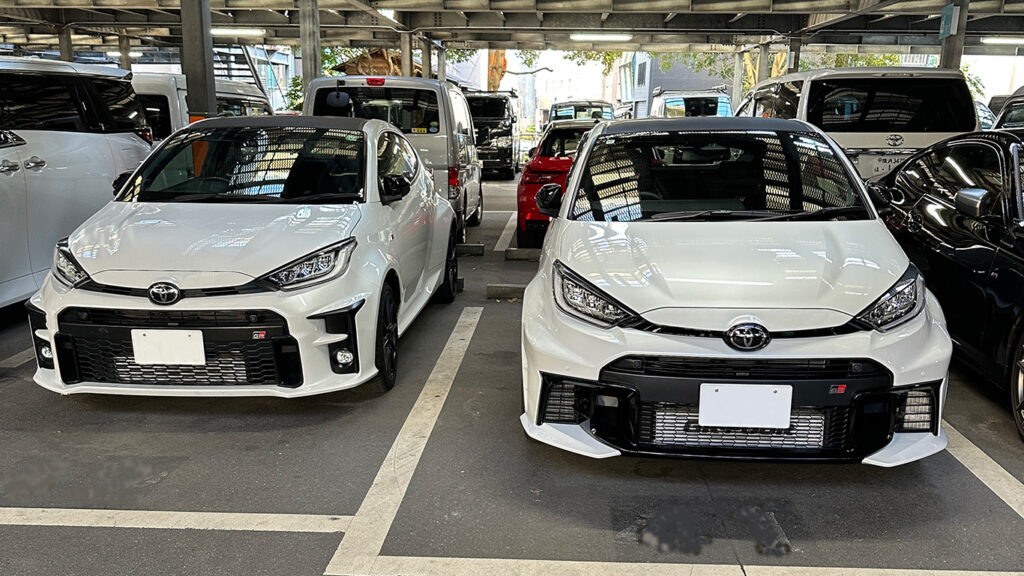
Three Conditions That Make This Luxury Possible
Whenever I look at the GR Yaris, which I regard as one of the world’s finest industrial products, I find myself thinking about how fortunate I am to own these two cars.
My financial circumstances are only part of what makes this possible.
First, there must be the technology and industry capable of producing a car like the GR Yaris.
Second, there must be a society in which people are free to choose, own, and drive such cars.
Third, I must have the money and time to own them, along with the physical ability and driving skills to enjoy them.
My present good fortune exists because all three conditions happen to coincide.
A rich life depends on more than what we own. It depends on having the conditions that allow us to enjoy what truly matters to us.
And those conditions change over time.
Technology and industry evolve. Societies and their institutions change. Our personal circumstances change as we grow older.
Each follows its own course and timetable.
The period during which all three conditions coincide may therefore be surprisingly short.
That is why, whenever I admire my GR Yarises, my thoughts often turn to the future of the Japanese society that made them possible.
Thinking About Japan’s Future While Admiring My GR Yarises
Since the end of World War II, which the Japanese government of the time called the Greater East Asia War, Japan has avoided another large-scale war on its own soil.
Despite the prolonged economic stagnation often described as the “Lost 30 Years,” Japan remains the world’s fourth-largest economy by projected nominal GDP in 2026.
It has maintained a peaceful and relatively safe society while continuing to produce outstanding industrial products, even as its citizens face substantial tax and social security burdens.
Those burdens can feel so heavy that one is tempted to complain about losing half one’s salary to taxes and social insurance contributions.
Japan’s national burden rate—the combined burden of taxes and social security contributions relative to national income—is projected to reach 45.7% in fiscal 2026.
Now in my sixties, I have become increasingly conscious of how society operates. I also find myself noticing the laziness, deception, hypocrisy, and self-serving arguments of people occupying positions of responsibility.
Sometimes, these observations leave me deeply pessimistic about Japan’s future.
One particular concern is the Japanese government’s continued support for renewable energy and battery electric vehicles (BEVs).
Renewable energy is supported in part through surcharges added to electricity bills, while BEV purchases are subsidized with public funds. Ultimately, these costs fall on the public.
The Japanese government aims for electrified vehicles to account for 100% of new passenger-car sales by 2035. Its definition includes hybrid electric vehicles (HEVs) and plug-in hybrids (PHEVs), but substantial purchase subsidies are also provided for BEVs.
My concern is that government support for particular technologies and products changes the conditions under which consumers make their choices.
Ordinarily, people choose cars by comparing price, performance, quality, practicality, and their own preferences.
Once subsidies are introduced, purchasing decisions are influenced by the amount of financial support the government has decided to provide, as well as by a product’s inherent competitiveness.
Japan is home to Toyota, one of the world’s leading automobile manufacturers.
Yet public money is being used to subsidize foreign-made BEVs that, in my judgment, fall short of Toyota vehicles in both performance and overall product quality.
To me, this looks like throwing money down the drain.
The government has policy objectives such as reducing greenhouse gas emissions and strengthening industrial competitiveness. But the means chosen to achieve those objectives should be evaluated according to their technological feasibility and cost-effectiveness.
I have serious doubts about using public funds to favor particular products without sufficiently rigorous examination of the scientific and economic reasoning behind such policies.
I also sense a certain arrogance in the way the government decides how tax revenue should be spent.
“Money can be put to better use if the government collects and spends it than if citizens decide for themselves how to spend it.”
At times, that seems to be the underlying assumption.
I find that attitude insulting to the public.
There is also a longer-term consequence worth considering.
Government subsidies influence which products consumers buy. Consumer demand, in turn, influences which technologies manufacturers invest in and which vehicles they develop and continue producing.
Over time, these decisions can change the range of cars available on the market.
The freedom to choose a car has practical value only when the kind of car one wants is actually available.
That is why policies affecting the direction of the automobile industry matter to me personally.
Battery Technology Will Determine the Future of BEVs
I have a high opinion of the driving characteristics of electric motors.
Their smoothness and excellent response at low and medium speeds offer a distinctive appeal that internal combustion engines cannot reproduce in quite the same way.
The technological challenge lies in how the electricity required to drive those motors is stored or generated inside the vehicle.
A BEV stores electricity in a battery. A hybrid or range-extender vehicle can also generate electricity onboard using an internal combustion engine or another power source.
To turn the attractive characteristics of an electric motor into a practical automobile, we must therefore consider how its energy is stored and supplied.
Current battery technology still has considerable room for improvement in energy density, weight, price, charging time, and durability.
Several years ago, there was considerable enthusiasm for the idea that revolutionary advances in battery technology would dramatically improve the practicality of BEVs.
I suspect that similarly optimistic expectations about future technological progress may have influenced policymaking during the administration of Japanese Prime Minister Yoshihide Suga, who served from 2020 to 2021.
I sometimes imagine a consultant whispering to senior government officials:
“By around 2023, there will be a revolutionary breakthrough in battery technology. Once commercialized, it will make BEVs just as convenient to use as cars powered by internal combustion engines.”
That is speculation on my part, but it illustrates the kind of technological optimism I suspect may have shaped policy expectations.
By 2025, however, the anticipated revolutionary battery technology had still not become widely available in mass-produced cars for ordinary consumers.
As of November 2026, research and development continue in areas such as all-solid-state batteries.
Toyota has stated that it aims to introduce all-solid-state batteries in a future vehicle model by the end of 2028. Establishing reliable mass-production technology and achieving widespread adoption remain major tasks.
There is an enormous difference between demonstrating a promising technology in a laboratory and turning it into an industrial product that can be manufactured in large quantities, at competitive prices, with consistent quality.
That transition requires additional time and investment.
At least over the next several years, I do not expect technologies currently approaching commercialization to make internal combustion vehicles comprehensively inferior to BEVs.
Internal combustion vehicles retain important advantages, including rapid refueling, convenience for long-distance travel, and the ability to use an extensive existing fuel infrastructure.
As technology advances, BEVs will become more competitive.
The important questions are when those improvements will reach ordinary consumers and at what price.
If expectations of future technological breakthroughs are to justify present-day tax expenditures and industrial policies, then technological feasibility and cost-effectiveness deserve especially rigorous examination.
The development of battery technology, government policy, and consumer preferences will all influence which kinds of cars manufacturers find it worthwhile to produce.
The cars we will be able to choose in the future depend partly on decisions being made today.
And that brings me back to the GR Yaris.
Both its existence and my freedom to enjoy it are products of Japan’s technology and society. Their continued availability depends on conditions that can change.
What Did Not Exist 15 Years Ago May Disappear 15 Years From Now
Before discovering the GR Yaris, I had almost no interest in Toyota cars.
I regarded Toyota as a manufacturer of reliable, well-engineered automobiles, but I had never encountered one that genuinely stirred my desire to drive.
Fifteen years ago, Toyota did not have the GR Yaris.
And fifteen years from now, will Toyota still be producing cars like it?
Automotive technology, social institutions, and consumer preferences will continue to evolve.
Meanwhile, my own circumstances will change as well.
Even if the GR Yaris had existed 15 years ago, I would have lacked both the financial resources to buy one and the time to fully enjoy driving it.
Fifteen years from now, my driving skills and physical abilities will probably have declined.
I might not even be alive.
A car’s production life, the course of a society, and the span of an individual’s ability to enjoy driving all follow different timelines.
For the moment, those timelines have converged.
Toyota produces a car that genuinely excites me. I live in a society where I can freely own and drive it. And I have the financial resources, time, and ability to enjoy it.
The overlap between these conditions is what makes my present circumstances so precious.
That Is Why the Time Is Now
Owning both a 2020 GR Yaris with a manual transmission and a 2024 GR Yaris with GR-DAT is an extraordinary privilege made possible by a rare convergence of circumstances.
I do not know how long it will last.
Society will change.
Technology will change.
And I will change.
That is why the time is now.
I intend to make the most of this almost miraculous convergence of circumstances—and enjoy it to the fullest.
Explore Other Subjects
These automotive articles are one part of a broader collection covering boating, fishing, photography, technology, human behavior, history, and life decisions.
English Articles : A Topic-by-Topic Guide to This Site
Want to know more about the author and the thinking behind this site?
→ About Rikutsu-Kone-Taro
