The character of a pleasure boat is strongly influenced by the shape of the hull where it meets the water.
Engine output, propulsion system, weight distribution, and payload all play important roles in how a boat runs.
Even so, traces of the designer’s priorities often appear clearly in the hull shape:
- how the boat is intended to enter waves,
- where the balance lies between ride comfort and stability,
- and whether efficiency or softer wave impact was given more emphasis in the planing range.
When I look at a pleasure boat, I like to use a simple way of looking at the hull:
I divide it into three places—the bow, midship, and stern—and compare the deadrise at each.
The hull changes continuously from bow to stern. Looking at these three places simply makes that continuous shape easier to observe.
Doing this often gives me some idea of what kind of running behavior the boat was designed for.
And I think that act of imagining is itself one of the pleasures of looking at boats.
This article is an attempt to set out that way of looking.
I have conventional small- to medium-size monohull V-bottom planing boats in mind here.
Actual running performance is also affected by factors such as:
- fuel load,
- passengers and the location of heavy equipment,
- length-to-beam ratio,
- strakes,
- chine shape,
- flare,
- running trim,
- and sea conditions.
Here, the aim is simply to offer one way of looking at a hull and imagining the character of the boat.
What Is Deadrise?
Deadrise is:
the angle, seen in a transverse cross-section of the hull, between the bottom surface running from the keel toward the chine and a horizontal reference plane.
Figure 1 makes the idea easier to see.
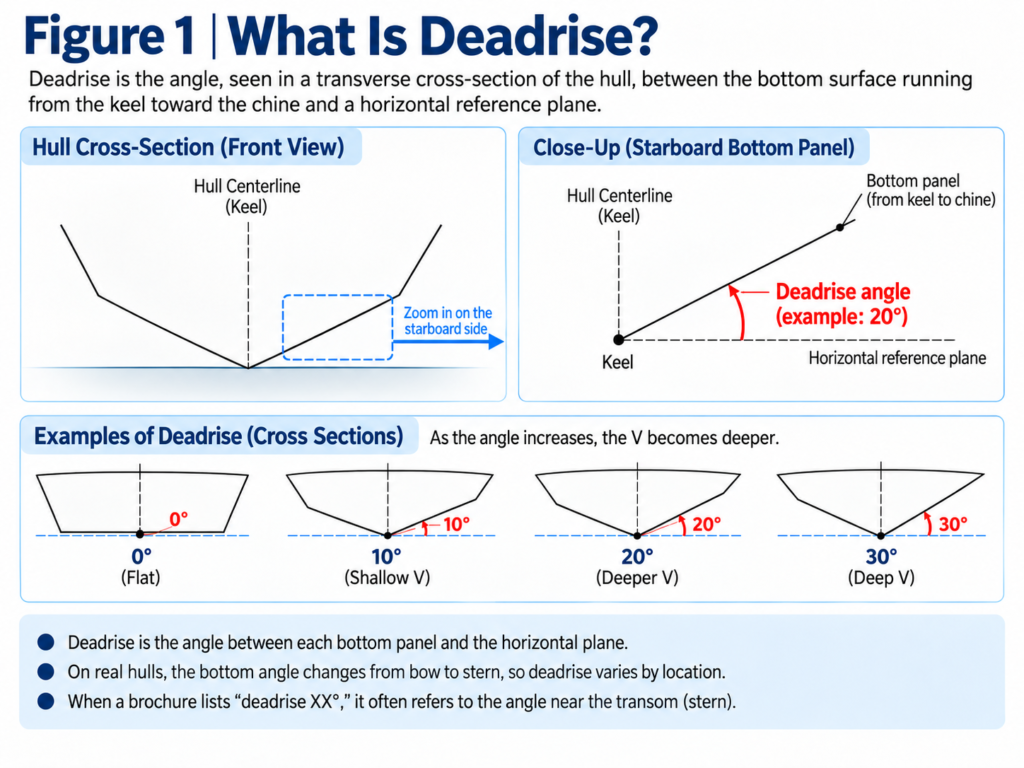
Figure 1 | Deadrise is the angle between the bottom surface from keel to chine and the horizontal reference plane, viewed in cross-section.
The closer the bottom surface is to horizontal, the smaller the deadrise angle.
The more steeply the bottom rises from the keel toward the chine, the larger the angle becomes.
In the examples in Figure 1:
- 0° is flat,
- 10° is a shallow V,
- 20° is a deeper V,
- 30° is deeper still.
In broad terms:
- larger deadrise
→ tends to give a softer entry into the water - smaller deadrise
→ tends to provide more hull volume, greater static stability, and more dynamic lift
On a real boat, deadrise changes along the length of the hull.
That is where things become interesting.
Looking at Deadrise in Three Places
I look at the continuously changing hull in three places:
- bow,
- midship,
- stern.
Figure 2 shows this way of looking at the boat.
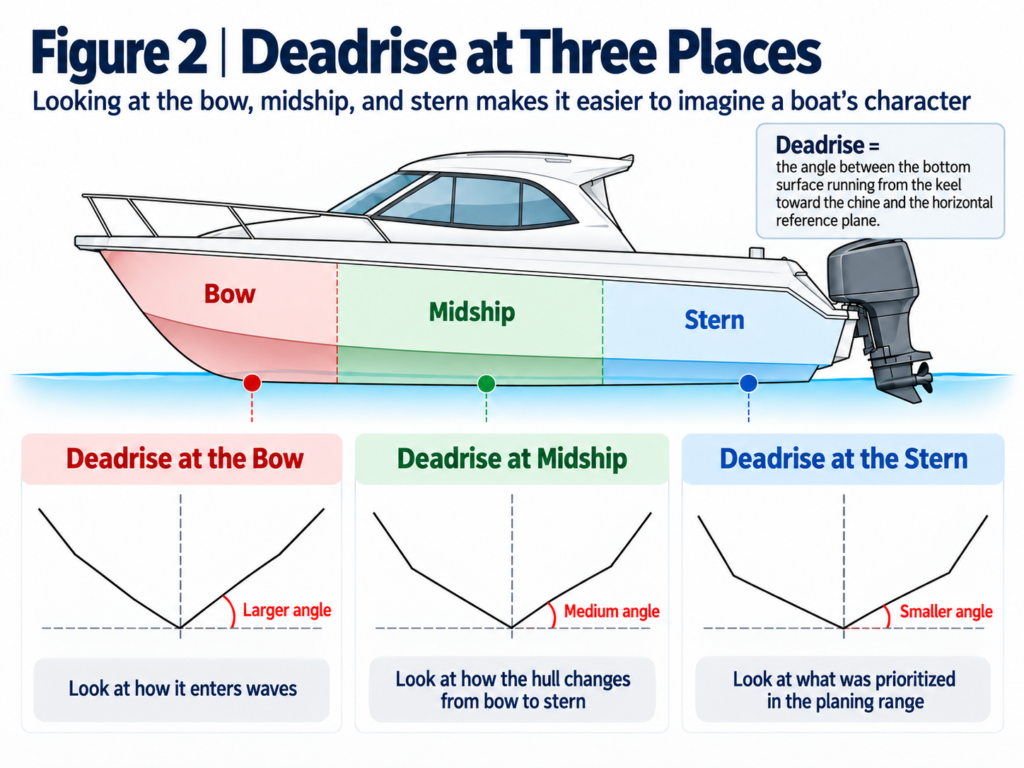
Figure 2 | Looking at deadrise at the bow, midship, and stern gives a simple way to read the changing shape of the hull.
Seen this way, you can start noticing things such as:
“The bow is quite sharp.”
“The V is still fairly deep at midship.”
“The stern becomes surprisingly shallow.”
A hull is a continuous three-dimensional surface from bow to stern.
Using three places as visual reference points makes that gradual change easier to see.
And once you see those differences, it becomes easier to imagine the character of the boat.
1 | Deadrise at the Bow
How does the boat enter the water?
The first place I look is the bow.
The forward part of the hull is where the boat enters waves as it moves ahead.
Its shape therefore relates to things such as:
- wave entry,
- impact,
- ride comfort,
- and spray behavior.
With a deeper V forward, the hull tends to enter the water more progressively.
This can help produce:
- less abrupt vertical impact,
- and a softer feeling as the bow meets the water.
There is also a tradeoff.
For the same overall beam and height, a deeper V tends to reduce the volume available low in the forward part of the hull.
That affects things such as:
- forward hull volume,
- load-carrying space,
- and cabin layout.
Flare can recover additional volume higher up.
So when I see a particularly sharp bow, I might think:
Perhaps this boat gives more priority to entering waves cleanly than to maximizing forward volume.
Wave impact and spray also depend on stem shape, flare, chines, and spray rails.
Even so, looking at the forward V gives a useful first clue to what the designer may have been trying to achieve.
2 | Deadrise at Midship
How does the hull connect the bow to the stern?
The next place I look is midship.
I find it useful to think of this area as:
the transition between the bow and the stern.
Even when a boat has a deep V forward, different hulls carry that depth aft to different degrees.
If the V becomes shallower relatively early, the hull can more readily gain:
- internal volume,
- waterline beam,
- static stability,
- and dynamic lift.
If a relatively deep V continues through the midship area, I tend to read that as:
the designer carrying that deeper-V character farther aft.
Some boats retain substantial deadrise from midship all the way toward the stern.
So when I look at the middle of the hull, I am really looking at:
where the sharp forward shape begins to relax,
and:
how far aft the deeper V is carried.
That transition reflects a balance among:
- wave impact,
- hull volume,
- stability,
- dynamic lift,
- and the kind of running the boat is intended to do.
At midship, the interesting question is less about one isolated cross-section and more about:
how the hull changes as it moves from bow to stern.
3 | Deadrise at the Stern
What was prioritized in the planing range?
The last place I look is the stern.
On a planing boat, deadrise near the transom can tell you a great deal about the boat’s character.
It helps first to distinguish between buoyancy and dynamic lift.
Buoyancy is:
the force that supports the boat by displacing water.
Dynamic lift is:
the supporting force generated by the relative motion between the hull and the water.
As speed rises, dynamic lift contributes more and more to supporting the boat.
A relatively shallow V aft tends to make it easier to:
- generate dynamic lift,
- climb onto plane,
- and run efficiently.
A hull that carries a deeper V all the way aft tends to favor:
- a softer meeting with the next wave,
- and reduced impact when running fast in rougher water.
This leads to an interesting point: there are different meanings of “high-speed performance.”
A boat designed to run efficiently and quickly on relatively smooth water may use a shallower aft section.
A boat intended to maintain speed across rougher water may retain substantial deadrise through midship and into the stern.
So even among fast boats,
the hull shape depends on what kind of water the boat is expected to run fast in.
Looking at the stern therefore makes me wonder:
How far did the designer lean toward efficiency, and how far toward softer wave impact?
Aft hull shape also affects directional behavior and turning characteristics.
As a first way of looking at a boat, simply asking:
How is the hull intended to support the boat while planing, and how is it intended to meet the water?
already makes the stern much more interesting to examine.
As Speed Changes, Where You Look Changes Too
So far, I have looked at the hull in three places:
- bow,
- midship,
- stern.
Now there is one more idea to add.
A pleasure boat changes its running attitude significantly with speed.
At low speed, a large portion of the hull remains in the water as the boat moves in displacement mode.
As speed increases, the bow rises and the wetted area shifts aft.
Once the boat is on plane, the hull rises substantially, the attitude becomes closer to level again, and mainly the aft portion remains in contact with the water.
Figure 3 illustrates this change.
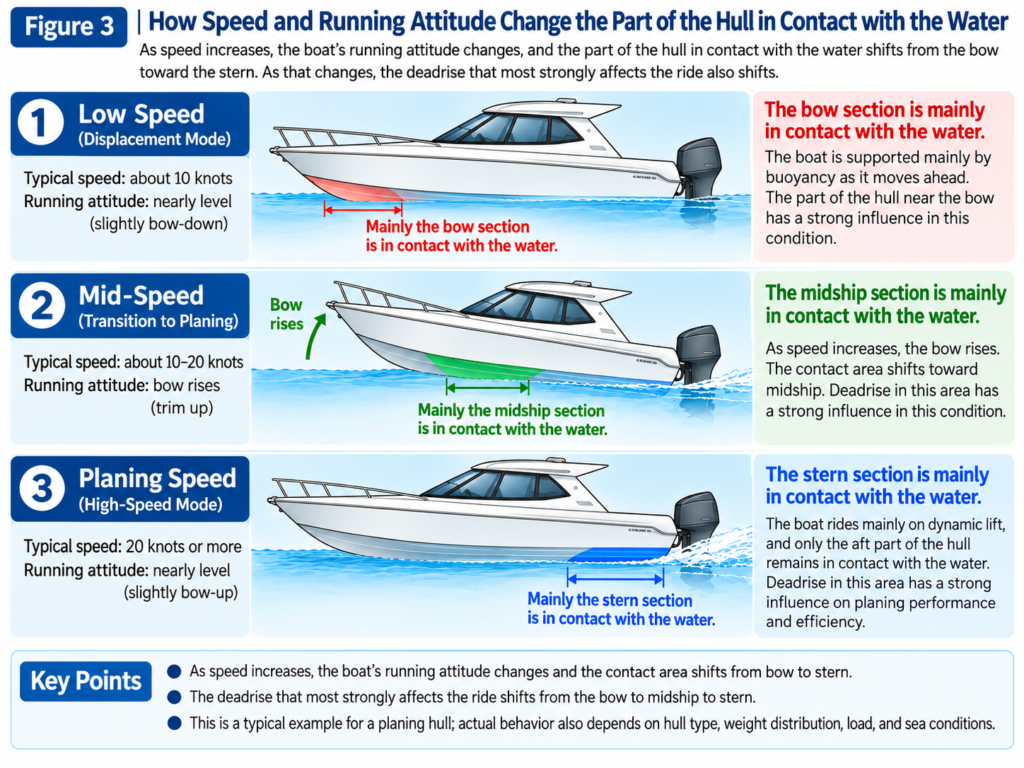
Figure 3 | As speed and running attitude change, the main part of the hull in contact with the water also changes.
Figure 3 shows the general progression:
- Low speed
→ a broad portion of the hull remains in contact with the water - Mid-speed / acceleration
→ the bow rises and the wetted area shifts aft - Planing
→ the hull rises and mainly the aft portion remains in contact with the water
So even on the same boat, the section of the hull that most strongly influences the running condition changes with speed.
That makes the three-location view more interesting.
You can look at the bow, midship, and stern—and then imagine which part of the hull is interacting most strongly with the water at a given speed.
Running Attitude Also Changes with Weight Distribution
Speed is one factor in running attitude.
Weight distribution is another.
The longitudinal center of gravity changes with the location of things such as:
- engines,
- fuel,
- fresh water,
- batteries,
- passengers,
- and other loads.
On an outboard boat, for example, a major mass—the engine—is located at the stern.
With a conventional straight-shaft inboard installation, the engine can often be positioned farther toward the center of the hull.
Propeller trim, trim tabs, and sea conditions also influence the actual running attitude.
So when I look at a boat, I sometimes ask:
What attitude will this boat actually take when it is running?
Once you start thinking that way, hull shape, weight distribution, and propulsion layout begin to connect.
Perhaps What I Am Really Looking At Is the Relationship Between Hull and Water
At this point, the thing I am trying to observe becomes a little clearer.
It is:
the relationship between the hull and the water.
The hull itself has one fixed shape.
But the way that shape is used changes with:
- speed,
- wetted position,
- wetted area,
- running trim,
- and weight distribution.
The same boat presents a different part of its hull to the water when:
- running slowly,
- transitioning onto plane,
- running at high speed,
- or meeting head seas.
So I keep three visual reference points in mind:
bow, midship, and stern.
Then I imagine the boat actually running.
That makes the hull much more interesting to look at.
Final Thoughts
A pleasure-boat designer has to balance many competing goals:
- soft wave entry,
- reduced impact,
- high speed,
- easy planing with modest power,
- payload,
- cabin space,
- static stability,
- and fuel efficiency.
Looking at the hull makes it possible to ask:
What did this boat’s designer choose to prioritize?
Look at the bow and think:
“That is quite sharp.”
Look at midship and think:
“The V is still fairly deep here.”
Look at the stern and think:
“It becomes surprisingly shallow here.”
Then imagine the running attitude:
“At this speed, which part of the bottom is carrying most of the load?”
Look at where the engine sits:
“With this weight distribution, what attitude might the boat take while running?”
And then ask:
Was this boat meant to run this way, in this kind of water?
That act of imagining changes the way the hull looks.
A surface that once seemed like nothing more than smooth fiberglass begins to reveal a series of design choices.
The boat starts to look like:
something created through a series of decisions among competing requirements.
The next time you walk through a marina or a used-boat yard, take a look under the hull as well as inside the cabin.
Start with Figure 1 and remember what deadrise means.
Then use Figure 2 and look at the bow, midship, and stern.
Finally, use Figure 3 and imagine how the boat’s attitude and wetted area change with speed.
That alone can make a familiar hull reveal much more than it did before.
And to me,
looking at a hull this way is one of the pleasures of owning a pleasure boat.
Want to know more about the author and the thinking behind this site?
→ About Rikutsu-Kone-Taro
