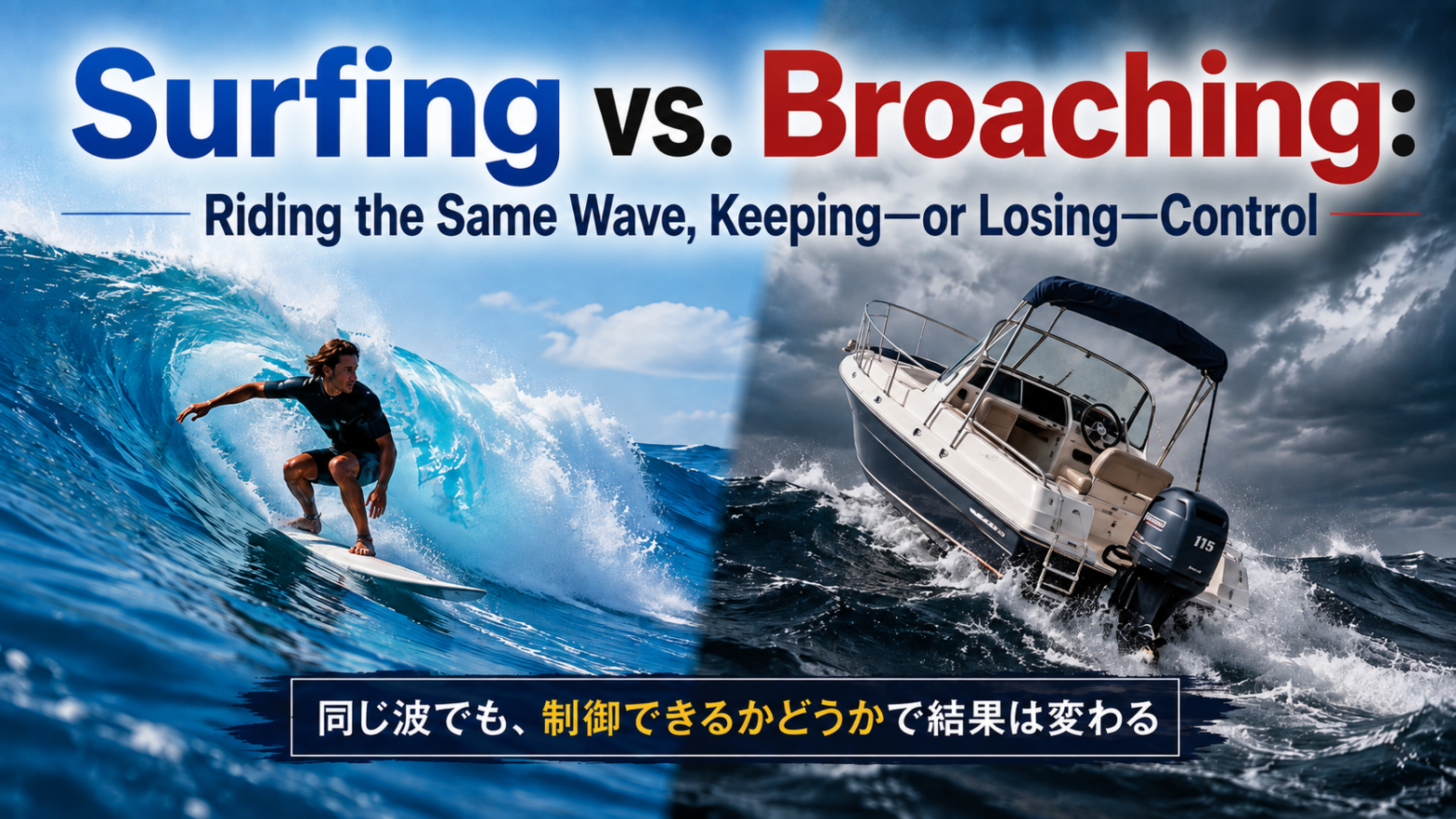
For recreational boaters and sailors, broaching is something to fear.
Surfers, by contrast, actively seek out waves and use their power for fun.
The same force of the sea that can frighten a skipper is exactly what a surfer wants.
Rikutsu Konetaro was once a pretty lousy surfer. Later, after becoming a serious recreational boater, he began to think that surfing and broaching were remarkably similar phenomena.
Yet they are normally discussed in completely different worlds.
Surfing has its own techniques, research, terminology, and accumulated experience. Broaching belongs mainly to naval architecture and seamanship, where it is studied as a dangerous loss of directional control.
Because each field is largely self-contained, the two are rarely placed on the same conceptual map.
But put them there—using the wave, wavelength, wave height, the board or boat, acceleration on the wave face, and control of attitude and direction as common coordinates—and a surprising amount of shared structure appears.
That comparison is especially useful from the boater’s side.
A surfer has little practical need to understand ship broaching. A skipper, however, can use surfing as a familiar model for breaking broaching down into its component parts.
Instead of treating broaching as a vaguely terrifying event that suddenly happens in following seas, we can ask:
What conditions are developing, what is the boat doing on the wave, and how much control margin remains?
That is the purpose of this article.
The discussion focuses on recreational boats in following or quartering seas that enter surf-riding and then progress toward broaching-to. Broaching can arise in other circumstances as well, including under strong aerodynamic forces on sailing vessels, but the surf-riding-to-broaching sequence is the most useful case for comparison with surfing.
Broaching can lead to severe heel and capsize. The numerical ranges discussed below are therefore indicators for understanding risk, not operational safety limits. Actual behavior depends on sea state, hull form, displacement, speed, loading condition, propulsion and steering arrangements, and many other factors.
1. What Is Broaching-To?
In the context of this article, broaching-to is a severe yawing motion in following or quartering seas in which the vessel turns away from its intended heading and can no longer maintain the desired course even with major corrective steering.
The violent yaw may be accompanied by heavy heel and, in extreme cases, capsize.
The essential problem is:
the yawing disturbance has exceeded the vessel’s ability to maintain course.
IMO guidance treats surf-riding and broaching-to as related hazards in following and quartering seas, and recommends changing speed, course, or both to remain outside the dangerous region.
The important word for this comparison is surf-riding.
2. Boats Surf Too
When a vessel moves onto the forward face of a sufficiently large following or quartering wave, the wave can accelerate it.
As the boat approaches the speed of the wave, it may remain on the face of that wave and travel with it.
In naval architecture, this is called surf-riding.
Now compare that with surfing.
A surfer rides on the face of a wave.
A boat in surf-riding also rides on the face of a wave.
Both accelerate while moving on a travelling wave face.
That is the first important link between the two.
The wave face is a moving slope
It is intuitive to say that a surfer or boat is being “pushed from behind by the wave.”
That is useful as a first approximation, but there is more going on.
A surfer catching a wave is positioned on the sloping face between crest and trough. Gravity acts downward, while buoyancy and hydrodynamic forces act through the board and surrounding water. Descending the wave face allows the surfer to gain speed; climbing it exchanges some of that kinetic energy back into potential energy.
A boat on a following wave experiences a different combination of forces, but the structural idea is similar. Wave-induced longitudinal forces, gravity, buoyancy, propulsion and resistance combine to alter the vessel’s speed. Under suitable conditions the boat accelerates toward wave speed and enters surf-riding.
So both systems share a basic sequence:
enter the wave face
→ accelerate on that moving surface
→ remain there long enough for wave-riding behavior to develop
Wavelength, craft length and wave steepness
Geometry matters as well.
In ordinary ocean surfing, the wavelength is much greater than the length of the surfboard. The board can therefore occupy a relatively small, continuous portion of one wave face.
Imagine an extreme case: a 2-meter board on a wave with a wavelength of only 1 meter. The board could span a crest and a trough at the same time. Riding one continuous travelling face in the ordinary surfing sense would be very difficult.
A boat in a broaching-prone regime is different in scale. Its length may be of the same order as the wavelength itself.
Under the IMO Second Generation Intact Stability Criteria, the detailed surf-riding/broaching assessment considers wavelength-to-ship-length ratios from 1.0 to 3.0, together with wave steepness.
Classic experiments on a small high-speed boat found broaching-to most readily under conditions around:
- wavelength / boat length: 2.0
- encounter angle: about 20°–30°
- the boat’s velocity component in the wave direction: approximately equal to wave propagation speed.
The numerical relationship is therefore very different for a surfboard and a boat.
A surfboard is tiny relative to the wavelength it rides. A vessel in a broaching-prone condition can be comparable in length to the wave itself. As a result, the distribution of wave-induced forces along a ship’s hull becomes much more significant.
But the shared structural question remains:
How is the whole craft positioned on the wave, and what forces does that position create?
Wave height matters too. Together with wavelength, it determines wave steepness and therefore the shape and severity of the wave face.
The IMO criteria explicitly treat both wavelength-to-ship-length ratio and wave steepness as variables in surf-riding/broaching vulnerability.
3. How a Surfer Stays in Control
Once on the wave face, a surfer continually modifies the motion of the board.
Weight shifts forward, aft and laterally.
The board changes pitch and roll.
The rail engages differently with the water.
The effective relationship between the board’s rocker and the wave face changes.
The fins meet the flow at different angles and generate different hydrodynamic forces.
Measurements made during real surfing maneuvers have confirmed pressure differences across surfboard fins that generate lift, with weight transfer and rail engagement playing an important role in turns and stability.
The important point is that a surfer is not simply steering with a pair of small fins.
The surfer uses body movement to change the attitude of the entire board and, through that change, makes use of the rail, bottom, rocker and fins together.
And the corrections can be rapid.
The surfer drops down the face.
Turns.
Climbs the wave.
Changes direction.
Drops again.
In other words, the surfer continually changes both direction and position on the wave face while remaining in the wave-riding state.
4. How a Boat Stays in Control—and How That Control Can Fail
A boat also has to maintain direction while travelling on a wave face, but its means of control are very different.
The vessel relies primarily on steering, propulsion and the inherent directional characteristics of the hull.
Turn the rudder or steering system.
A lateral hydrodynamic force develops.
That force produces a yawing moment.
The hull, with its mass and rotational inertia, changes heading.
At the same time, however, the wave is acting on the vessel.
Classic experimental and simulation work on broaching found that, on the down-slope of a following wave and at speeds close to wave speed, the wave-excited yaw moment can become very large compared with the hydrodynamic course-keeping moment generated by the rudder.
That gives us a simple way to frame the problem.
On one side:
the wave-induced tendency to rotate the vessel
On the other:
the vessel’s available ability to maintain or recover its intended heading
The boat has rudder or steering authority, propulsion and inherent directional stability.
The wave side includes wavelength, wave height, steepness, direction, speed and the vessel’s position on the wave face.
As long as the vessel has enough corrective authority, surf-riding does not necessarily mean that directional control has already been lost.
But once the wave-induced yawing effect exceeds what the vessel can counter:
wave-induced yawing effect > available corrective ability
the intended course can no longer be maintained.
That is the critical transition toward broaching-to.
On some craft, the available control may also deteriorate during this process. High-speed-craft guidance notes poor steering response and ventilation of propellers or waterjets among warning signs associated with surfing and broaching. These are additional ways in which the remaining control margin can shrink; they are not the single universal cause of broaching.
5. Put Both Phenomena on the Same Map
Now place surfing and boat surf-riding on the same structural map.
Surfing
wave approaches
→ board enters the wave face
→ board accelerates
→ surfer changes board attitude and hydrodynamic forces
→ position and direction are continually corrected
→ wave riding continues
Boat
following or quartering sea acts on the vessel
→ boat enters the wave face
→ boat accelerates
→ surf-riding develops
→ wave-induced yawing forces act on the vessel
→ steering, propulsion and directional stability work to maintain course
Up to that point, the structures are surprisingly similar.
Then the paths divide.
For the surfer:
control is maintained
→ the wave remains usable
For the boat:
wave-induced yawing effect exceeds corrective ability
→ directional control breaks down
→ broaching-to
This is the central point of the comparison.
Surfing and broaching are not two identical phenomena, but neither are they unrelated events that merely happen to involve waves.
They share a remarkably similar underlying problem:
ride a moving wave face, accelerate on it, and control the resulting motion.
The decisive difference is whether sufficient control can be maintained.
6. What Should a Skipper Watch for?
This is where the comparison becomes useful to a recreational boater.
The skipper should watch the relationship between the wave-side conditions and the boat-side capabilities.
On the wave side:
- wavelength
- wave height
- wave steepness
- wave direction
- wave speed
On the boat side:
- vessel length
- hull form
- boat speed
- directional stability
- steering authority
- propulsion characteristics
Risk develops through the interaction between the two.
As a broad warning range, wavelengths on the order of 1 to 3 vessel lengths deserve attention in the context of surf-riding and broaching, particularly when combined with sufficiently steep following or quartering seas and boat speed approaching wave speed. The IMO Level 2 vulnerability procedure evaluates this 1.0–3.0 wavelength-to-length range; this is a vulnerability-analysis range, not a recreational-boating go/no-go rule.
For high-speed craft specifically, IMO-derived operating guidance lists practical warning signs that include:
- large variations in craft speed at nearly constant throttle
- craft speed close to wave speed
- wavelength in a potentially unfavorable range relative to waterline length
- slight bow-down attitude
- a crest remaining aft of amidships
- poor response to steering controls
- severe yawing to either side of the intended course
- ventilation of an up-sea propeller or waterjet
- surfing itself.
These signs are most useful when read as a developing pattern.
Imagine this sequence.
The boat is running in following or quartering seas.
The wavelength looks significant relative to the boat.
Without much change in throttle, the boat suddenly accelerates.
Its speed approaches that of the wave.
It remains on one wave face longer than before.
The bow attitude changes.
Steering response feels less authoritative.
Yaw excursions begin to grow.
Seen separately, each sensation may seem like just another feature of running in rough water.
Seen together, they describe a structure:
the boat is being captured into surf-riding while its directional control margin is shrinking.
That is a much more useful way to fear broaching than simply thinking, “Following seas are dangerous.”
IMO guidance likewise recommends changing speed, course, or both to move outside conditions associated with surf-riding and possible broaching.
To anticipate broaching, then, the skipper should be watching:
the relationship between the wave and the boat—and how much control authority remains.
7. Conclusion: Fear Broaching for the Right Reasons
Surfers know surfing.
Boaters know broaching.
Because the two belong to different fields, they are rarely examined as parts of the same structural problem.
Put them on the same map, however, and the common elements become clear:
wavelength relative to the craft,
wave height and steepness,
position on the wave face,
acceleration,
hydrodynamic forces,
and control of attitude and direction.
A surfer stays within that structure while continually modifying the board’s motion.
A boat in surf-riding occupies a surprisingly similar structure.
The crucial divergence comes when the forces acting on the vessel exceed its available directional-control capability.
That is where surf-riding can progress into broaching-to.
For a recreational skipper, the goal is not to stop fearing broaching.
It is to fear it properly.
Look at the wavelength.
Look at the wave height and steepness.
Look at the wave direction.
Compare wave speed with boat speed.
Notice where the boat is sitting on the wave face.
Pay attention to changes in steering response and yaw.
And keep asking how much control margin remains.
Surfing provides a useful comparison because it makes the structure visible.
One rider stays in control of motion on the wave face.
The other can reach a point where the wave overwhelms the available means of correction.
As Rikutsu Konetaro would put it:
Know the wave, know your boat, and a thousand voyages need not end in disaster.
Understand the structure linking the sea and the vessel.
Then respect the sea for the right reasons.
That is the value of placing surfing and broaching—two phenomena usually discussed in completely different worlds—side by side.
References
- International Maritime Organization. Revised Guidance to the Master for Avoiding Dangerous Situations in Adverse Weather and Sea Conditions, MSC.1/Circ.1228.
- International Maritime Organization. Interim Guidelines on the Second Generation Intact Stability Criteria, MSC.1/Circ.1627, especially the surf-riding/broaching vulnerability criteria.
- Motora, S., Fujino, M., Koyanagi, M., Ishida, S., et al. “A Consideration on the Mechanism of Occurrence of Broaching-to Phenomenon.” Journal of the Society of Naval Architects of Japan, Vol. 150, 1981, pp. 211–222. DOI: 10.2534/jjasnaoe1968.1981.150_211.
- Fuwa, T., Yoshino, T., Yamamoto, T., and Sugai, K. “An Experimental Study on Broaching-to of a Small High Speed Boat.” Journal of the Society of Naval Architects of Japan, Vol. 150, 1981, pp. 223–231. DOI: 10.2534/jjasnaoe1968.1981.150_223.
- International Maritime Organization. Guidelines for Uniform Operating Limitations of High-Speed Craft, MSC.1/Circ.1329, Appendix 2: Guidance for Operation of High-Speed Craft in Following and Stern-Quartering Seas.
- Kniesburges, S., Punger, N., Tur, B., et al. “Measurements of the Hydrodynamic Pressure on a Surfboard Fin During Surfing.” Scientific Reports, 2025. DOI: 10.1038/s41598-025-94834-0.
Explore Other Subjects
These automotive articles are one part of a broader collection covering boating, fishing, photography, technology, human behavior, history, and life decisions.
English Articles : A Topic-by-Topic Guide to This Site
Want to know more about the author and the thinking behind this site?
→ About Rikutsu-Kone-Taro
