In the previous article, I focused on the first half of the corner, from the end of the straight to the clipping point: GR Yaris Understeer in the Second Half of a Corner ★ One Cause Was Insufficient Braking at the End of the Straight.
The main idea was to complete most of the necessary deceleration while the car is still travelling straight, then progressively reduce brake pressure while increasing steering angle during turn-in, allowing all four tires to contribute to the corner as the car approaches the clipping point.
This article continues from there.
Here, I will focus on the section from around the clipping point to corner exit, where the next straight begins.
The discussion is based on my own circuit-driving experience in a 2020 GR Yaris RZ High Performance 6MT and a 2024 GR Yaris RZ High Performance 8AT, together with instruction I received from professional drivers.
The basic conclusion is simple:
In the second half of the corner, progressively unwind the steering while increasing throttle only as much as possible without producing understeer.
In the GR Yaris, the front tires also receive drive torque.
If too much throttle is applied while a large steering angle remains, the front tires must use their available friction for both cornering and driving force. At the same time, acceleration transfers load rearward and reduces front-axle load.
Eventually, the front tires may no longer be able to hold the intended line.
That is when understeer appears.
The Clipping Point as the Point of Minimum Speed and Maximum Steering Angle
For this discussion, imagine a medium- to high-speed 180-degree corner connecting a long entry straight to a long exit straight, as shown in the figure below.
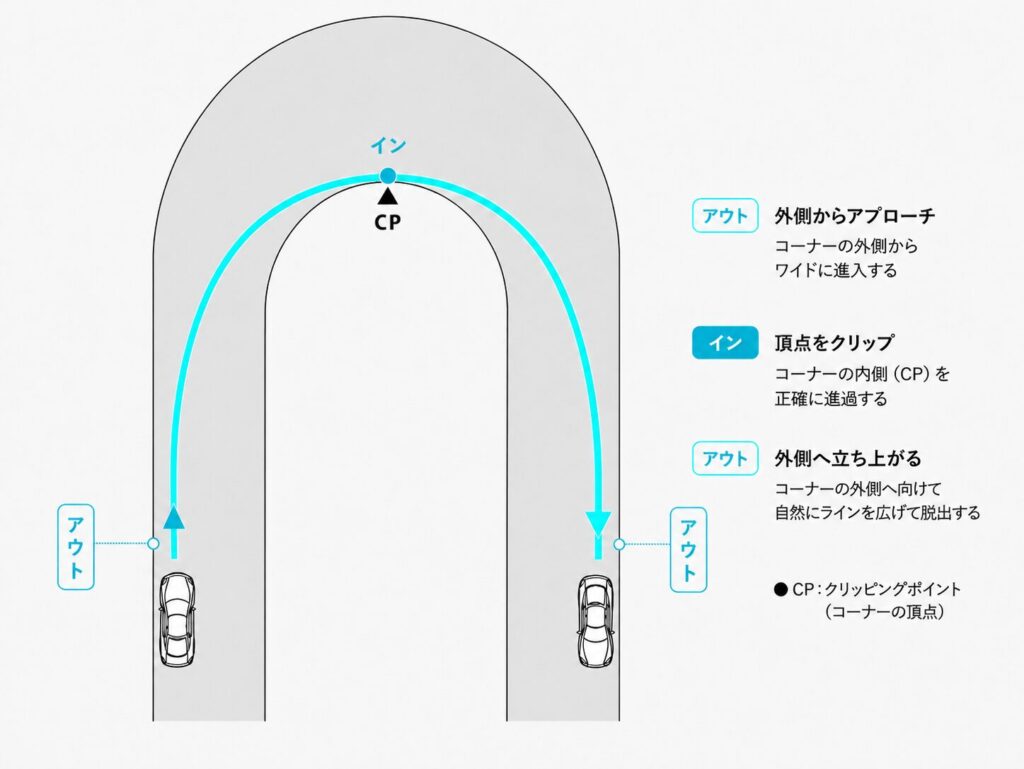
The road itself has a constant-radius centerline, but the curvature of an out-in-out driving line is not constant.
I discuss why out-in-out appears naturally as a result of cornering technique in another article: The Outside–Inside–Outside Line Is a Result★Cornering Basics Through Trail Braking and Steering Angle
In the corner considered here, the driver performs strong, short braking at the end of the straight.
After turn-in begins, brake pressure is progressively reduced while steering angle increases.
During heavy braking, much of the tire’s available friction is being used longitudinally for deceleration.
As brake pressure is reduced, some of that friction capacity becomes available for lateral force.
Steering angle can then be increased in proportion to that newly available cornering capacity as the car approaches the clipping point.
This transition is trail braking.
In the type of corner considered here, deceleration finishes around the clipping point.
That therefore becomes approximately the lowest-speed point of the corner.
At the same time, steering angle is near its maximum.
Around the clipping point:
- vehicle speed is at or near its minimum;
- steering angle is near its maximum;
- brake pressure is approaching zero;
- much of the tires’ available friction is being used for cornering.
This is the transition point between the first half of the corner, dominated by braking and turning, and the second half, dominated by turning and acceleration.
Move Quickly from the Brake to the Throttle
Near the clipping point, the right foot should move quickly from the brake pedal to the accelerator.
But moving quickly to the accelerator does not mean applying a large amount of throttle immediately.
The objective is to avoid spending unnecessary time coasting with neither pedal applied, and instead transition promptly to a small throttle opening.
At this point, steering angle is still near its maximum.
The tires are using a large proportion of their available friction laterally to keep the car on the intended line.
There is therefore still relatively little longitudinal grip available for acceleration.
That is why the initial throttle opening should be small.
From there, the driver progressively unwinds the steering.
As steering angle decreases, less cornering force is demanded from the front tires.
That frees more friction capacity for longitudinal drive force, allowing the throttle to be opened farther.
The basic operation in the second half of the corner is therefore:
Unwind the steering while progressively increasing throttle, staying just below the point where understeer begins.
The Front Tires Do Not Turn the Car by Themselves
Because steering input changes the direction of the front wheels, it is easy to imagine that the front tires alone are responsible for turning the car.
But that is not how a car actually corners.
At very low speeds, the front wheels roll in the direction determined by their steering angle, while the rear wheels roll approximately along the longitudinal axis of the vehicle.
The vehicle rotates so that both front and rear tires can roll without significant lateral slip, creating a curved path.
At higher speeds, both the front and rear tires generate lateral force against the road surface to keep the car on its trajectory.
The rear tires are not simply following passively behind the front tires.
They play an essential role in making the corner possible.
Inside a turning car, the vehicle and its occupants feel as if they are being pushed toward the outside of the corner. In this article, I will use the familiar term centrifugal force for this outward sensation from the perspective of someone inside the car.
From an external reference frame, however, the car’s inertia carries it toward the tangent of its current path, while the front and rear tires generate inward lateral forces through friction with the road, continuously changing the direction of travel.
Tires Use Friction Longitudinally and Laterally
Tire-road friction can be thought of as being used mainly in two directions.
Longitudinal friction is used for acceleration and braking.
Lateral friction is used to keep the car from sliding outward and to maintain the intended cornering path.
In real driving, tires must also deal with road camber, bumps, surface irregularities, crosswinds, and many other effects.
For simplicity, however, this article focuses on the two major demands involved in performance cornering: longitudinal acceleration or deceleration, and lateral cornering force.
Each tire has a finite amount of combined friction available.
If a large proportion is being used longitudinally, less remains available laterally.
Likewise, if most of the available friction is being used for cornering, less remains for acceleration or braking.
The familiar friction circle is one way of visualizing this relationship.
Importantly, there is not one single friction circle representing all four tires together.
Each of the four tires has its own limit.
And that limit is not fixed.
It changes with vertical load, road condition, tire temperature, tire pressure, wear, and many other variables.
In general, increasing the vertical load on a tire increases the absolute force it can generate.
But doubling the load does not exactly double the usable friction force.
Because of tire load sensitivity, concentrating too much load on a single tire can actually reduce the total force that the four tires can generate together.
In an FR Car, the Rear Tires Must Handle Both Driving Force and Cornering
In a front-engine, rear-wheel-drive car, the rear tires perform two major jobs during corner exit.
One is to keep the rear of the vehicle on the intended path.
The other is to transmit engine torque to the road.
As the driver increases throttle, more of the rear tires’ available friction is used longitudinally for acceleration.
That leaves less lateral capacity for keeping the rear of the car on line.
Once that combined demand exceeds the rear tires’ limit, the rear begins sliding toward the outside of the corner.
The tail moves outward and the nose rotates toward the inside.
The car transitions into power oversteer.
If the driver deliberately maintains that rear-tire slip and vehicle rotation using throttle and countersteering, the result becomes what we normally call drifting.
Even in an FR car, however, initial throttle application can temporarily increase understeer because acceleration transfers load away from the front axle.
If the driver then continues applying more throttle and the rear tires eventually reach their limit first, the balance can shift from understeer to power oversteer.
In the GR Yaris, the Front Tires Also Receive Drive Torque
The GR Yaris is an all-wheel-drive car.
When the accelerator is pressed, drive torque is distributed not only to the rear tires but also to the front tires.
During the second half of a corner, the front tires must therefore keep the front of the car on the intended line while also transmitting some drive force to the road.
Near the clipping point, steering angle is still large, so the front tires are already using a substantial amount of their friction capacity laterally.
If the driver opens the throttle aggressively in this condition, the front tires are also required to generate significant longitudinal drive force.
At the same time, acceleration transfers load rearward, reducing the vertical load on the front tires.
Two things therefore happen simultaneously:
- the front tires are asked to produce substantial cornering and driving force at the same time;
- the amount of grip available at the front axle is moving in the direction of decreasing because front-tire load is being reduced.
If the combined longitudinal and lateral demand exceeds what the front tires can provide, they can no longer keep the front of the vehicle on the intended line.
Even though the steering wheel remains turned, the front tires begin sliding toward the outside of the corner.
The driving line opens up.
This is the late-corner understeer I have experienced in both my 2020 GR Yaris RZ High Performance 6MT and 2024 GR Yaris RZ High Performance 8AT.
The GR-FOUR AWD system, limited-slip differentials, and electronic controls can influence how torque and grip are distributed, but they cannot eliminate the fundamental friction limit of each tire.
Which tire reaches its limit first depends on many factors, including torque distribution, vehicle speed, steering angle, throttle opening, tire load, and road conditions.
The point of this article is narrower:
under my own driving conditions, the front tires were the first to run out of available grip, and the result appeared as understeer.
Increase Throttle as Steering Angle Decreases
After the clipping point, steering angle should progressively decrease.
As the steering is unwound, the front tires are asked to generate less lateral force.
Some of the friction capacity previously being used for cornering therefore becomes available for longitudinal drive force.
Throttle can be increased in proportion to that newly available capacity.
In real driving, the driver is continuously estimating the maximum throttle opening that can be used at that moment without producing understeer.
That limit changes constantly with:
- steering angle;
- vehicle speed;
- tire load;
- road condition;
- available grip.
If throttle opening is too small, acceleration begins later than necessary.
If throttle opening is too large, the combined lateral and longitudinal demand on the front tires exceeds their available friction and the car begins to understeer.
So the objective is not simply to get on the throttle as early as possible.
The objective is to apply as much throttle as possible while the front tires can still maintain the intended line.
What to Do When Understeer Has Already Started
If understeer develops during the second half of the corner, there are two fundamental things the driver can do.
The first is to reduce speed.
The second is to reduce steering angle.
Reducing speed decreases the lateral force required to keep the car on the desired path.
Unwinding the steering slightly can reduce an excessive front-tire slip angle and help the front tires return to a condition where they can generate effective lateral force.
So when understeer appears, the first step is to stop increasing throttle.
Reduce throttle as much as necessary while also unwinding the steering slightly.
If speed is still too high, gentle braking can be used as long as it does not destabilize the car.
When the car is running wide, the instinctive reaction is often to add more steering.
But if the front tires have already exceeded their useful operating range, turning the steering wheel farther does not generate more cornering force.
It simply increases front-tire slip.
When Left-Foot Braking Can Be Useful
In some cars, especially those with weak low-rpm torque or a noticeable delay before power returns after lifting off the throttle, reducing throttle too much can have disadvantages.
Engine speed may fall, boost pressure may drop, and it can take time for acceleration to return.
In such vehicles, it can sometimes be useful to maintain a certain amount of throttle while applying a small amount of brake pressure with the left foot to fine-tune vehicle speed.
However, this should not be considered a basic method for correcting major understeer after it has already developed.
If brake pressure is too strong, the front tires are once again asked to generate significant braking and cornering force simultaneously, reducing their remaining friction capacity.
Electronic control systems also respond differently to simultaneous brake and throttle inputs depending on the vehicle.
Left-foot braking is therefore better understood as an advanced technique for making small speed or balance adjustments before understeer becomes severe.
The 2020 GR Yaris 6MT and the 2024 GR Yaris 8AT also differ in transmission behavior, throttle response, engine speed management, and electronic control logic.
The reaction of each car needs to be learned individually.
Conclusion
In the type of corner considered in this article, the clipping point is approximately where vehicle speed reaches its minimum and steering angle reaches its maximum.
At that point, the right foot moves quickly from the brake to the accelerator.
But because steering angle is still large, the initial throttle opening should remain small.
From there, the steering is progressively unwound.
As the lateral demand on the front tires decreases, more friction capacity becomes available for drive force, allowing the driver to increase throttle.
In the GR Yaris, the front tires must handle both cornering and drive torque.
Acceleration also transfers load away from the front axle.
That means opening the throttle too far while substantial steering angle remains can push the combined longitudinal and lateral demand beyond the front tires’ available grip.
The result is understeer.
The basic principle of the second half of the corner can therefore be summarized in one sentence:
Progressively unwind the steering while increasing throttle up to the maximum level that does not produce understeer at that moment.
If understeer does occur, reduce speed and unwind the steering slightly.
The fastest driving is the driving that does not require corrective inputs in the first place.
At the clipping point, transition from maximum steering angle to a small throttle opening.
Then, as steering angle decreases, smoothly transfer the tires’ available friction from cornering toward acceleration.
That is the basic way to build the second half of a corner in the GR Yaris.
Want to know more about the author and the thinking behind this site?
→ About Rikutsu-Kone-Taro
