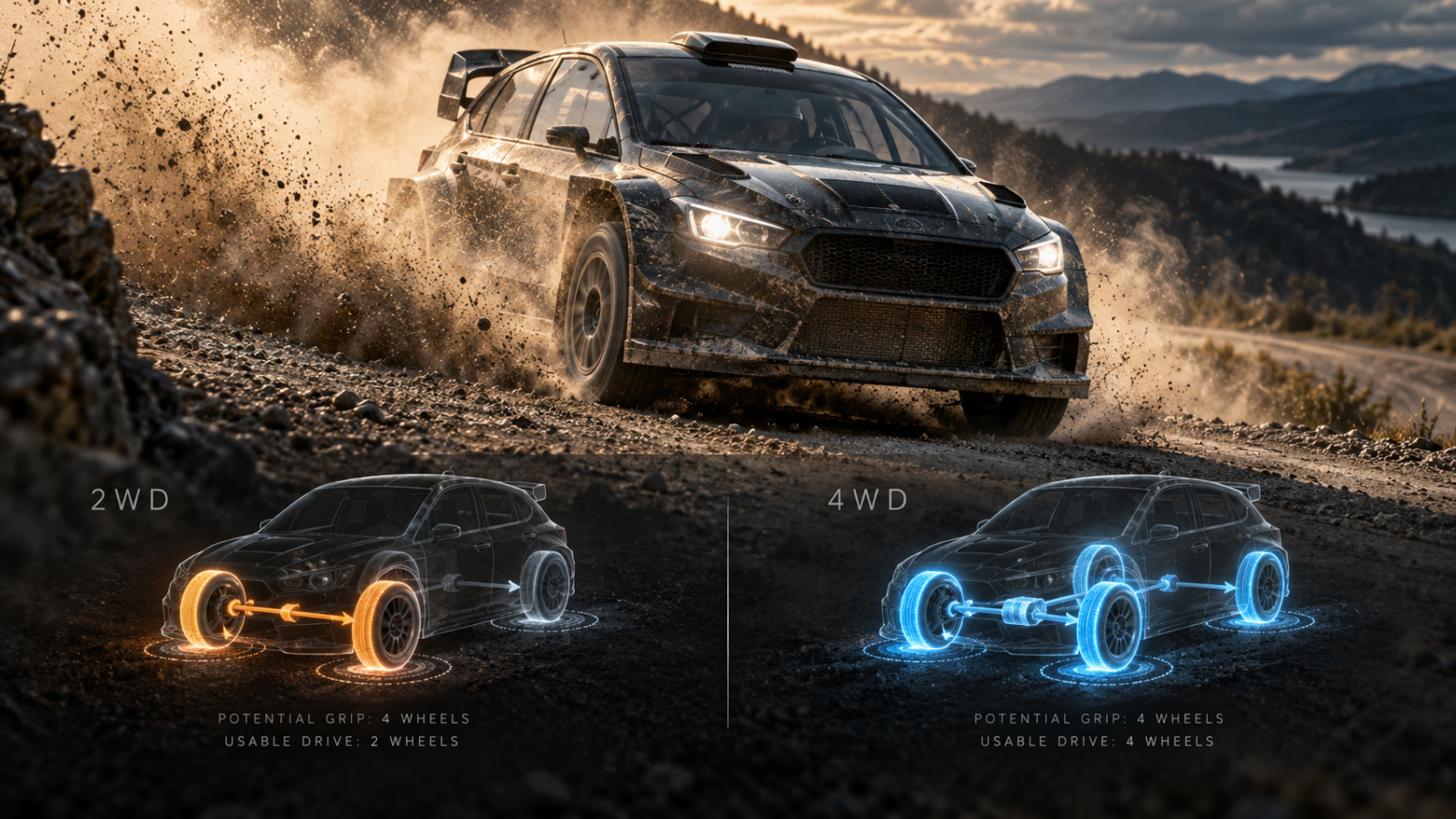
In the World Rally Championship (WRC), four-wheel drive has replaced the two-wheel-drive cars that once dominated the sport’s top category.
Both 2WD and 4WD cars have four tires. Even with identical tires on the same surface, however, their acceleration capabilities can differ significantly.
The key to understanding this difference is to distinguish between the friction force a tire can generate and how much of that force the drivetrain can actually use for propulsion.
This distinction becomes particularly important in rallying, where the vertical load on each tire changes constantly. The wheels with the greatest available grip can change from moment to moment.
The question, then, is which wheels can receive engine torque when that grip becomes available.
This underlying structure explains much of the competitive advantage of four-wheel drive in rallying.
1 | Having Grip and Being Able to Use It
The maximum friction force a tire can generate depends on factors such as the coefficient of friction between the tire and the road, the vertical load acting on the tire, and the tire’s characteristics.
Under identical conditions, the maximum friction force available at an individual tire is essentially the same whether the vehicle is 2WD or 4WD.
What changes is which wheels can receive engine torque.
In a 2WD vehicle, either the front or rear wheels provide propulsion. In a 4WD vehicle, all four wheels can contribute.
Four-wheel drive therefore provides a structure through which the available grip at all four tires can be used to transmit engine power to the road.
The total friction force the tires are capable of generating and the amount that can be used for propulsion must be considered separately.
2 | The Difference Exists Even When All Four Tires Are on the Ground
Consider a simplified model.
Assume that each of the four tires carries a vertical load of 1,000 N and that the coefficient of friction between the tires and the road is 0.5.
The maximum friction force available at each tire is:
1,000 N × 0.5 = 500 N
Assuming straight-line acceleration and a drivetrain capable of delivering the necessary torque to each driven wheel, the theoretical maximum tractive force becomes:
- 2WD: 500 N × 2 wheels = 1,000 N
- 4WD: 500 N × 4 wheels = 2,000 N
The combined friction-force capacity of all four tires is 2,000 N in either vehicle.
Yet the maximum amount available for propulsion differs.
In an actual vehicle, acceleration-induced weight transfer, the load sensitivity of tires, and other factors affect these values. The underlying structural distinction remains.
When the engine can provide sufficient power and acceleration is limited by tire grip, four-wheel drive can transmit greater tractive force to the road.
Even when all four tires remain in contact with the ground, drivetrain architecture determines how much of their available grip can be used for propulsion.
3 | In Rallying, the Location of Available Grip Keeps Changing
In rallying, gravel, snow, bumps, and uneven surfaces constantly change the vertical load acting on each tire.
A wheel may occasionally leave the ground completely, but fluctuations in tire load occur far more frequently.
As the vertical load on a tire decreases, the friction force it can generate also decreases.
Consider a front-wheel-drive car.
When the vertical load on its front tires decreases, the amount of grip available for propulsion also falls.
At that same moment, the rear tires may still carry substantial vertical loads. Yet the drivetrain sends engine torque exclusively to the front wheels.
A four-wheel-drive car can also use the grip available at the rear wheels.
Conversely, when rear-wheel loads decrease, the front wheels can contribute more to propulsion.
Four-wheel-drive architecture creates the potential to use the grip available at both axles. The differential system, limited-slip differentials (LSDs), and related mechanisms determine how effectively that potential is converted into actual torque distribution.
This reveals an important structural relationship in rallying:
How closely do the wheels with available grip correspond to the wheels capable of receiving engine torque?
On rally surfaces, where tire loads change continuously, the ability to maintain this correspondence across a wider range of conditions has a significant effect on how much tractive force a vehicle can generate.
4 | The Same Structure Matters While Cornering
Rally drivers repeatedly accelerate while their cars are still negotiating corners.
During cornering, tires generate lateral forces to change the vehicle’s direction. Acceleration simultaneously requires longitudinal force.
The combined longitudinal and lateral forces a tire can generate are limited. This relationship is commonly illustrated by the friction circle, also known as the traction circle.
In a 2WD vehicle, the two driven wheels must handle the engine’s tractive force.
In a 4WD vehicle, distributing torque between the front and rear axles can reduce the longitudinal force demanded from any individual tire.
This makes it easier to remain within each tire’s friction limit while transitioning from cornering to acceleration.
Because front-to-rear torque distribution also influences handling characteristics, competitive rally cars require careful coordination of their differentials, suspension settings, and other components.
5 | How Tractive Force Becomes a Difference in Stage Times
A rally special stage consists of repeated braking, cornering, and acceleration.
A car capable of generating greater tractive force when exiting a corner can begin increasing its speed more rapidly.
The resulting speed advantage can carry into the following straight.
Four-wheel drive provides greater opportunities to use the grip available at both axles, particularly on low-grip surfaces and where tire loads fluctuate.
These differences in acceleration appear repeatedly throughout a stage and ultimately influence the total elapsed time.
The causal relationship can therefore be expressed as follows:
A difference in usable tire grip produces a difference in tractive force, which produces a difference in acceleration, then vehicle speed, and ultimately stage time.
6 | How Rallying Shifted from 2WD to 4WD
In the early 1980s, the introduction of the Audi quattro marked a turning point in the history of the World Rally Championship.
Audi demonstrated the competitive potential of four-wheel drive through its superior traction performance and won the WRC Manufacturers’ Championship in 1982.
The following year, the rear-wheel-drive Lancia Rally 037 won the 1983 Manufacturers’ Championship. It remains the last 2WD car to have secured that title.
Over the following years, competitive top-level rally cars increasingly adopted four-wheel drive.
Under the FIA rally car classification system, the upper categories—Rally1, Rally2, and Rally3—use four-wheel drive, while Rally4 and Rally5 use front-wheel drive.
The technical regulations for the new top-level WRC cars scheduled for introduction in 2027 also specify four-wheel drive.
The competitive advantages of four-wheel drive were demonstrated on rally stages and later reflected in the technical regulations governing the sport’s top categories.
7 | Conclusion: Performance Depends on Both Available Capability and the Ability to Deploy It
Four-wheel drive gained its competitive advantage in rallying because its architecture allows the grip available at all four tires to be used for propulsion.
Each tire has a friction-force limit determined by its contact conditions.
How much of that available force can be converted into propulsion depends on the drivetrain.
When vertical tire loads fluctuate, four-wheel drive provides greater opportunities to direct engine torque toward wheels with sufficient available grip, converting that advantage into acceleration performance.
A more general principle emerges from this relationship.
The total capability a system possesses and the amount of that capability it can actually deploy are two different things.
The difference is determined by the structure through which available capability is delivered to where it is needed.
The distinction between 2WD and 4WD in rallying provides a concrete illustration of this principle.
Want to know more about the author and the thinking behind this site?
→ About Rikutsu-Kone-Taro
