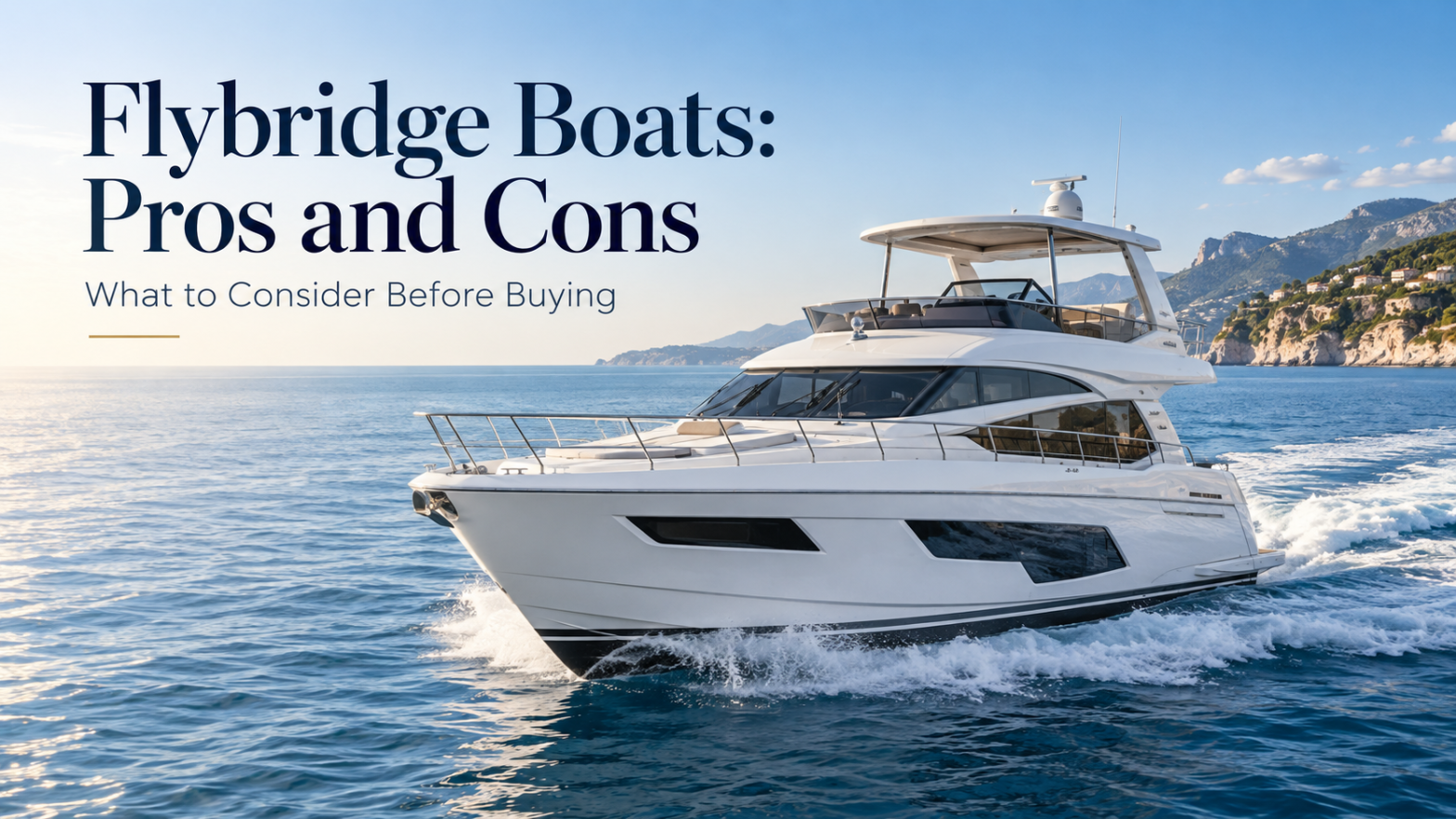
Introduction | Does a Flybridge Suit Your Boating Style?
Whenever I see a flybridge boat at a marina, I find myself looking up.
The thrill of looking out over the sea from an elevated helm, the freedom of an open-air lounge, and that commanding appearance—flybridge boats have a special appeal that captures the imagination of boat enthusiasts.
But owning one brings practical considerations, including access between the helm and deck, exposure to weather, and maintenance requirements.
The value of a flybridge depends on how much you can actually enjoy and benefit from it in your own boating activities.
As someone who prefers boating single-handed or with a small crew, I’d like to examine the advantages and disadvantages of flybridge boats from that perspective.
1. Advantages of Flybridge Boats
Better Visibility from an Elevated Helm
One of the greatest advantages of a flybridge is the view from its elevated helm.
The higher position makes it easier to observe surrounding waters, waves, and other vessels. It can also improve forward visibility when the bow rises during acceleration.
This elevated perspective is useful for spotting feeding seabirds that may indicate schools of fish, searching for promising fishing grounds, and assessing traffic in congested waterways. Seeing developing situations earlier gives the operator more time to make decisions.
And there is something special about the view itself. Looking out over the sea from a higher vantage point while cruising can be a pleasure in itself.
An Open-Air Lounge with a View
A flybridge serves as both a helm station and an outdoor observation lounge.
With comfortable seating and a table, it becomes a place to enjoy meals, conversation, and sea breezes. Imagine anchoring in calm waters and relaxing above the main deck, taking in the surrounding scenery.
When the layout allows guests to sit near the helm, everyone can enjoy the view and conversation while underway.
For owners who value spending time at sea with family and friends, a flybridge can be a particularly appealing space.
A Choice of Helm Positions
Boats equipped with both upper and lower helm stations allow the operator to choose the most suitable position for the conditions.
On a pleasant, sunny day, the flybridge offers an exhilarating open-air experience. In cold or rainy weather, the enclosed lower helm provides greater comfort.
During docking, the operator can also select the helm that offers better visibility and easier access to the deck.
Potential Advantages in Radar Antenna Height
A flybridge may provide a convenient location for mounting a radar antenna at a greater height.
Because radar waves generally travel in straight lines, raising the antenna extends the radar horizon. This can increase the detection range for distant, low-lying targets.
There is, however, an interesting technical trade-off.
A higher radar antenna can improve long-range detection while making some nearby, low-lying targets more difficult to detect.
Radar energy spreads through a certain angle in the vertical direction. This angular spread is known as the vertical beamwidth.
As antenna height increases, the lower edge of the main radar beam intersects the sea surface farther from the vessel. Consequently, nearby low targets may fall below the main beam, making them more difficult to detect.
Actual detection performance depends on antenna height, vertical beamwidth, target height, radar reflectivity, and other factors.
Radar antenna height therefore involves a trade-off between long-range coverage and close-range detection.
And Yes, They Look Great
I think appearance matters when choosing a boat, too.
With their elevated structures and commanding profiles, flybridge boats have an unmistakable presence. Even someone with little interest in boating might look at one and say, “Wow, that’s quite a boat!”
And after experiencing the view and exhilaration of being up on the flybridge, the attraction may become even stronger.
Boat ownership is about practical considerations, but it also involves the pleasure of admiring your vessel and the satisfaction of operating it.
There is something special about looking back at your own boat and thinking, “That really is a beautiful boat.”
2. Disadvantages of Flybridge Boats
Greater Exposure to Weather
Operating a boat in the open air can be exhilarating, but the weather can make the experience considerably less comfortable.
A flybridge exposes the operator directly to sunlight, wind, rain, and cold. A pleasant sea breeze on a warm day can become uncomfortable in colder temperatures or strong winds. Intense summer sunlight can also contribute to fatigue during long passages.
Sunshades and enclosures can improve comfort, although some configurations also increase the area exposed to wind.
The number of days each year when a flybridge is genuinely comfortable depends greatly on the cruising area and season.
Increased Windage and Weight Above the Main Deck
The structure and equipment of a flybridge add weight relatively high on the vessel, affecting its center of gravity and motion characteristics.
A larger upper structure also tends to increase windage, the area exposed to wind.
This can become particularly noticeable during low-speed maneuvers, docking, or navigation through confined waterways, where crosswinds may push the vessel sideways.
The actual effect depends on the boat’s design, but handling in crosswinds is worth evaluating before purchase—especially at the marina where the boat will normally be kept.
The Skipper Can End Up Alone
Imagine the guests relaxing and chatting in a comfortable, climate-controlled saloon while the skipper remains upstairs on the flybridge, exposed to the wind and concentrating on the helm.
It’s an entirely plausible situation.
After setting out to enjoy a day at sea with family or friends, finding yourself reduced to the role of the group’s driver can feel a little lonely.
Of course, a flybridge with generous passenger seating allows everyone to share the view and conversation.
Where the skipper and guests are likely to spend their time while underway is an unexpectedly important consideration for anyone who values the social side of boating.
Higher Purchase and Maintenance Costs
A flybridge adds equipment such as an additional helm station, navigation instruments, seating, and stairs.
These features contribute to the purchase price and create additional maintenance requirements.
Outdoor seating and electronics are particularly exposed to ultraviolet radiation, rain, and salt. Cleaning and maintaining equipment installed high above the deck also takes extra effort.
For someone who regularly enjoys the flybridge, those costs and chores may be well worthwhile. If it rarely gets used, the additional maintenance can become a less welcome part of ownership.
Height Restrictions
The additional height of a flybridge can restrict passage beneath bridges or access to certain storage facilities.
The height of a vessel above the waterline is commonly referred to as its air draft.
If your usual cruising grounds include low bridges, or your storage facility has height restrictions, verifying the vessel’s air draft is an essential part of the purchasing decision.
3. Why Helm-to-Deck Access Matters in Single-Handed Boating
This is where my own priorities come into focus.
The visibility from a flybridge is certainly attractive, but when operating single-handed, the route between the helm and the working deck becomes particularly important.
Moving Between the Helm and Mooring Lines
When docking alone, the skipper must control the vessel’s position while also handling mooring lines and fenders.
Getting from the flybridge to the deck where the lines are handled requires descending stairs or a ladder.
Think about the sequence: leave the helm, go downstairs, handle a mooring line, and return to the controls if necessary.
When you imagine doing this during an actual docking maneuver, the inconvenience becomes obvious.
In windy conditions, with the boat moving beneath your feet, the vertical movement also demands care.
By comparison, a boat with a side door immediately beside the lower helm allows the skipper to step directly onto the side deck.
For single-handed boating, the route between the helm and the mooring positions has a major influence on both docking convenience and safety.
Once you begin using a boat regularly, the quality of these everyday working arrangements can make a substantial difference.
Blind Spots Vary with Helm Position
Although a flybridge offers excellent overall visibility, parts of the bow, stern, or sides may be obscured depending on the vessel’s design.
The lower helm has its own blind spots as well.
During docking, accurate awareness of the distance to the quay, the position of mooring equipment, and clearance from neighboring vessels is essential.
Before purchasing, it is worth sitting at each helm and checking exactly how much of the surrounding area you can see.
The Location of Auxiliary Controls
Bow thrusters, stern thrusters, and joystick control systems can reduce the workload during docking.
Some boats also allow auxiliary controls to be installed where the skipper has a better view of the vessel’s surroundings.
For example, being able to maneuver from a position near the side deck can make it easier to judge clearance from the quay while making small adjustments.
What matters is the combination of where you can control the boat and where you can move from that position.
4. Five Things to Consider Before Buying
If a flybridge boat appeals to you, imagine how you would actually use it and consider the following five factors.
1. Your Main Purpose
Start by deciding what you want to do with the boat: fishing, cruising, entertaining guests, or simply enjoying time on the water.
Do you want an elevated viewpoint for spotting seabirds feeding over baitfish? Or do you picture yourself enjoying a meal with family while looking out over the sea?
Your priorities determine what the flybridge needs to provide.
2. Crew Size
With several people aboard, lookout duties and mooring operations can be shared.
If you usually operate alone, the route from the helm to the mooring lines and the location of auxiliary controls deserve particular attention.
3. Climate and Season
In warm, sheltered cruising areas, there may be plenty of opportunities to enjoy a flybridge.
In regions with cold temperatures or frequent strong winds, an enclosed helm or a well-designed flybridge enclosure becomes more valuable.
Consider the seasons when you actually go boating. This will give you a realistic idea of how often you would use the upper helm.
4. Cruising Grounds and Mooring Conditions
Consider your marina’s layout, exposure to crosswinds, and any bridges along your usual routes.
If possible, operate the prospective boat in conditions similar to those you will encounter at your own berth.
Experiencing its low-speed handling firsthand can be especially useful.
5. Whether the Benefits Justify the Costs
A flybridge comes with additional purchase and maintenance costs.
If you genuinely want to enjoy the elevated view and spend time with guests above the main deck, those costs may be entirely worthwhile.
Think about how often you will use the flybridge throughout the year and whether the enjoyment it provides justifies the expense.
Conclusion | The Value of a Flybridge Depends on Your Boating Style
Flybridge boats offer excellent visibility, open-air living space, flexibility in helm selection, and an undeniable appeal to people who love boats.
They also bring additional weight and windage, maintenance requirements, and the need to move between the upper helm and the working deck.
I began fishing in September 2025, and I still spend most of my boating time operating single-handed or with a small crew.
I’ve written about how I took up fishing and my thoughts on our relationship with nature in two other articles:
- Fishing Without the Fishy Smell: A Senior’s Search for His Place in Nature (in Japanese)
- Is Catch-and-Release Fishing Cruel? A Perspective from the Natural World (in Japanese)
Given the way I use my boat, I currently place greater value on easy access from the helm to the deck, practical docking arrangements, and a helm environment that remains comfortable in changing weather than on the elevated views and open-air experience of a flybridge.
Even so, I still find myself drawn to the commanding appearance of flybridge boats.
Perhaps part of the pleasure of choosing a boat lies in weighing that sense of attraction against the realities of owning and operating it.
The practical case for choosing a flybridge comes down to how much you will actually use and enjoy what it offers.
Ultimately, I want a boat that suits the way I go to sea—and lets me make the most of every hour spent on the water.
Want to know more about the author and the thinking behind this site?
→ About Rikutsu-Kone-Taro
