In circuit driving, two of the best-known cornering principles are “outside–inside–outside” and “slow in, fast out.”
The basic meaning of slow in, fast out is simple:
Do not chase excessive corner-entry speed. Enter at a speed that allows you to turn the car properly, then prioritize a strong exit and carry a higher speed onto the following straight.
A small increase in exit speed can continue to benefit you for the entire length of the next straight. For that reason, sacrificing a little entry speed often produces a better overall sector time.
The principle itself is sound.
However, the phrase slow in, fast out leaves out a major part of the process.
Before entering the corner, the car is not slow at all. It may have been running at full throttle along a long straight and may be close to its highest speed of the lap.
How does the car move from that high-speed condition to the “slow in” condition?
When should braking begin? How hard should the driver brake? How much speed should be removed before turn-in? What role does trail braking play?
The famous phrase does not answer these questions.
The missing piece is how the driver creates the “slow” part of slow in, fast out.
Safety note: This article concerns driving on a closed racetrack. Hard braking and trail braking should be practiced only in a controlled environment, with sufficient safety margins and preferably with professional instruction. They should not be practiced on public roads.
The Simplified Corner Used in This Article
For clarity, this article assumes a simple layout:
- a long entry straight;
- a constant-radius 180-degree corner;
- and a long exit straight.
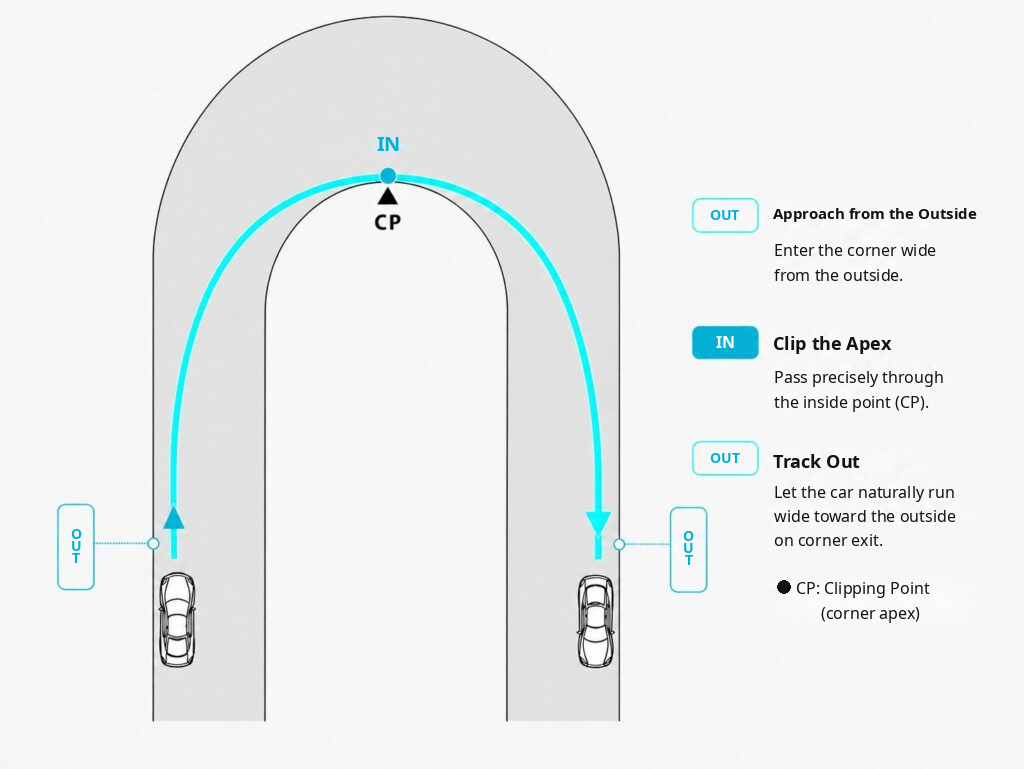
The car on the left represents the moment when the main straight-line braking phase has ended and turn-in is beginning.
The car on the right represents the first moment when the steering angle has returned to approximately zero and the throttle is fully open.
For this simplified corner, a typical sequence is as follows:
- Run at full throttle along the entry straight.
- Apply hard, brief, straight-line braking at the end of the straight.
- Begin turning while progressively releasing the brake: trail braking.
- Reach the lowest speed and the largest or near-largest steering angle around the chosen apex.
- Reduce the steering angle while progressively increasing the throttle opening.
- Reach full throttle as the steering returns to approximately zero on the exit straight.
The exact timing will vary with the car, driver, tires, track surface and corner geometry. This is a simplified model, not a universal telemetry trace for every corner.
What Is Trail Braking?
Trail braking means that the driver does not suddenly release all brake pressure at the moment of turn-in.
Instead, the driver continues to hold some brake pressure after beginning to steer, then gradually reduces that pressure as the steering angle increases.
In simple terms:
As the driver asks the tires to turn more, the driver asks them to brake less.
The available tire grip must be shared between longitudinal work, such as braking, and lateral work, such as turning.
During hard straight-line braking, most of the available grip is being used to slow the car.
During trail braking, the driver progressively transfers the tires’ main task from braking to cornering. The car continues to decelerate, but the rate of deceleration becomes gentler as the steering demand increases.
Slow in, fast out roughly describes the speed distribution through the middle part of this sequence. It says almost nothing about the hard braking that must happen before it.
It also says very little about trail braking.
It does not clearly explain where the “slow” section begins, where it ends, or how the car moves from slow to fast.
That was exactly what confused me as a beginner.
“Slow In, Fast Out” Starts Halfway Through the Story
The phrase slow in, fast out begins its explanation after the car has already become relatively slow.
But between a full-throttle straight and the slow-in condition, there are normally two connected braking stages.
The first stage is the main straight-line braking phase.
The second stage is trail braking after turn-in.
During the main braking phase, the driver removes a large amount of speed within a short time and distance.
During trail braking, the driver gradually releases brake pressure while increasing steering input. The car continues to lose some speed while also changing direction.
These two stages take the car toward its minimum speed near the chosen apex.
In other words, “slow” is not simply a fixed low speed that exists at corner entry.
It is a condition created by:
hard straight-line braking followed by progressively reduced braking while turning.
Slow in is the result of a braking process.
Stage One: Remove Most of the Speed at the End of the Straight
The first step in creating slow in is hard, brief braking near the end of the straight.
The driver moves quickly from the accelerator to the brake, keeps the steering close to neutral and applies a large amount of braking force.
By hard braking, I do not mean stamping on the pedal without control.
I mean using a large, repeatable share of the maximum braking force that can be used safely and consistently with that particular car, tires, track surface and weather conditions.
This requires practice.
A beginner may understand the theory but still find it difficult to apply strong brake pressure quickly and confidently. I certainly did.
For the remainder of this article, assume:
- a dry track;
- properly functioning tires and brakes;
- a properly maintained car;
- and a normal, functioning ABS system where fitted.
With the steering nearly straight, the car can use most of the available tire grip for deceleration rather than cornering.
ABS can help prevent sustained wheel lock, but it does not create additional grip or remove the need for controlled inputs.
During this main braking phase, the objective is not simply to make the car as slow as possible.
The objective is to reduce speed to a level from which the driver can:
- begin turning;
- transition smoothly into trail braking;
- increase the steering angle while releasing brake pressure;
- and reach the chosen apex without panic braking or exceeding the available grip.
The correct speed at the end of the main braking phase is therefore determined by what the car must do next.
Stage Two: Continue Decelerating While Turning
After the main straight-line braking phase, the driver begins to turn and moves into trail braking.
Brake pressure is progressively reduced from its high initial level.
At the same time, steering input is increased as the car moves toward the apex.
This is often the section that people describe as “slow in.”
However, the car is not travelling at one fixed, low speed. Its speed is still decreasing.
The rate of deceleration is normally much lower than it was during the main straight-line braking phase, but the car has not finished slowing down.
This means the real movement is closer to:
decelerating in
than simply:
slow in.
As the driver reduces brake pressure, the speed falls more slowly.
At the same time, the larger steering angle changes the direction of the car more rapidly.
The main task of the tires is changing from:
producing strong deceleration
to:
continuing a smaller amount of deceleration while producing increasing cornering force.
The transition should be continuous rather than abrupt.
Hard straight-line braking does not suddenly disappear and become pure cornering. Brake pressure is released while steering demand is added.
For a more detailed explanation of the relationship between trail braking, brake pressure and steering input, see:
Turning Has Begun, but Deceleration Has Not Ended
The words slow in can create the impression that all deceleration should be completed before the steering wheel is turned.
That is not necessarily what happens.
In the model corner used in this article, the car continues to lose speed after turn-in because the driver is still trail braking.
The speed normally reaches its minimum near the chosen apex.
The exact location of minimum speed depends on the car, line and corner. It may occur slightly before, at or after the geometric apex. Here, “apex” means the chosen clipping point on the inside of the corner rather than a point that is identical in every possible driving line.
The car therefore does not simply enter the corner at a completed “slow” speed.
It enters while still becoming slower.
That is why decelerate in describes the actual motion more accurately.
Professional drivers sometimes say that a driver should not “carry the brakes into the corner.” The intended meaning may be that the heavy main-braking pressure should not be carried deeply into the turning phase.
However, terminology varies. Some drivers may be describing a particular corner or a particular car in which little or no trail braking is required.
The phrase should not automatically be interpreted as a universal instruction to release every trace of brake pressure before turn-in.
When Should Braking Begin?
There is no single braking point that works for every driver, car and corner.
The required braking distance changes with:
- entry speed;
- driver skill;
- corner radius;
- vehicle weight;
- tire condition and temperature;
- braking performance;
- track surface;
- gradient;
- weather;
- and available aerodynamic downforce.
However, the basic criterion is clear.
The braking point should allow the driver to:
complete the heavy main-braking phase before or around turn-in, then reach the chosen apex by progressively releasing brake pressure while increasing steering input.
If the driver still needs strong, speed-removing brake pressure after meaningful steering has begun, the braking point may be too late, or the initial braking may have been too weak.
The driver is then asking the tires for a large amount of braking force and a large amount of cornering force at the same time.
At the other extreme, if braking ends and the car then coasts for a long distance before turn-in, braking may have begun too early or too much speed may have been removed.
A short transition between braking and turning can occur. The problem is not the existence of any neutral moment. The problem is a long, unintended coasting period that shows the braking and turn-in phases are poorly connected.
A Practical Way to Find the Braking Point
Begin with a conservative braking marker.
The marker might be:
- a distance board;
- the beginning of a curb;
- a change in the track surface;
- or another fixed visual reference.
Brake from the same marker with approximately the same pressure on each lap.
First, concentrate on making the sequence repeatable:
main braking
→ brake release
→ turn-in
→ trail braking
→ apex
Once the process is consistent, make small adjustments.
If there is a long coasting period before turn-in, move the braking point slightly later or reduce the amount of braking.
If strong braking is still required after turn-in, move the braking point earlier or improve the initial braking phase.
Do not change the braking point, brake pressure and turn-in point all at once.
If several variables change on the same lap, it becomes difficult to know which change caused the difference in the car’s behavior.
Change one element at a time.
The objective is not simply to brake later than before.
The objective is to arrive at turn-in with a repeatable speed and vehicle balance that allow a smooth transition into trail braking.
From Minimum Speed to Acceleration
In the simplified corner used here, the car reaches its minimum speed near the chosen apex.
Around this point, the final brake pressure is released.
The driver then begins to reduce the steering angle while increasing the throttle opening.
This is the process normally described as fast out.
However, the car does not instantly become fast at the apex.
It begins to accelerate from its minimum speed.
For that reason, the actual process is better described as:
accelerating out.
Touching the accelerator early does not mean that the driver can immediately use full throttle.
While a large steering angle remains, the tires are still using much of their available grip to turn the car.
If the driver applies too much throttle while asking for a large amount of cornering force, the car may run wide with understeer or lose rear traction with oversteer, depending on the drivetrain, setup and balance of the car.
The throttle opening must therefore be increased in step with the reduction in steering angle.
In everyday driving language:
As you unwind the steering wheel, you can progressively add more throttle.
“Unwinding the steering” means returning the steering wheel toward its straight-ahead position.
For a more detailed discussion of steering angle and throttle application on corner exit, see:
How to Avoid Understeer When Exiting a Corner in the GR Yaris | Steering Angle and Throttle Position
The complete speed pattern through the braking zone and corner can therefore be described as:
rapid deceleration during hard straight-line braking
→ gentler deceleration during trail braking
→ minimum speed near the chosen apex
→ acceleration as the steering angle is reduced
This is a continuous process.
Why the Phrase Can Cause Opposite Mistakes
Slow in, fast out omits the process that connects the full-throttle straight to the slow-in condition.
Because of that omission, beginners can misunderstand the phrase in completely opposite ways.
Mistake 1: Braking Too Early and Too Gently
A driver may think:
“Slow in means I should begin braking far before the corner and make sure the car is already very slow before I turn.”
The driver then applies weak braking for a long time, removes more speed than necessary and creates a long coasting period before turn-in.
The car may be safe and stable, but the connection between braking and cornering is inefficient.
The driver has interpreted slow in as a command to remain slow for a long time.
Mistake 2: Braking Too Late
Another driver may think:
“I do not want to lose time on corner entry, so I should stay at full throttle for as long as possible and brake at the last moment.”
This can leave too much speed to remove after turn-in.
The driver then carries heavy brake pressure into the section where the tires are also being asked to produce substantial cornering force.
The problem is not trail braking itself.
The problem is carrying too much of the main speed-removing braking phase into the corner.
Mistake 3: Applying Too Much Throttle at the Apex
The words fast out may also suggest that the accelerator should be opened aggressively as soon as the car touches the apex.
But the apex is not an automatic full-throttle switch.
If a large steering angle remains, full throttle may simply push the car away from the intended line or destabilize it.
The driver should increase throttle opening as steering input is reduced.
That is why accelerating out is a more accurate description than simply fast out.
What Must Be Added to “Slow In, Fast Out”?
To make the famous phrase useful as an actual cornering explanation, it needs several additional steps.
On the simplified corner used in this article:
- The car runs at full throttle along the long entry straight.
- At the end of the straight, the driver applies hard, brief braking with the steering close to neutral.
- Around turn-in, the driver begins progressively releasing brake pressure.
- As brake pressure decreases, steering input increases and the car moves toward the chosen apex.
- The car continues to decelerate during trail braking, but more gently than during the main straight-line braking phase.
- The car reaches its minimum speed near the apex.
- The driver then reduces the steering angle while progressively increasing the throttle opening.
- Full throttle becomes possible as the steering returns toward the straight-ahead position.
In a shorter form:
Full throttle
→ hard straight-line braking
→ decelerating and turning while releasing the brake
→ minimum speed
→ accelerating while unwinding the steering
This is:
decelerate in, accelerate out.
“Slow In, Fast Out” Is a Principle, Not a Universal Law
The basic principle is especially useful when a corner leads onto a long straight. A good exit speed then produces a benefit for a relatively long time.
However, not every corner should be driven with exactly the same priority.
The optimum technique can change when:
- one corner immediately leads into another;
- the exit straight is very short;
- the corner radius tightens or opens;
- the track is wet;
- the corner is uphill, downhill or off-camber;
- or the car depends heavily on aerodynamic downforce.
In a sequence of corners, the best line through the first corner may be determined by the entry required for the second.
Slow in, fast out should therefore be treated as a useful principle rather than a complete law of cornering.
The purpose of this article is not to claim that every corner has the same braking trace.
It is to explain the process that the famous phrase leaves unstated.
Conclusion: The Missing Pieces Are How “Slow” Is Created and What Kind of “Slow” It Is
The “quality of slow” does not mean simply travelling at a low speed.
It means reaching the correct speed while the car is in a useful dynamic state:
- brake pressure is being reduced;
- steering input is increasing;
- the car is rotating toward the exit;
- and the driver is preparing for the transition to acceleration.
Slow in, fast out teaches drivers not to sacrifice the entire corner and following straight merely to gain a little more entry speed.
That lesson is valid.
But before entering the corner, the car may be travelling at full throttle near its highest speed of the lap.
It cannot move from that condition to slow in without a braking process.
Between the full-throttle straight and the slow-in condition are:
a strong main braking phase at the end of the straight
and:
a trail-braking phase in which brake pressure decreases as steering input increases.
The main braking phase rapidly removes speed.
Trail braking continues to reduce speed more gently while changing the direction of the car.
Near the chosen apex, the car reaches its minimum speed.
The driver then reduces the steering angle, increases the throttle opening and accelerates toward the exit.
The actual speed transition is therefore:
decelerate in, accelerate out.
When someone tells you to use slow in, fast out, do not interpret it only as “enter slowly and leave quickly.”
Ask what happens before the car becomes slow.
Where does the main braking phase end?
How is brake pressure released?
How does steering input increase?
Where is minimum speed reached?
How is throttle opening increased as steering angle is reduced?
Only after those missing steps are added does slow in, fast out become practical knowledge that can be applied on a racetrack.
Want to know more about the author and the thinking behind this site?
→ About Rikutsu-Kone-Taro
