On cars and many sport boats, the windshield slopes backward, with its upper edge positioned farther aft than its lower edge.
Yet some pleasure boats have windshields that lean in the opposite direction, with the top extending toward the bow.
This is known as a reverse-raked windshield.
To someone unfamiliar with the design, it may look rather unusual, even awkward.
My own Jeanneau Merry Fisher 895 Sport has this type of windshield. Having operated the boat myself, I have come to appreciate the practical reasoning behind its unusual shape.
Boats designed around a sleek, streamlined appearance often use conventionally raked windshields. Boats designed for long periods at the helm and continuous observation of the surroundings may instead use reverse-raked windshields.
The most rational shape for a windshield depends on what the boat’s designers choose to prioritize.
Once you understand that distinction, the angle of a windshield becomes a clue to the priorities behind the entire boat.
Conventional and Reverse-Raked Windshields
For simplicity, we can divide boat windshields into two main categories.
A conventionally raked windshield slopes backward, placing its upper edge farther toward the stern than its lower edge.
This is the familiar arrangement found on automobiles, many sport boats, and streamlined cruisers.
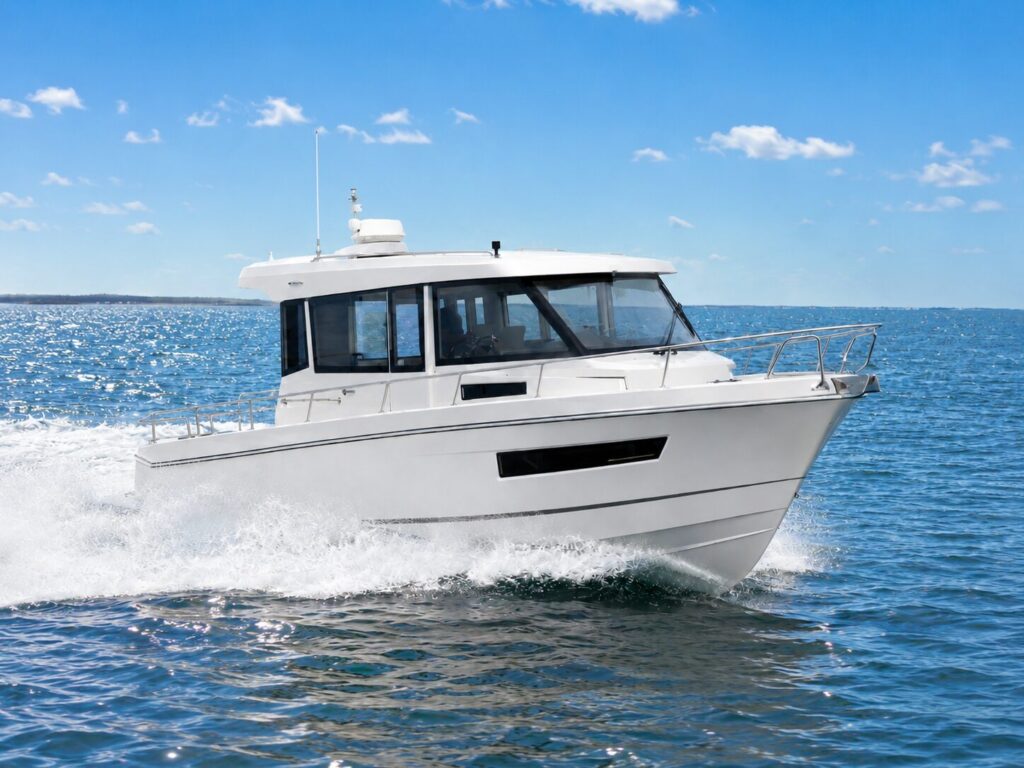
A reverse-raked windshield slopes forward, with its upper edge extending toward the bow.
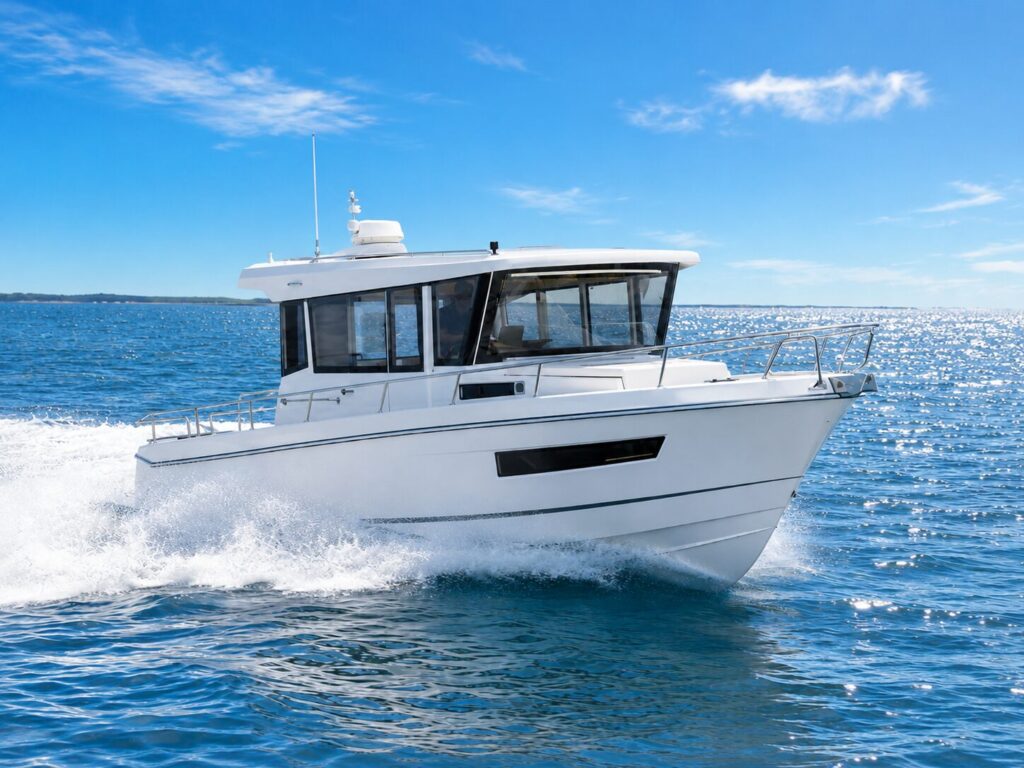
Examples can be found on Scandinavian pilothouse boats from builders such as Sargo, Targa, and Nord Star, as well as on various North American utility-oriented boats.
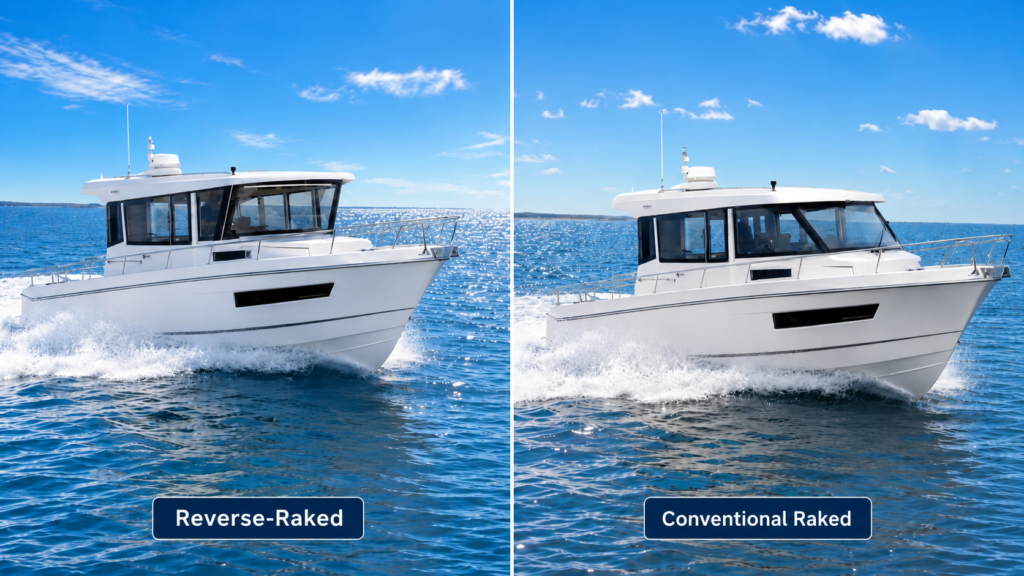
From the outside, the conventional design tends to look streamlined and sporty, while the reverse-raked design often suggests practicality.
The more meaningful differences become apparent when you sit at the helm and look out through the glass.
1. Reducing Interior Reflections to Preserve Forward Visibility
One of the clearest advantages of a reverse-raked windshield is its ability to reduce reflections from inside the cabin.
With a conventionally raked windshield, sunlight can illuminate the dashboard and other interior surfaces, causing their images to appear on the glass.
Most drivers have encountered this effect in a car.
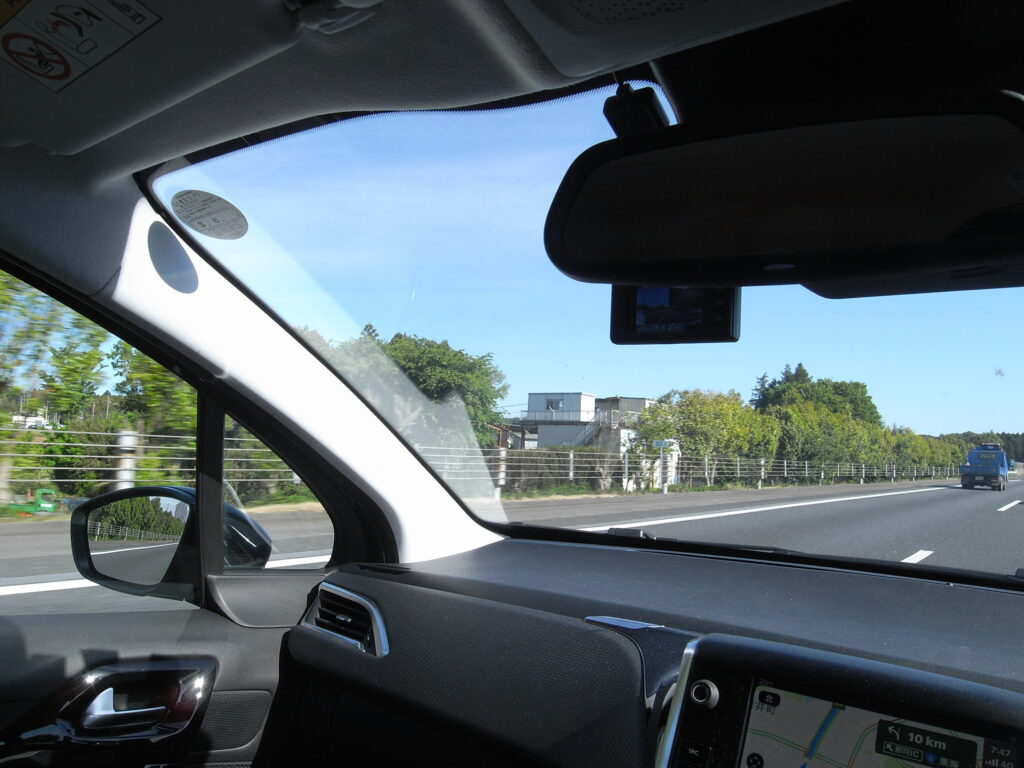
When light reaches a glass surface, some passes through while some is reflected.
Depending on the angle of the windshield, light reflected from the dashboard or other bright interior surfaces can overlap the driver’s forward view.
A reverse-raked windshield changes the direction of those reflections, making it easier to keep them out of the operator’s forward line of sight.
In my own boat, I find that the view ahead is noticeably clearer under sunny conditions.
When operating a boat, you continually observe waves, floating debris, other vessels, buoys, and fishing gear.
Reflections become particularly troublesome when trying to identify small, distant objects or objects with little contrast against their surroundings.
Reducing those reflections therefore has practical value for navigation.
The Same Principle Appears in International Maritime Safety Standards
Interestingly, this optical principle is also reflected in international maritime safety regulations.
Under SOLAS Chapter V, Regulation 22, ships measuring at least 55 metres in length overall (LOA) and constructed on or after 1 July 1998 are required to have their navigation bridge front windows inclined outward at the top by between 10 and 25 degrees from the vertical.
The regulation explicitly identifies the reduction of reflections as the reason for this requirement.
Reference: SOLAS Chapter V — Regulation 22, Navigation Bridge Visibility
The regulation concerns larger ships, but the same optical principle also applies to smaller pleasure boats.
There is also a relevant observation from an independent boat test.
In its 2026 review of the Jeanneau Merry Fisher 895 Sport Series 2, the German boating magazine BOOTE reported that windshield reflections were not an issue, attributing this to the angle of the windshield together with the dark-colored helm interior.
Reference: BOOTE — Merry Fisher 895 Sport Series 2
The review concerns the newer Series 2 model, but its observation is consistent with the advantage I have experienced in my own boat.
A reverse-raked windshield can reduce distracting interior reflections, helping the operator maintain a clear view of the surroundings.
2. Reducing Direct Sunlight at the Helm
Another advantage of a reverse-raked windshield is its potential to reduce direct sunlight entering the cabin.
A conventionally raked windshield has an outward-facing surface angled partly upward. Depending on the position of the sun, it may receive substantial direct sunlight.
A reverse-raked windshield has an outward-facing surface angled partly downward.
When the sun is high in the sky, this orientation can reduce the amount of direct sunlight striking the glass.
Furthermore, the forward projection of the windshield’s upper edge, combined with the cabin roof, can create a shading effect similar to an overhang.
Together, these features can reduce glare and solar heat entering the helm area, making the cabin a more comfortable place to operate the boat.
The actual amount of sunlight entering the cabin depends on solar elevation, the boat’s heading, windshield angle, roof overhang, and the solar-control properties of the glass.
Protection of interior materials and instruments from ultraviolet degradation also depends significantly on the glass’s UV-filtering performance.
From my own experience, the immediate benefit is a calmer, less glaring environment in which to maintain a forward lookout.
That becomes increasingly valuable during long periods at the helm.
3. Creating More Space Above and Ahead of the Helm
Windshield rake also affects the available space inside the cabin.
With a conventionally raked windshield, the upper portion slopes backward toward the operator. Depending on the arrangement, this can limit the space above and ahead of the helm.
With a reverse-raked windshield, the upper edge extends forward.
If the lower edge of the glass and the roof height remain unchanged, this arrangement can provide more space in front of and above the operator.
On smaller and medium-sized cabin boats, the difference can noticeably affect how spacious the helm area feels.
Actual interior space also depends on the positioning of the helm seat, dashboard, and roof. Nevertheless, having the windshield extend forward can create a greater sense of openness.
This helps explain part of the appeal of the arrangement on Scandinavian pilothouse boats such as Sargo, Targa, and Nord Star, as well as North American boats from builders such as Duckworth and KingFisher.
These first three advantages share a common purpose.
They help create an environment in which the operator can continue observing the outside world over long periods.
Reducing interior reflections, limiting direct sunlight, and providing more room around the helm all serve that broader purpose.
A reverse-raked windshield makes it easier to incorporate these priorities into a single design.
4. How Do Water Droplets Move Across the Glass?
A windshield must also deal with rain and sea spray striking its exterior surface.
The angle of the glass affects how that water behaves.
A droplet adhering to a windshield experiences gravity, which tends to pull it downward.
When the boat is moving, aerodynamic forces also act on the droplet.
Consider a simplified model.
On a conventionally raked windshield, if airflow moves upward along the glass, it can push water droplets upward, opposing the downward movement caused by gravity.
On a reverse-raked windshield, if airflow moves downward along the glass, aerodynamic forces and gravity can act in the same direction.
Under those conditions, the reverse-raked arrangement may help water travel downward across the windshield.
However, airflow around an actual boat is far more complicated than this simplified model suggests.
The bow, cabin roof, and surrounding structures all affect how air moves across the glass.
Water movement also depends on boat speed, wind direction, droplet size, surface wettability, and drainage arrangements along the lower edge of the windshield.
In my own reverse-raked boat, there are situations in which water droplets seem to remain on the glass longer than I would like.
Determining why this happens requires considering the actual airflow and drainage characteristics of the boat.
The ability of a windshield to shed water depends on the interaction between its angle, the airflow around it, and the behavior of water on its surface.
5. The Mechanical Challenge of Windshield Wiper Pressure
Another detail I find interesting about reverse-raked windshields is the contact pressure of the windshield wipers.
This can be understood from the relationship between the angle of the glass and gravity.
With a conventionally raked windshield, the exterior surface of the glass faces partly upward.
A component of the wiper blade’s weight therefore acts toward the glass, helping press the blade against it.
With a reverse-raked windshield, the exterior surface faces partly downward.
A component of the blade’s weight acts away from the glass, slightly reducing the net contact force.
Under otherwise identical conditions—the same wiper arm, blade, and spring force—the reverse-raked arrangement is therefore at a small mechanical disadvantage in terms of blade contact pressure.
In practice, however, the contact pressure of a windshield wiper is determined primarily by the spring mechanism in the wiper arm.
For example, marine wiper manufacturer Exalto offers arms with adjustable spring pressure, allowing the force exerted by the blade against the glass to be regulated.
Reference: Exalto — PU Marine Wiper Arms
By selecting appropriate spring pressure and blade geometry, a designer can provide the required wiping performance for the windshield’s inclination.
This is a useful example of how a mechanical consequence of windshield geometry can be addressed through the design of related equipment.
6. Crosswind Effects Depend on the Entire Superstructure
When maneuvering my boat slowly inside a marina, gusty crosswinds can make it difficult to maintain the intended heading.
At low speeds, wind forces can become particularly significant relative to the available directional control.
The important factors include the lateral projected area of the cabin and roof, the position of the center of wind pressure, and the underwater shape of the hull.
Many utility-oriented boats with reverse-raked windshields also have relatively tall cabins and substantial roof structures.
Their behavior in crosswinds therefore reflects the aerodynamic and hydrodynamic characteristics of the vessel as a whole.
Crosswind handling must be assessed from the boat’s overall design and maneuvering characteristics, rather than from windshield rake alone.
7. What Does Windshield Rake Reveal About Design Priorities?
The reasons for choosing a reverse-raked windshield become clearer when we consider the priorities of the boat as a whole.
A conventionally raked windshield integrates naturally with a low-profile cabin and a streamlined exterior. This makes it attractive for many sport-oriented designs.
A reverse-raked windshield offers advantages in reducing interior reflections, controlling direct sunlight, and creating space around the helm.
These characteristics can be especially valuable on cruising boats used for longer passages, utility-oriented boats, fishing boats, and pilothouse vessels operated for extended periods from inside the cabin.
My own Jeanneau Merry Fisher 895 Sport offers an interesting example.
Although the boat emphasizes sporting and recreational activities, it uses a reverse-raked windshield.
Jeanneau itself identifies the inverted windscreen as one of the distinctive features of the Merry Fisher Sport range.
Reference: Jeanneau — Spotlight on the Merry Fisher Sport
This illustrates why windshield rake is more revealing as an expression of design priorities than as a label for a particular category of boat.
Even a sporty recreational boat may benefit from a reverse-raked windshield when visibility and helm space are important design objectives.
To realize those benefits, the windshield also needs to work with the roof, drainage arrangements, wipers, and surrounding structures.
The direction in which a windshield slopes offers a clue to what the designer has chosen to prioritize, rather than simply identifying what category the boat belongs to.
Conclusion: Windshield Geometry Reveals Design Priorities
Reverse-raked windshields offer practical advantages in reducing interior reflections, limiting direct sunlight, and creating more room above and ahead of the helm.
At the same time, water drainage and windshield wiper performance require appropriate design considerations.
From my own experience operating a boat with this arrangement, I regard the reverse-raked windshield as a highly useful design.
A windshield is the transparent boundary between the person at the helm and the outside world.
Its angle reflects a series of engineering decisions: where reflected light should go, how sunlight should be controlled, and how much space should be provided around the operator.
A shape that initially looks unusual can become entirely rational once we understand what the designer was trying to achieve.
The next time you look at a pleasure boat, pay attention to the angle of its windshield.
You may begin to recognize the design priorities behind a shape that once seemed merely a matter of appearance.
Want to know more about the author and the thinking behind this site?
→ About Rikutsu-Kone-Taro
